Every business you admire that sells consistently online has one thing in common: a healthy email list. Not the biggest social media following. Not the flashiest ads. An email list they own, control, and talk to directly.
Email marketing is the practice of sending targeted emails to a list of people who have chosen to hear from you — to build a relationship with them, deliver value, and drive action over time. That action might be a purchase, a click, a booking, a download, or simply staying engaged with your brand long enough to become a loyal customer.
It sounds simple because it is, at the core. But the gap between sending emails and running email marketing that actually works comes down to understanding why it remains the highest-ROI digital channel available, what the different types of email actually do, and how to get set up correctly from the beginning without the mistakes that quietly kill results for years.
This guide covers all of it — no jargon before you need it, no tools to buy before you understand what they do.
What is email marketing, exactly?
Email marketing is a form of direct digital marketing where a business or creator sends commercial or informational messages to a list of subscribers who have opted in to receive them. The keyword there is opted in — permission-based email marketing is both a legal requirement in most countries and the practical difference between emails that get opened and emails that get marked as spam.
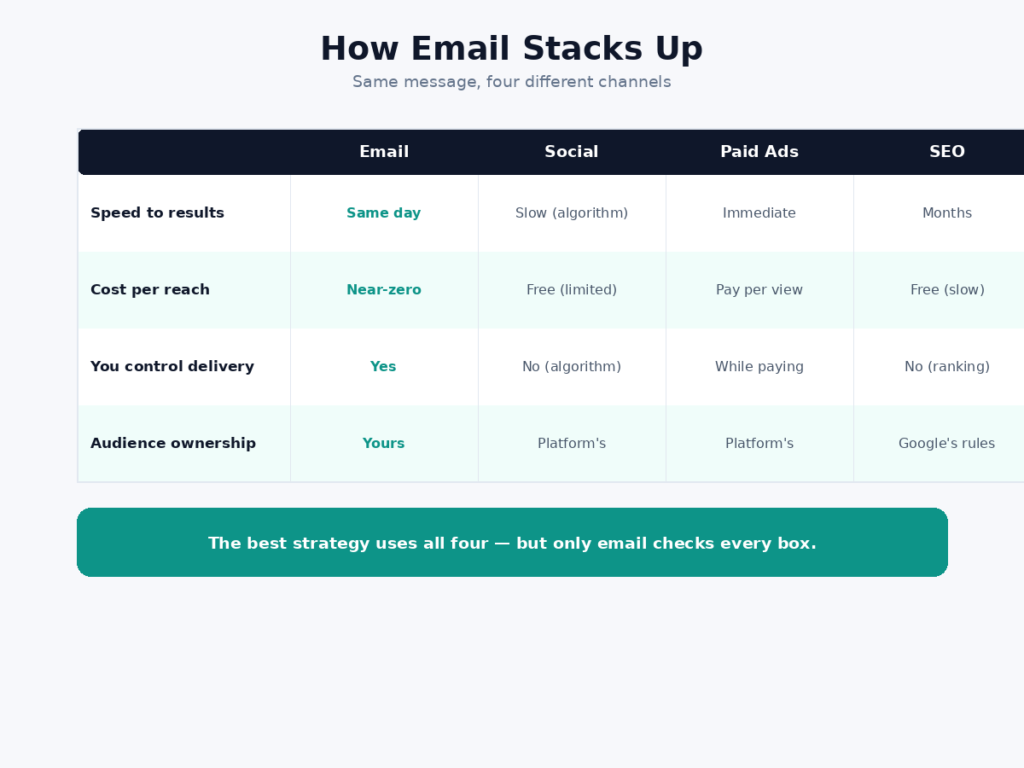
Unlike social media, where an algorithm decides whether your followers see your content, email goes directly to the recipient’s inbox. Unlike paid ads, you don’t pay per send once someone is on your list. Unlike SEO, you aren’t waiting months for traffic — you can send an email today and see results today.
That combination — direct access, no algorithmic gatekeeping, owned audience, immediate feedback — is why email has outperformed every other digital marketing channel for decades and continues to in 2026.
How does email marketing work?
The basic mechanism has four parts that work together:
1. You build a list of subscribers
Someone visits your website, social profile, or store and voluntarily gives you their email address — usually in exchange for something useful (a discount, a free guide, a course, or simply the promise of helpful content). This creates a subscriber on your list. You never buy, rent, or scrape email addresses. Every address on a healthy list came from someone who actively chose to be there.
2. You send emails through a platform
You use an email marketing platform — tools like Mailchimp, MailerLite, ActiveCampaign, Brevo, GetResponse, or others — to design, send, and track your emails. These platforms handle the technical delivery (ensuring emails reach inboxes, not spam folders), manage your subscriber list, let you segment it into groups, and show you performance data after each send.
See our Best Email Marketing and Automation Tools 2026 guide for a full comparison of the top platforms and which one fits your situation.
3. Subscribers receive your emails in their inbox
Your email arrives in the subscriber’s personal inbox — not a social feed, not a notification bar. They see your subject line and sender name, decide whether to open it, read it at their own pace, and either take the action you’re asking for or don’t. The relationship builds or fades based on whether your emails consistently deliver something they find worth opening.
4. You measure, learn, and improve
After each email, your platform shows you who opened it, who clicked links, who unsubscribed, and — if connected to your store or website — who made a purchase. This data tells you what’s working and what isn’t, so each campaign improves on the last. Over time, this feedback loop is what separates email lists that drive meaningful revenue from lists that just exist.
Why does email marketing matter in 2026?
With social media, short-form video, and paid ads all competing for attention and budget, it’s fair to ask whether email is still worth focusing on. The data gives a clear answer.
The ROI is unmatched
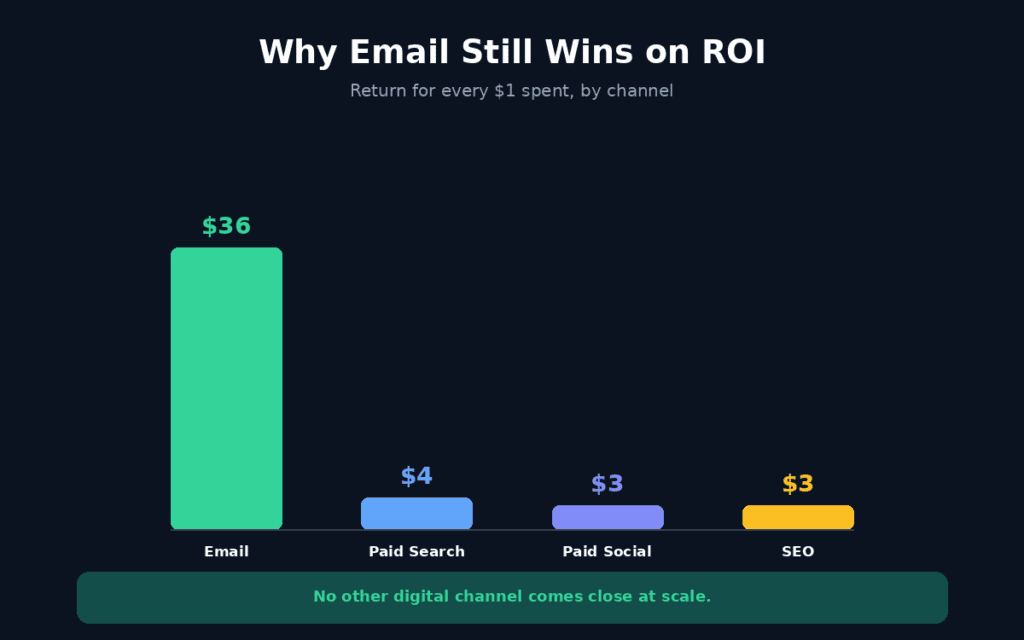
Email marketing consistently returns around $36 for every $1 spent — a figure that has held steady across multiple years of industry research. No other digital channel comes close at that scale. Paid social and search ads typically return $2–$5 per $1 spent and require ongoing spend to maintain. SEO returns take months to materialise. Email, once the list is built, costs almost nothing to send and converts at rates that outperform both.
You own your audience
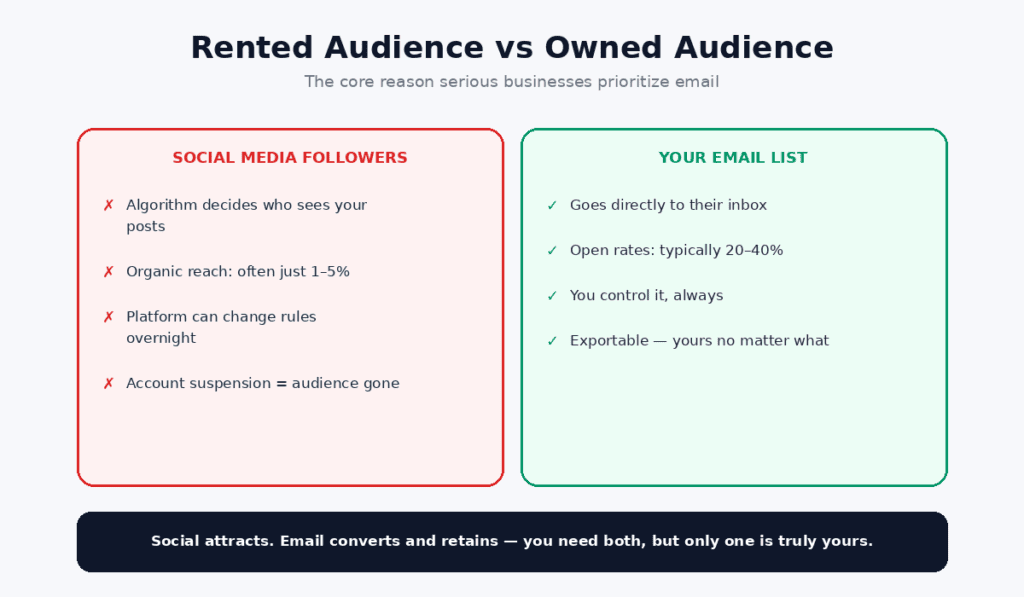
Your email list is an asset you own. Social platforms can change their algorithm, reduce organic reach to near-zero, or shut down accounts without warning. An email list lives in your platform, can be exported, and gives you direct access to your audience regardless of what any third-party platform decides to do. Businesses that built their entire audience on a single social platform and experienced sudden reach drops understand this the hard way.
Email reaches people where they actually check
Over 4.5 billion people use email globally in 2026 — more than any social network. The average professional checks their email multiple times per day. While social feeds are skimmed passively, email is an active inbox people return to with intention. That context difference matters enormously for getting your message noticed and acted on.
It scales without proportionally increasing cost
Sending to 500 subscribers costs roughly the same effort as sending to 50,000. Your cost per email drops dramatically as your list grows while your potential revenue per send scales upward. This is the compounding economic logic behind why every serious content creator, eCommerce store, and SaaS business treats list building as a top priority from day one.
The main types of email marketing
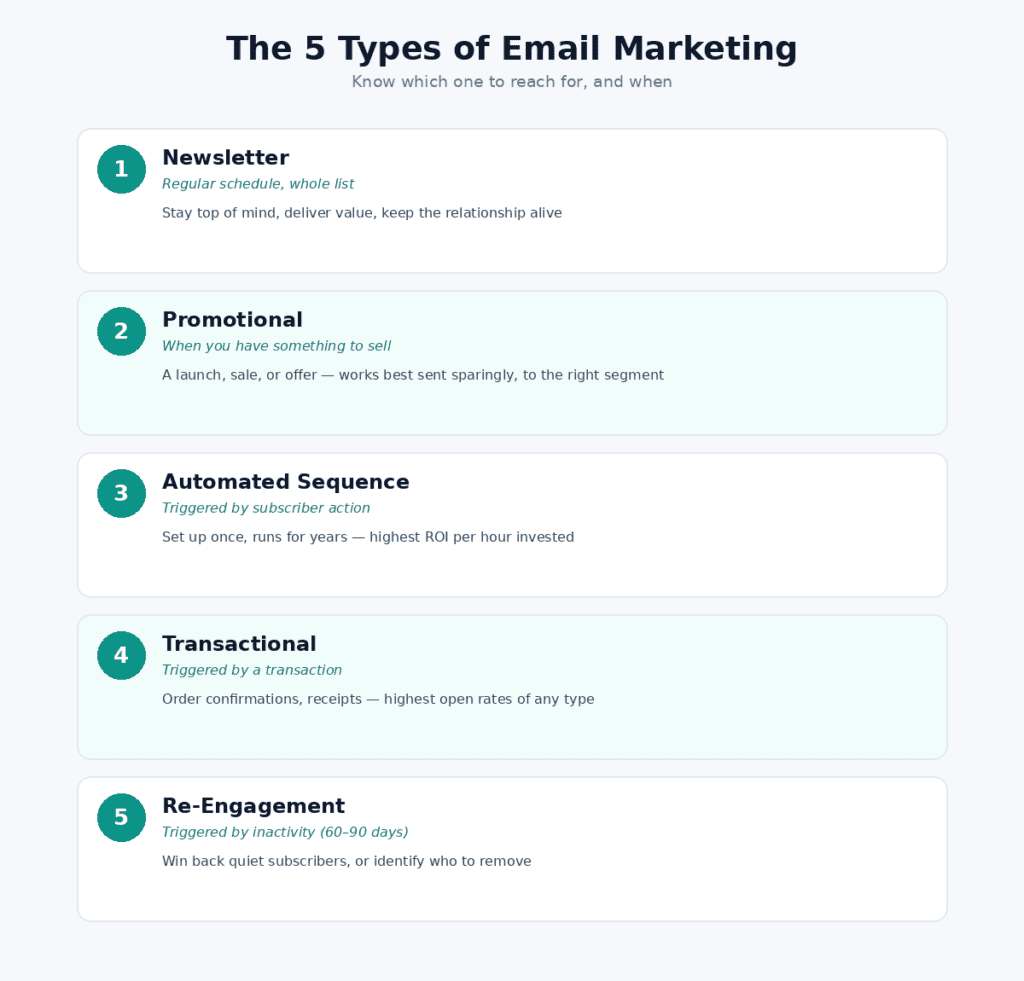
Email marketing isn’t just one thing — different email types serve different purposes in the relationship between a business and its subscribers. Understanding which type does what helps you use each one at the right moment.
Newsletter emails
Sent on a regular schedule (weekly, fortnightly, monthly) to your whole list or a segment of it. The primary goal is staying top of mind, delivering value, and maintaining an ongoing relationship. Newsletters that work aren’t primarily promotional — they give the reader something worth reading even if they never buy anything, which is precisely why subscribers stick around long enough to eventually buy something.
Promotional emails
Sent when you have something specific to sell, promote, or announce — a product launch, a sale, a new service, a limited offer. These are the emails most people picture when they think of “marketing emails.” They work best when they’re not sent so frequently that subscribers tune them out, and when they’re sent to segments who are most likely to be interested in that specific offer.
Automated sequence emails (drip campaigns)
Pre-written emails that send automatically based on a trigger — someone joining your list, making a purchase, clicking a specific link, or going inactive for a set period. Automated sequences are where email marketing delivers its highest ROI per hour of effort invested, because you set them up once and they run continuously without your involvement. A well-built welcome sequence can run for years, introducing every new subscriber to your brand in exactly the same carefully crafted way.
Our What Is Email Marketing Automation guide goes deeper on how triggers, sequences, and flows work — a natural next read once you understand the basics here.
Transactional emails
Automated emails triggered by a specific action the customer took — order confirmations, shipping notifications, password resets, account welcome emails. These are technically triggered by a transaction rather than a marketing decision, but they have some of the highest open rates of any email type (people actively want to see their order confirmation) and represent a missed opportunity for relationship-building when they contain nothing but bare functional information.
Re-engagement emails
Sent to subscribers who haven’t opened or clicked in a defined period — typically 60–90 days of inactivity. The goal is either to win them back with a compelling reason to re-engage, or to identify them as genuinely uninterested so they can be removed from your list. A clean list of engaged subscribers consistently outperforms a large list of inactive ones on every metric that matters, including deliverability.
Email marketing vs other digital marketing channels
It helps to understand where email marketing fits relative to the other channels most businesses use.
Email vs social media marketing
Social media is excellent for reaching new audiences and building brand awareness. Email is better for converting and retaining the audience you’ve already earned. Organic reach on most social platforms is between 1–5% of your followers. Email open rates average 20–40% depending on industry and list quality. For the same message reaching the same number of people, email almost always drives more action. The best strategy uses both — social to attract, email to convert and retain.
Email vs paid ads
Paid ads are rented attention — you pay every time someone sees your message, the moment you stop paying the traffic stops, and you have no ongoing relationship with the people who clicked. Email is owned attention — once someone subscribes, you can reach them again and again at no additional cost per send. Paid ads are often more effective at driving the initial acquisition; email is what you do with those people once they’ve shown interest.
Email vs SEO
SEO drives passive, search-intent traffic from people looking for something specific — powerful for discovery but slow to build and dependent on ranking in a competitive environment. Email drives active, relationship-based communication with people who already know you — faster feedback, higher conversion rates, no dependency on search algorithms. Most successful businesses treat SEO and email as complementary: SEO brings people in, email builds the relationship that makes them stay and buy.
Key email marketing terms you’ll encounter
You don’t need to memorise all of these before you start, but knowing what they mean removes the intimidation factor when you encounter them in your platform.
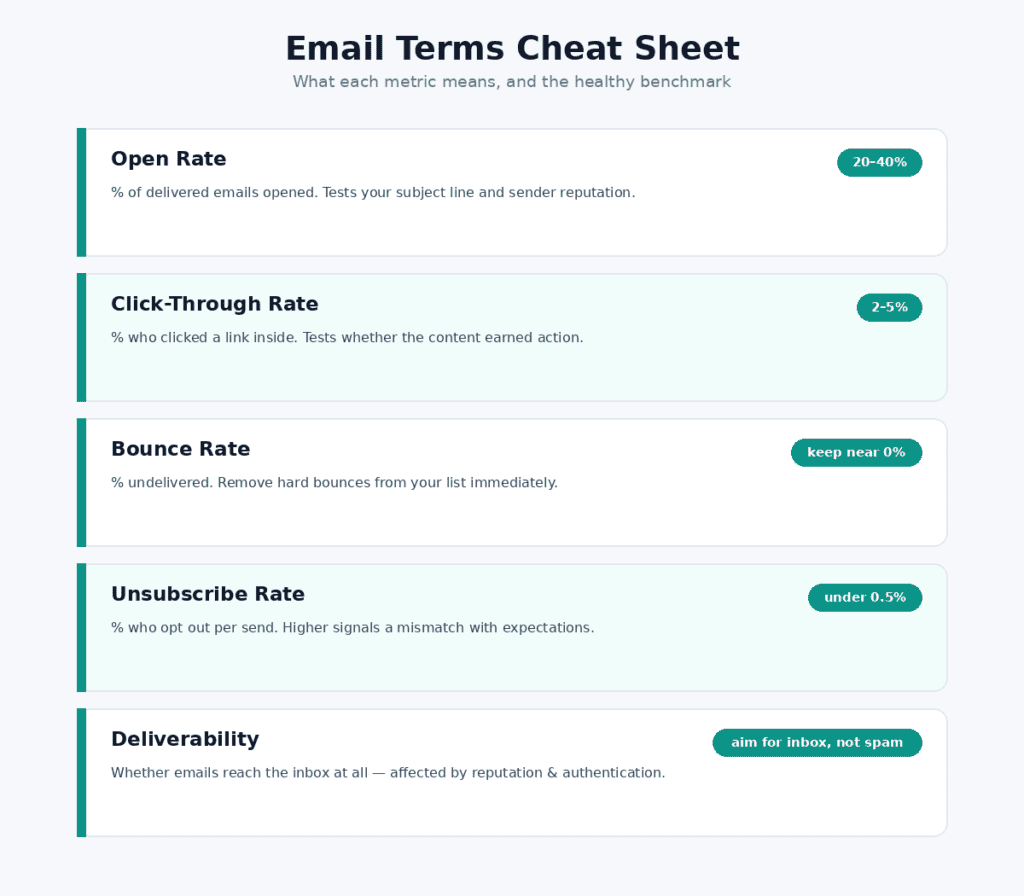
Open rate
The percentage of delivered emails that were opened. Average open rates vary by industry but typically sit between 20–40% for well-maintained lists. It measures whether your subject line and sender reputation are working.
Click-through rate (CTR)
The percentage of email recipients who clicked at least one link inside the email. This measures whether the content inside the email was compelling enough to act on. Average CTRs typically sit between 2–5%.
Bounce rate
The percentage of emails that couldn’t be delivered. Hard bounces (permanent delivery failures, usually invalid addresses) should be removed from your list immediately. Soft bounces (temporary issues like a full inbox) are monitored but not always acted on immediately.
Unsubscribe rate
The percentage of recipients who opt out after a given email. A healthy unsubscribe rate is under 0.5% per send. Higher than this consistently signals a mismatch between what subscribers expected when they signed up and what they’re receiving.
Deliverability
Whether your emails reach the inbox rather than the spam folder. Deliverability is affected by your sender reputation, technical authentication settings (SPF, DKIM, DMARC), list quality, and engagement rates. Poor deliverability is the hidden reason many email lists underperform — emails are being sent but never seen.
Segmentation
Dividing your subscriber list into groups based on shared characteristics — purchase history, location, signup source, engagement level, interests — so you can send more relevant emails to each group. More relevant emails get higher open rates, more clicks, and fewer unsubscribes.
Automation / workflows
Pre-built email sequences that fire automatically when a subscriber meets a defined condition. A welcome series, an abandoned cart recovery sequence, and a re-engagement campaign are all examples of automations.
Lead magnet
A free incentive offered in exchange for someone’s email address — a discount code, a PDF guide, a free template, a mini course. Lead magnets dramatically increase signup rates by giving people a specific, immediate reason to subscribe rather than asking them to trust that your future emails will be worth receiving.
How to get started with email marketing in 5 steps
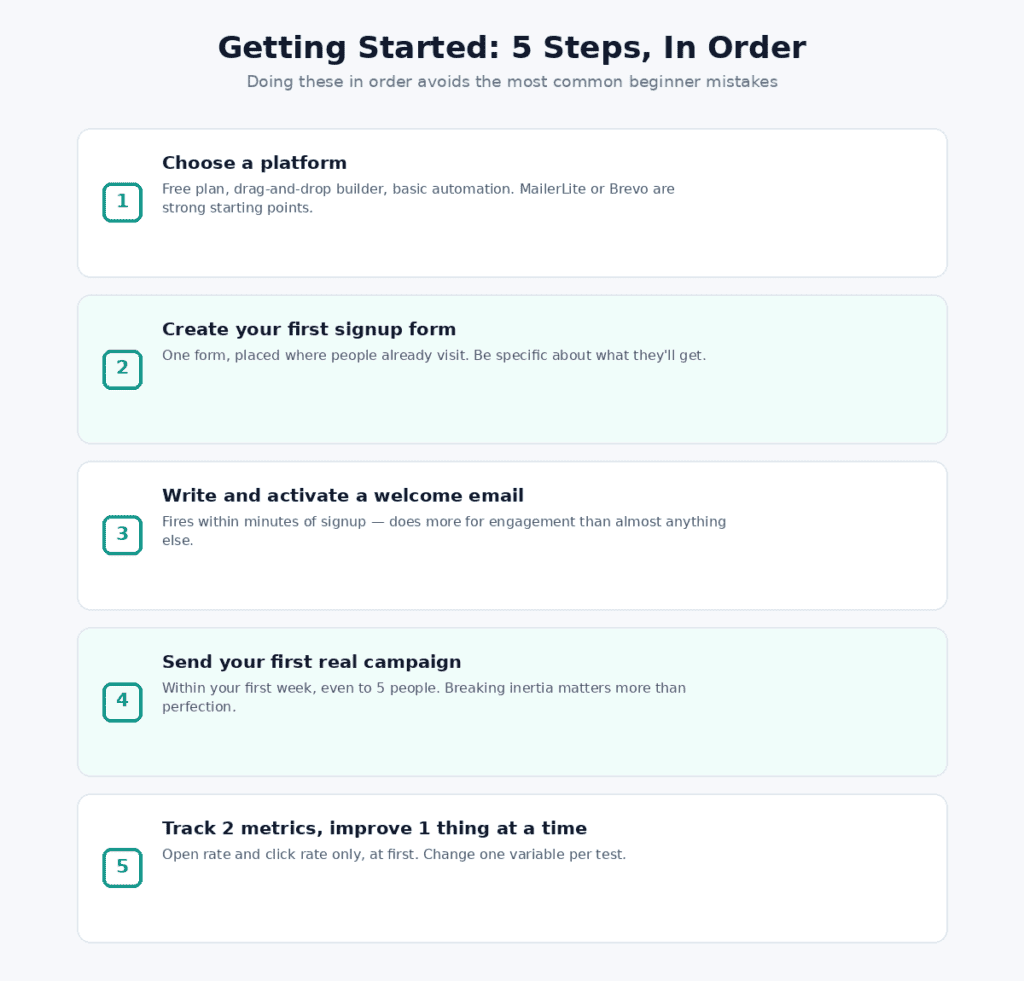
The following is the correct sequence for someone starting from zero. Doing these in order avoids the most common mistakes beginners make.
Step 1: Choose an email marketing platform
Start with a platform that has a free plan generous enough to let you learn without paying, a drag-and-drop email builder that doesn’t require technical skills, and basic automation capability (at minimum, the ability to send a welcome email automatically when someone subscribes).
For most beginners, MailerLite or Brevo are the strongest starting points — both have genuinely usable free plans, clean interfaces, and enough features to grow with for the first year or two without needing to switch. Mailchimp is widely known but its free plan was significantly cut in early 2026, making it less beginner-friendly than it used to be.
See our full comparison in Best Free Email Marketing Tools 2026 — we break down exactly what each free plan includes and which platform suits which situation.
Step 2: Create your first signup form
Set up one signup form and place it somewhere people already visit — your website’s homepage, your blog sidebar, or a link in your social media bio. Be specific about what they’re signing up for. “Get weekly tips on [your topic]” converts better than “Join our newsletter” because it sets a clear expectation and delivers an implicit promise the subscriber can evaluate.
If you want to accelerate early list growth, create a simple lead magnet — a one-page checklist, a short PDF guide, or a discount code — and offer it as the signup incentive. This can multiply signup rates by 3–5x compared to a form with no incentive.
Step 3: Write and activate a welcome email
Before sending any campaigns, set up an automated welcome email that fires within minutes of someone subscribing. This single email does more for your list’s long-term engagement than almost anything else — it arrives when interest is highest, sets expectations, and begins building the relationship at the moment the subscriber is most likely to open and read what you send.
Keep it short: thank them, remind them what they signed up for, and give them one useful thing (your best piece of content, your flagship product, or simply an invitation to reply). Don’t try to say everything in the first email.
When you’re ready to expand this into a full sequence, our Best Welcome Email Sequences 2026 guide walks through the 5-email framework that consistently drives 4× higher engagement than a single welcome email.
Step 4: Send your first campaign
Within your first week of having any subscribers at all, send a real campaign. Not a test. Not a draft you keep refining. A real email with a subject line, actual content, and a clear call to action — even if you’re sending it to five people.
The goal of your first campaign isn’t a perfect email. It’s breaking the inertia of not having sent anything yet. Every email you send teaches you something the next one benefits from. Waiting until you feel “ready” is how list-building stalls indefinitely before it ever begins in earnest.
Step 5: Track two metrics and improve one thing at a time
After each send, look at open rate and click-through rate only. Open rate tells you whether your subject line and sender reputation are working. Click rate tells you whether the content inside the email earned action. Everything else can wait until you have enough volume for the numbers to be meaningful.
When you want to improve, change one element at a time — subject line style, send day and time, email length, or call-to-action placement. Changing multiple things at once makes it impossible to know what actually moved the needle.
Our Email Marketing Metrics Explained 2026 guide covers all seven key metrics in detail — what each one measures, what healthy benchmarks look like, and when to start paying attention to the more advanced numbers.
Common email marketing mistakes beginners make
Buying an email list
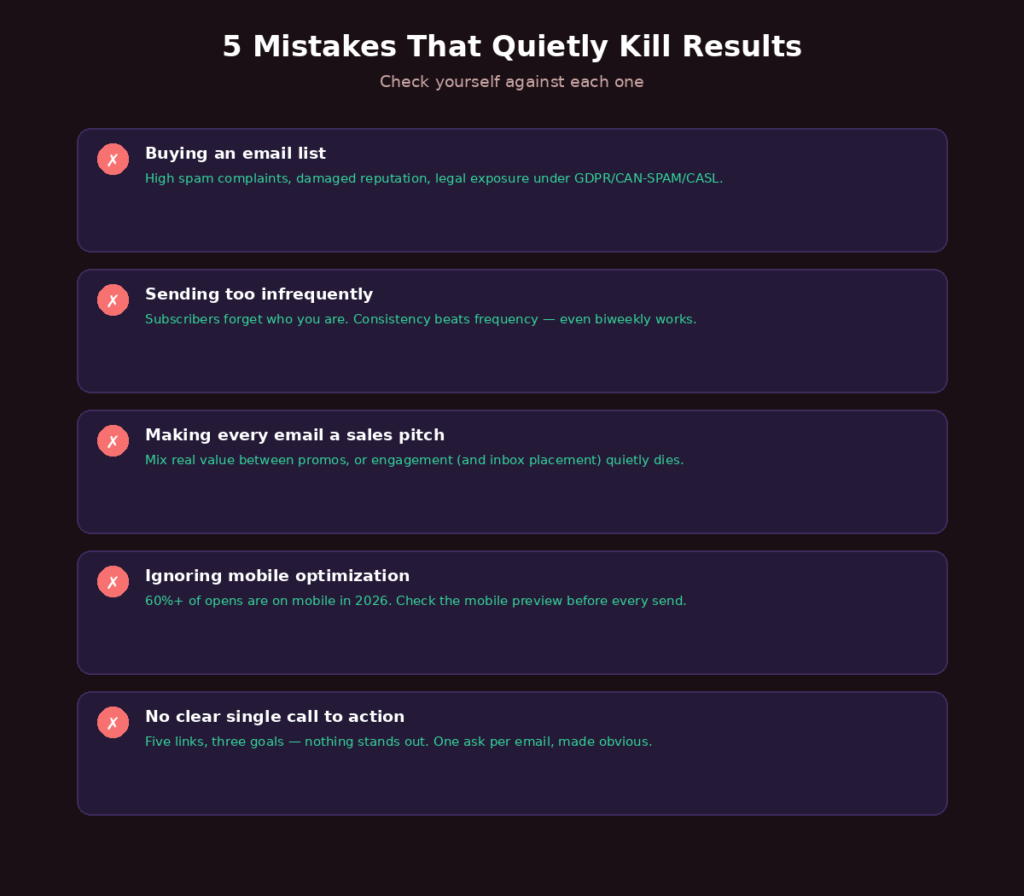
The single most damaging mistake a beginner can make. Purchased lists are filled with people who never chose to hear from you — leading to immediate high spam complaint rates, a sender reputation that takes months to recover, and often outright legal exposure under GDPR, CAN-SPAM, and CASL regulations. A list of 100 genuine opt-ins will outperform 100,000 purchased addresses on every metric that matters.
Sending too infrequently
Going silent for weeks after a subscriber joins means they’ve forgotten who you are by the time your next email arrives. Consistency matters more than frequency — even a simple email every two weeks sent reliably builds more trust than an occasional “big” send.
Making every email a sales pitch
Subscribers who receive only promotional emails quickly learn to ignore them entirely. Mixing genuinely useful content between promotional sends keeps engagement healthy — which is what keeps your emails landing in the inbox rather than the promotions tab or spam folder when a promotional email finally arrives.
Ignoring mobile optimisation
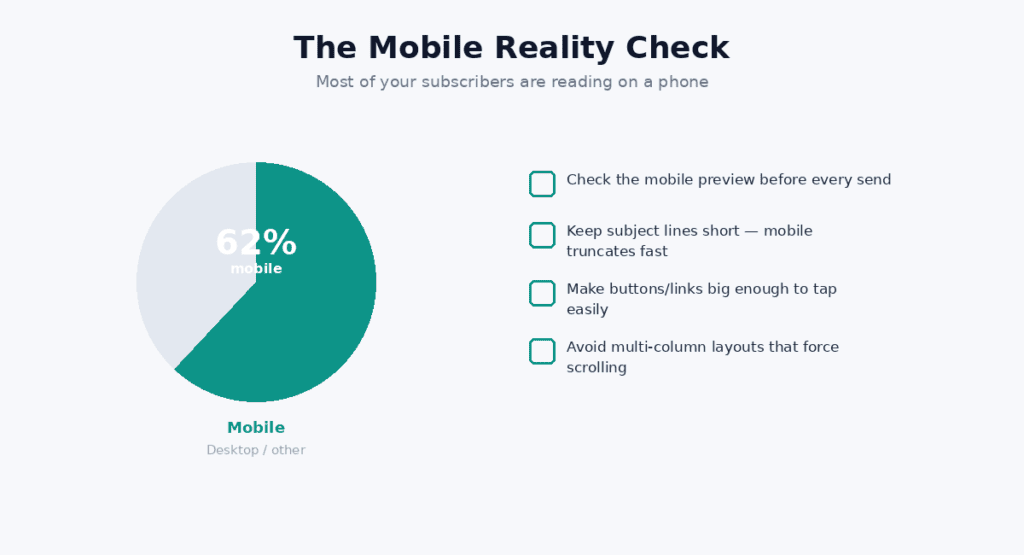
Over 60% of emails are opened on a mobile device in 2026. An email that looks fine on desktop but requires horizontal scrolling or has tiny, untappable links on mobile will lose a significant portion of its potential engagement before the content even has a chance to do its job. Most modern email platforms handle this automatically — check the mobile preview before every send.
Not having a clear single call to action
Emails with five different links and three different goals typically convert worse than an email with one clear ask. When everything is equally emphasised, nothing stands out. Decide what you most want the reader to do, make that the obvious action, and make everything else secondary or cut it entirely.
What makes email marketing work long-term
The businesses that generate consistent revenue from email share a few characteristics that have nothing to do with advanced automation or sophisticated segmentation at the start.
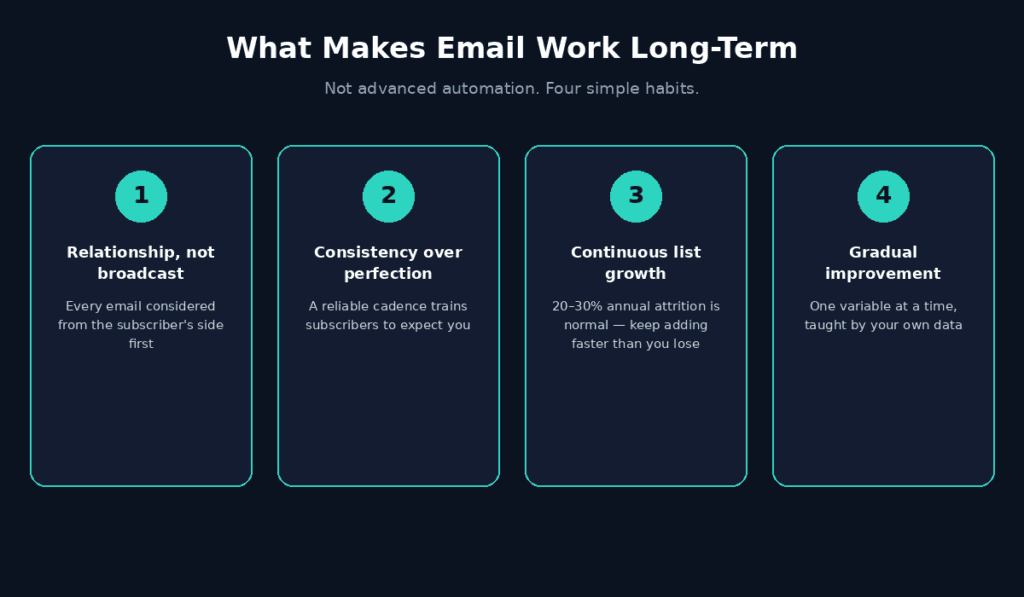
They treat their list as a relationship, not a broadcast channel. Every email is considered from the subscriber’s perspective first — is this worth their time? — before the business objective. This sounds soft but it’s the practical reason engagement stays high enough for the channel to keep working.
They send consistently. Not perfectly. Not with elaborate production values every time. Consistently. A reliable cadence trains subscribers to expect and look for your emails, which is the underlying mechanism behind high open rates on established lists.
They build their list continuously. List attrition (unsubscribes, bounces, disengagement) is inevitable and normal — healthy lists typically lose 20–30% of subscribers annually through natural attrition. The businesses with growing, effective email lists are always adding new subscribers at a rate that outpaces attrition, not just maintaining what they have.
They improve gradually rather than overhauling constantly. The most effective email marketers make small, deliberate improvements to one variable at a time — subject line, send time, content format, CTA placement — and let their own data teach them what works for their specific audience. Generic best practices are a starting point, not a permanent prescription.
Which email marketing platform should beginners use?
The best platform for a beginner is the one with the most forgiving learning curve that still has enough capability to grow into for the first couple of years. Here’s a quick orientation:
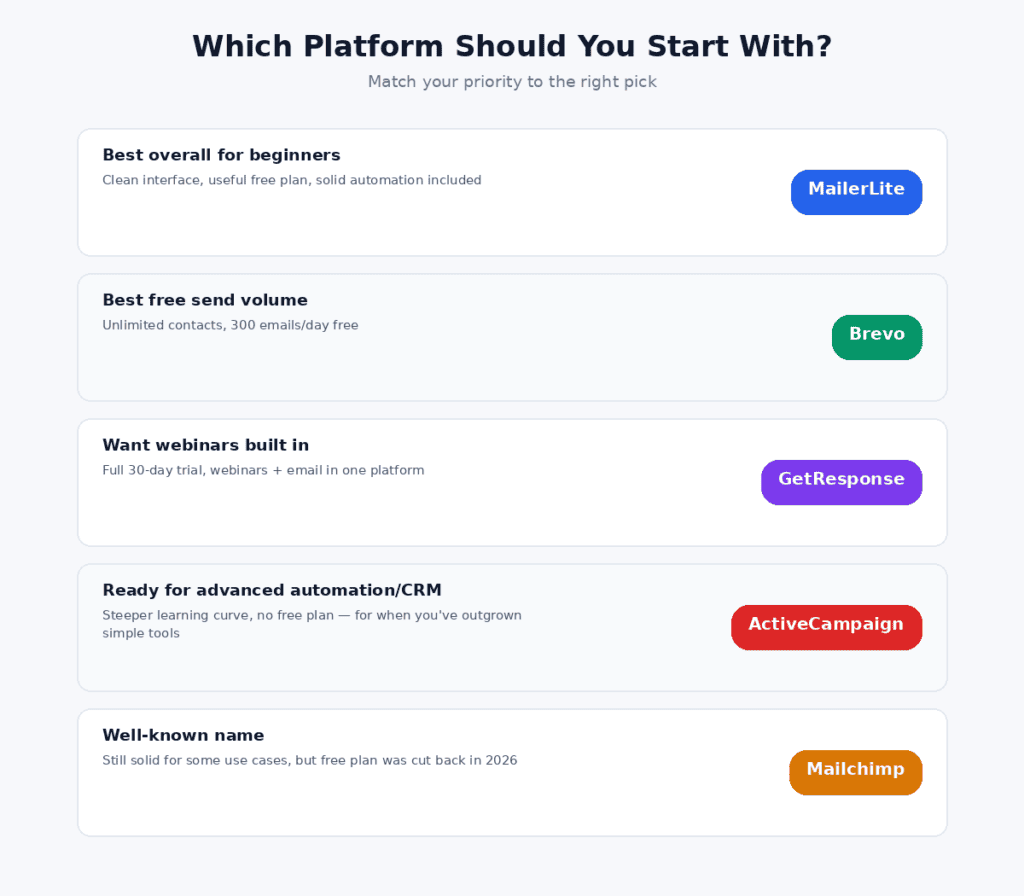
MailerLite — Best overall for beginners. Clean interface, genuinely useful free plan (up to 1,000 subscribers and 12,000 emails/month), solid automation on free tier, excellent landing page builder included. Our full MailerLite review covers exactly what’s included at each plan level.
Brevo — Best free plan by send volume (300 emails/day free, unlimited contacts). Particularly strong for transactional email and SMS alongside marketing email. Slightly more complex interface than MailerLite but very capable.
GetResponse — Best if you want to run webinars alongside email from a single platform. Solid all-rounder with a full 30-day free trial rather than a permanent free plan. Our GetResponse review has the full breakdown.
ActiveCampaign — Best when you’re ready for advanced automation and CRM. Not the right starting point for most beginners due to its learning curve and lack of a free plan, but the platform to consider when your needs outgrow the simpler tools. See our ActiveCampaign review for a detailed assessment.
Mailchimp — The most well-known name in email marketing but no longer the best choice for beginners after its January 2026 free plan changes removed automation and cut the subscriber limit. Still a solid paid option for some use cases. Our Mailchimp 2026 review explains exactly what changed and who it still makes sense for.
Final verdict
Email marketing in 2026 remains what it has always been: the most direct, highest-ROI channel for building a relationship with an audience and converting that relationship into consistent revenue. The fundamentals haven’t changed — permission-based, value-first, consistent — and they won’t.
What has changed is how easy it is to get started. Modern email platforms remove almost every technical barrier that used to make this intimidating. You can set up a functional list, a working signup form, and an automated welcome email in an afternoon with no coding and no significant upfront cost.
The only thing that remains hard is the same thing that’s always been hard: showing up consistently for your subscribers with something genuinely worth reading. Do that, and the channel will work. It’s worked for every other business that has built it patiently and honestly, and it will work for yours.
Continue learning: guides & comparisons
Once you’re set up, these guides go deeper on specific parts of the process:
- How to Grow an Email List: 6 Proven Tactics
- Email List Segmentation: 5 Smart Splits
- A/B Testing Subject Lines: 5 Rules
- Email Marketing Compliance: GDPR, CAN-SPAM & CASL
- Email vs SMS Marketing
- Best Newsletter Platforms 2026
- Best Email Marketing for Small Business
- MailerLite vs GetResponse
- ConvertKit vs MailerLite
- Brevo vs Mailchimp
1. What is email marketing in simple terms?
Email marketing is the practice of sending targeted emails to people who have chosen to hear from you — to build a relationship, deliver value, and drive them to take action over time. Unlike social media, you own your list and reach subscribers directly in their inbox without any algorithm filtering what they see.
2. How much does email marketing cost to get started?
You can start for free. MailerLite and Brevo both offer genuinely functional free plans — MailerLite gives you up to 1,000 subscribers and 12,000 emails per month, Brevo gives you unlimited contacts with up to 300 emails per day. Most small businesses and bloggers can run effective email marketing for months before needing a paid plan.
3. What is the ROI of email marketing?
Email marketing consistently returns around $36 for every $1 spent — a figure backed by multiple independent industry studies and consistently higher than any other digital marketing channel. The ROI is this high because the marginal cost of sending to a larger list is minimal once it’s built, while the revenue potential scales with list size.
4. How is email marketing different from spam?
The critical difference is consent. Email marketing is sent only to people who have actively opted in to receive communications from you — they gave you their email address and agreed to be contacted. Spam is unsolicited email sent to people without their permission. Permission-based email marketing is also a legal requirement under most countries’ regulations, including GDPR in Europe and CAN-SPAM in the United States.
5. What are the main types of email marketing?
The five main types are: newsletter emails (regular value-first content sent to your whole list), promotional emails (announcing specific offers, products, or events), automated sequences or drip campaigns (pre-written emails that trigger based on subscriber behaviour), transactional emails (order confirmations, shipping notifications, password resets), and re-engagement emails (sent to subscribers who have gone inactive).
6. How do I build an email list from scratch?
Choose an email marketing platform, create a signup form, place it somewhere people already visit (your website, social bio, or checkout flow), and give people a specific reason to subscribe — either a clear promise of what they’ll receive or a lead magnet like a free guide or discount. Never buy an email list. Every address should come from someone who actively chose to subscribe.
7. What is a good open rate for email marketing?
Average open rates vary by industry but typically sit between 20–40% for well-maintained, permission-based lists. eCommerce lists tend toward the lower end; newsletters with niche, engaged audiences often see 40–60%. If your open rate is consistently below 15%, the most common causes are a weak subject line, poor sender reputation, or a list with too many inactive subscribers.
8. What is email automation and do I need it?
Email automation means sending pre-written emails automatically when a subscriber meets a specific condition — joining your list, abandoning a cart, going inactive for 60 days. You don’t need complex automation to start, but a single automated welcome email is worth setting up from day one. It fires when subscriber interest is highest and sets the tone for the entire relationship with zero ongoing effort after setup.
9. Is email marketing still effective in 2026?
Yes — more than ever by most measures. Over 4.5 billion people use email globally, average ROI remains the highest of any digital marketing channel at around $36 per $1 spent, and email open rates continue to outperform organic social reach by a factor of 5–10x. The businesses that treat email as a core channel consistently outperform those that rely primarily on social or paid ads for audience retention and conversion.
10. What is the difference between email marketing and a newsletter?
A newsletter is one type of email marketing — specifically a regular, schedule-based email focused primarily on delivering value and maintaining an ongoing relationship. Email marketing is the broader category that includes newsletters, promotional campaigns, automated sequences, transactional emails, and re-engagement emails. A newsletter is a component of an email marketing strategy, not a synonym for it.





I am Ashish Yadav a software engineer and AI tools researcher with over five years of practical experience working with real-world systems and automation. I am founder of CognifyFuture, where I analyzes, tests, and breaks down AI tools with a focus on what actually works—not what’s trending.
My content is built on hands-on usage, not theory. Instead of generic advice, I focuses on real implementation—how AI tools can be used to automate tasks, improve efficiency, and solve any specific business or individual problems.
Through CognifyFuture, My aims is to eliminate confusion around AI by delivering clear, honest, and actionable insights that help users make smarter technology decisions.