
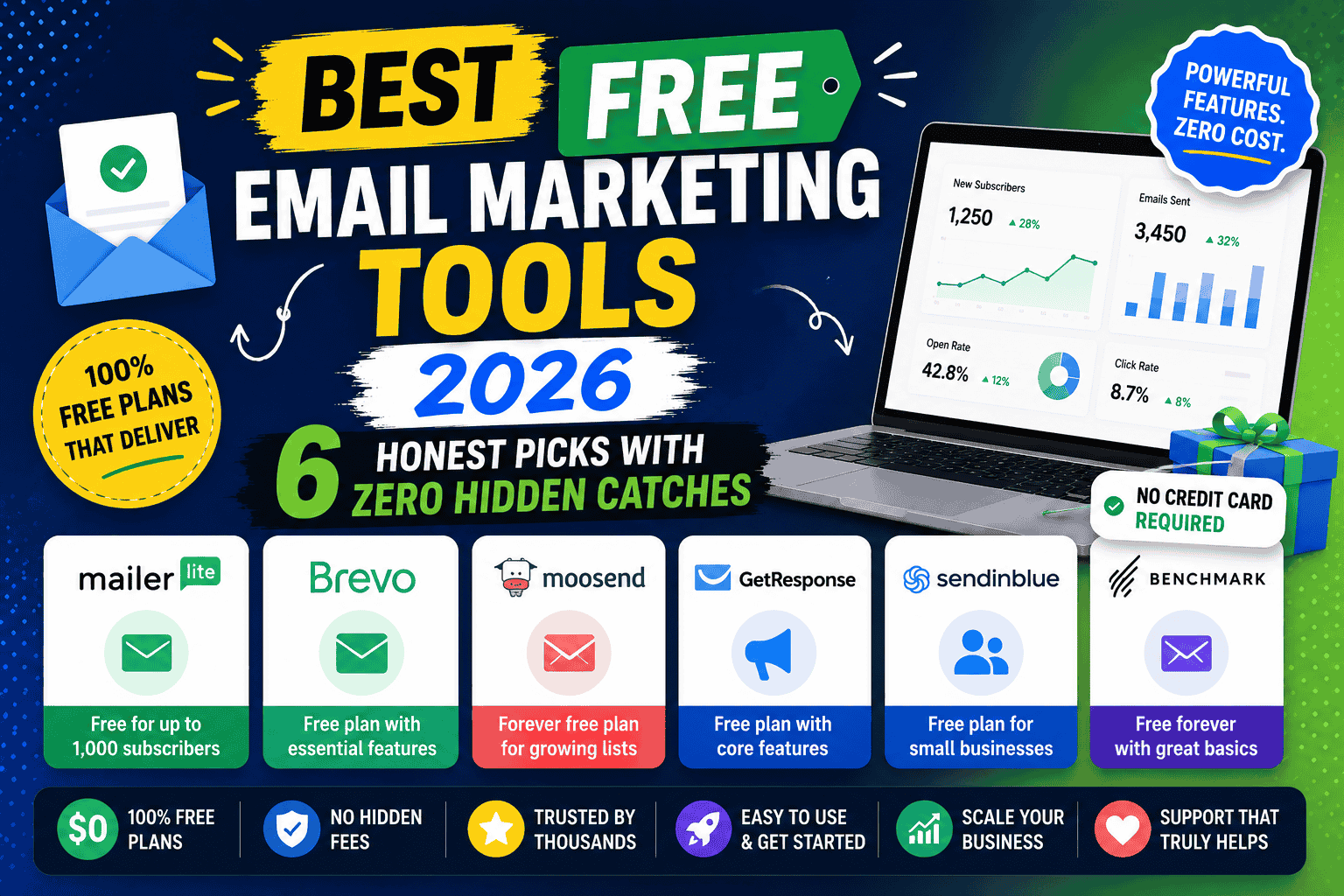
Can you actually run real email marketing without paying a cent?
Yes — but “free” means wildly different things depending on which platform you pick, and most comparison articles bury the catches in fine print. One platform’s “free plan” gives you 500 contacts and barely any automation. Another gives you 10,000 contacts but locks you to one automation. A third gives you real automation on unlimited contacts but caps your daily sends. None of these are wrong choices — they’re just built for different starting points.
I went through the Free Email Marketing Tools that are still genuinely usable in 2026 (not 14-day trials disguised as “free”) to answer the question that actually matters:
- Which free plan gives you real automation, not just single-step welcome emails?
- Which free plan has the highest subscriber or send ceiling before you have to pay?
- What’s the catch on each one — branding, feature limits, or support restrictions?
- Which free plan actually fits your specific situation (newsletter, startup, small business)?
Short answer: Brevo’s free plan is the most generous for large, low-frequency lists (essentially unlimited contacts, capped at 300 emails/day, with automation included). Kit’s free plan is best for newsletter writers (10,000 subscribers, but only 1 automation). Sender’s free plan offers the best balance of subscriber count, send volume, and automation for small businesses (2,500 subscribers, 15,000 emails/month). Mailchimp’s free plan, despite being the most recognized name, is now the least generous of the major players. Let’s break down exactly what each one gets you.
How to Actually Compare “Free” Plans
Before the list, it’s worth establishing the four things that actually differentiate one free plan from another, since headline numbers alone are misleading:
- What’s the limiting factor? Some platforms cap by contacts stored (Mailchimp, Kit), others by emails sent per day or month (Brevo, Sender). This determines whether you’re optimized for a large-but-quiet list or a smaller-but-active one.
- Is automation actually included? Several “free” plans technically include automation but restrict it to a single welcome email — not a real multi-step sequence. This is the single biggest hidden catch across this category.
- Is branding forced onto your emails? Most free plans add “Sent via [Platform]” branding to outgoing emails — fine for a personal newsletter, potentially unprofessional for a business.
- How steep is the upgrade cliff? Some platforms have a gentle pricing ramp once you outgrow free; others jump dramatically at the first paid tier.
With that framework, here’s how the major free plans actually stack up.
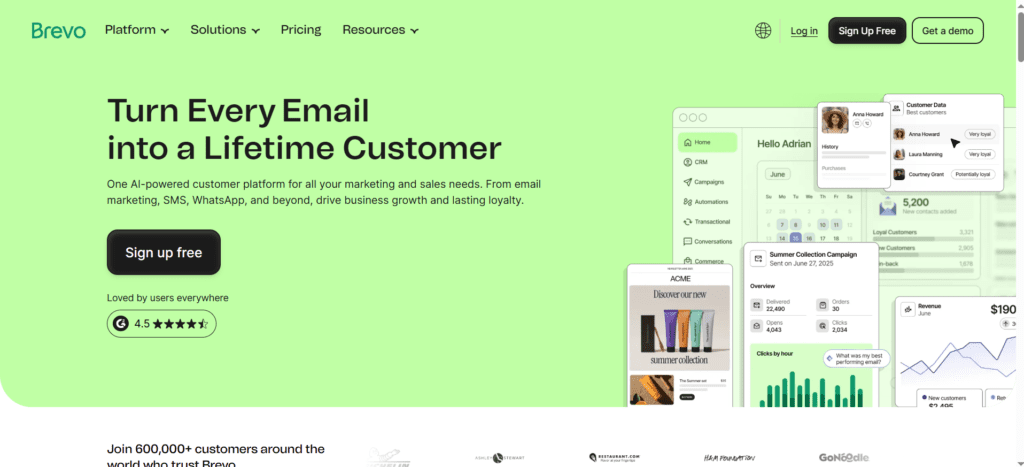
1. Brevo — Best for Large Lists With Low Send Frequency
Brevo’s free tier is structured differently from almost everything else on this list: instead of capping you by contacts, it caps you by daily sends.
- Contacts: Effectively unlimited — you can store tens of thousands of contacts at no cost
- Sends: Capped at 300 emails per day (roughly 9,000/month if sent daily)
- Automation: Included — genuinely rare for a free plan, and covers multi-step sequences, not just a single welcome email
- Catch: Brevo branding appears on all free-plan emails, and there’s no A/B testing or landing pages on free
See our Brevo vs Mailchimp 2026 comparison for the full pricing breakdown once you outgrow free.
Best for: Startups and small businesses with a growing contact list but low send frequency — if you’re sending a few campaigns a month to a list that’s accumulating faster than you’re emailing it, Brevo’s model directly rewards that pattern.
Outgrow it when: You need to send more than 300 emails/day, or want to remove the Brevo branding (paid plans start around $9/month).
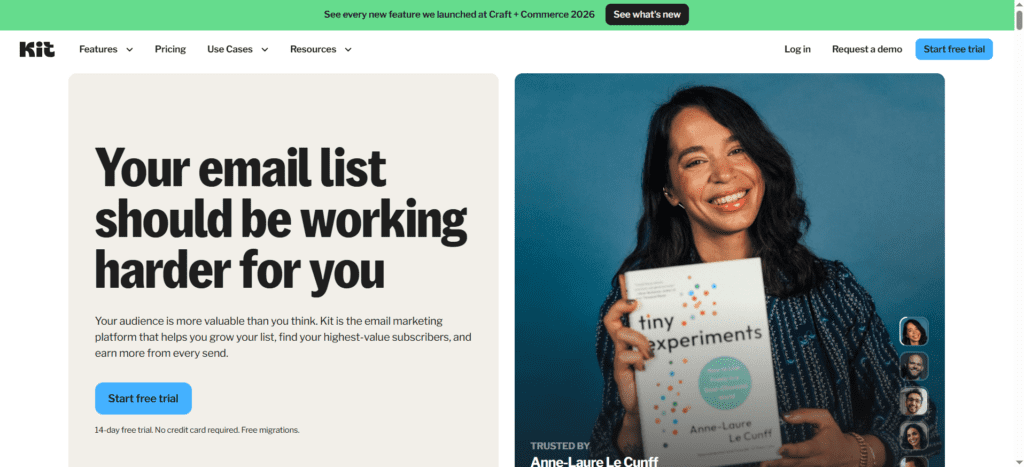
2. Kit (formerly ConvertKit) — Best for Newsletter Writers and Creators
Kit’s free Newsletter plan has the highest subscriber ceiling on this list by a wide margin, making it the obvious starting point for anyone building an audience around written content.
- Subscribers: Up to 10,000 — far beyond what most creators need in their first year or two
- Sends: Unlimited
- Extras: Unlimited landing pages and forms, plus subscriber tagging for basic segmentation
- Catch: Restricted to a single automation and a single sequence — not real multi-step automation — and Kit branding appears on every email
Important: Kit’s paid Creator plan jumped significantly in price in September 2025. See our ConvertKit vs Mailchimp 2026 comparison for the real numbers before you plan your upgrade path.
Best for: Bloggers, newsletter writers, and course creators who want a long-term free home for their list while they build an audience, without urgent need for sophisticated automation.
Outgrow it when: You need more than one automation sequence, or you’re ready to sell digital products and want the commerce tools that come with Kit’s paid Creator plan ($33+/month).
3. Sender — Best Overall Balance for Small Businesses
If you want the single most generous all-around free plan — not the highest in any one category, but the best combination of subscribers, sends, and features — Sender is the standout.
- Subscribers: 2,500
- Sends: 15,000 emails/month — enough to send six full-list campaigns monthly
- Automation: Included, along with audience segmentation — genuinely full-featured for a free tier
- Catch: Sender branding appears on all free-plan emails, which is the trade-off for such generous limits
Best for: Small businesses with up to 2,500 subscribers who want full-featured email marketing, including real automation, without paying anything — and don’t mind the branding.
Outgrow it when: Your list passes 2,500 subscribers, or you want to remove branding (the Standard plan starts around $8/month for the same subscriber count, just without the branding).
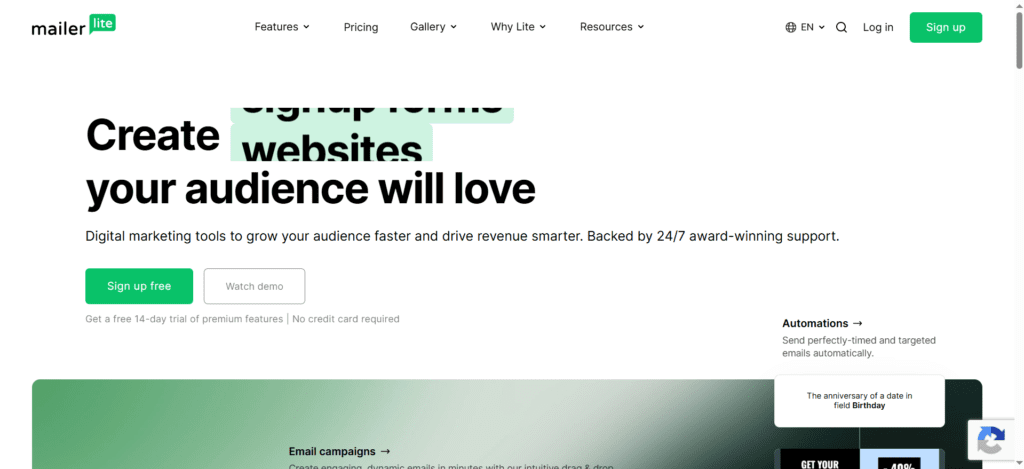
4. MailerLite — Best for Landing Pages and Basic Automation
MailerLite’s free plan is smaller in raw numbers than Sender’s or Brevo’s, but it includes a clean, simple interface and genuinely usable automation and landing page tools.
- Subscribers: 500
- Sends: 12,000 emails/month
- Extras: Up to 10 landing pages and signup forms included on free
- Catch: The 500-subscriber ceiling is reached quickly compared to Sender or Brevo
Read our full MailerLite Review 2026 for the complete pricing and feature breakdown.
Best for: Freelancers and small teams who specifically want a clean, easy interface and don’t need a large free subscriber ceiling — the platform’s overall ease of use is the draw here, not the free tier’s raw limits.
Outgrow it when: You pass 500 subscribers; paid plans start around $10/month with the same clean interface and expanded automation.
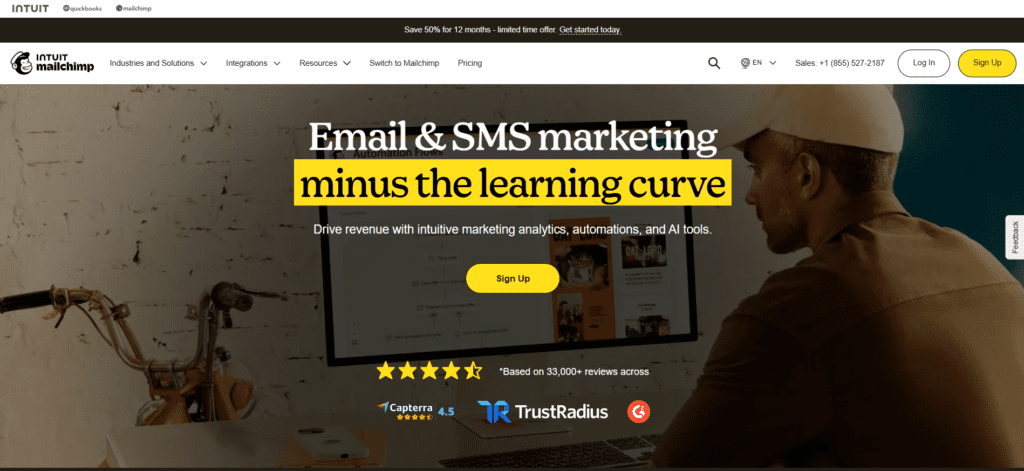
5. Mailchimp — Recognizable, But the Least Generous Free Plan Now
Mailchimp deserves an honest mention because it’s still the most recognized name in this category, but its free plan has been progressively reduced and is no longer competitive against the alternatives above.
- Contacts: 500
- Sends: 1,000 emails/month — noticeably lower than MailerLite, Sender, or Brevo at a comparable contact count
- Automation: Single-step only on free (a basic welcome email, not a sequence) — multi-step automation requires the $13/month Essentials plan
- Catch: Mailchimp can charge for unsubscribed contacts on certain paid plans, a billing quirk worth knowing before you ever upgrade
Read our full Mailchimp Review 2026 for the complete picture of what changed and why.
Best for: Very early-stage businesses who specifically want Mailchimp’s brand recognition or its large app integration library, and don’t mind the single-step automation limit.
Outgrow it when: You need any multi-step automation at all — this happens faster on Mailchimp’s free plan than on most competitors because the limitation is so immediate.
6. GetResponse — Best Free Plan for AI Tools and Light Webinars
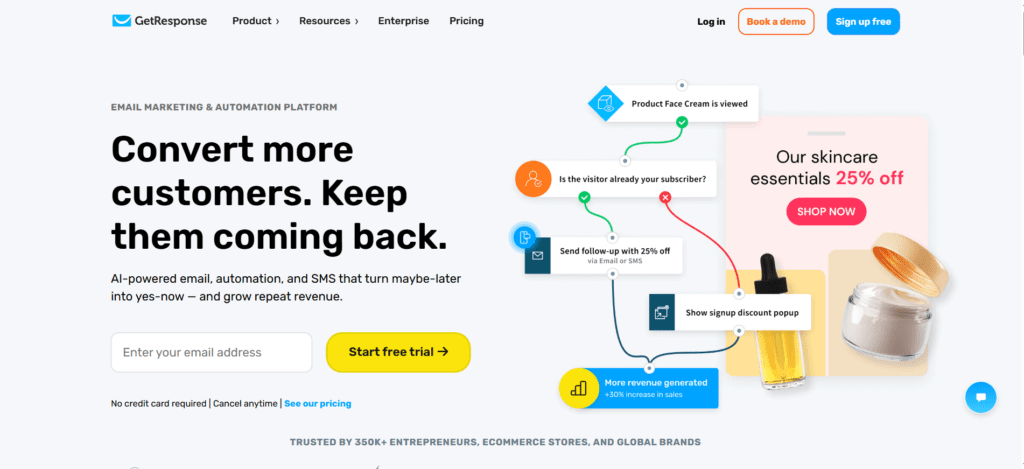
GetResponse’s free plan doesn’t lead with subscriber count, but it bundles in a feature set the others on this list don’t touch for free: AI content generation and limited webinar hosting.
- Contacts: 500
- Sends: 2,500 emails/month
- Extras: AI campaign generator, unlimited landing pages (capped at 1,000 monthly visitors), and webinar hosting for up to 10 attendees via recording only
- Catch: Automation on free is basic, without dynamic segment filters — and the webinar feature is recording-only, not live
See our MailerLite vs GetResponse 2026 comparison for how the free and paid tiers stack up directly against a more straightforward alternative.
Best for: Anyone who wants to test AI-assisted campaign writing or dabble in webinar-adjacent content before committing to a paid plan, without needing a large subscriber base yet.
Outgrow it when: You need live webinars or more than basic automation — both require the Marketer plan at roughly $59/month, a substantial jump from free.
Honorable Mentions Worth Knowing About
A few other free plans are worth a brief mention if the main five above don’t fit your specific situation:
- Systeme.io: 2,000 subscribers with unlimited emails, plus basic funnel-building tools — worth a look if you want simple sales funnels alongside email
- Zoho Campaigns: 2,000 subscribers and 6,000 emails/month, useful if you’re already using other Zoho products and want consistent ecosystem integration
- Mailjet: 1,000 subscribers and 6,000 emails/month, a reasonable middle-ground option if neither Brevo’s send cap nor MailerLite’s contact cap fits your pattern
- Klaviyo: Free plan caps mirror Omnisend’s at the entry level, but the free-tier feature set is less robust — worth considering once you’re ready to pay, less so while you’re still on free
Practical Use Case: Matching Your Situation to a Free Plan
A Brand-New Newsletter (0-1,000 Subscribers)
Start with Kit. The 10,000-subscriber ceiling means you won’t need to think about upgrading for a long time, and the single-automation limit is rarely a problem this early — most new newsletters only need one welcome sequence anyway.
A Small Business That Needs Real Automation From Day One
Start with Sender or Brevo. Both include genuine multi-step automation on their free plans, which Kit and Mailchimp don’t offer. Choose Sender if your list is under 2,500 and you send frequently; choose Brevo if your list might grow large but you’ll send infrequently.
A Startup Validating Product-Market Fit
Brevo’s combination of unlimited contact storage and included automation makes it a strong default — you can capture every signup without worrying about a contact cap while you’re still figuring out whether email is a meaningful channel for your product.
A Side Project With Irregular Time to Send Campaigns
If you’re running a side project or hobby blog where you might go weeks without sending anything, Kit or Brevo both work well since neither penalizes inactivity the way a strictly time-based send allowance (like Mailchimp’s monthly cap) can. Kit in particular suits this pattern well: its free plan doesn’t expire unused sends or otherwise punish irregular posting schedules, so a newsletter that publishes sporadically loses nothing by sitting dormant between issues.
Does Free Mean Worse Deliverability?
This is a fair question, and the honest answer is: somewhat, but not for the reason most people assume. Free-plan emails aren’t sent through a “slower” or “lower-quality” sending infrastructure than paid emails on the same platform — the underlying delivery system is identical.
What does affect deliverability on a free plan is the mandatory branding. A “Sent via Brevo” or “Powered by Kit” footer is a minor signal to spam filters and, more importantly, to recipients — some studies on email trust suggest unbranded, personal-feeling emails get marked as spam less often than obviously templated, platform-branded ones. This is a real but modest effect, not a fundamental deliverability handicap.
The bigger deliverability factor, regardless of free or paid, is your own sending practice: using double opt-in, authenticating your domain (SPF, DKIM, DMARC) as soon as your platform allows it, and avoiding purchased or scraped contact lists. Get these right on a free plan and your deliverability will be comparable to a paid account on the same platform.
Planning Your Transition Off the Free Plan
One mistake people make with free email marketing tools is waiting until they’re forcibly blocked by a limit before thinking about upgrading — which often means making a rushed decision under pressure rather than a considered one.
A better approach: once you’re at roughly 70-80% of your free plan’s limit (whether that’s contacts or sends), start evaluating the first paid tier on your current platform and on one or two alternatives. This gives you time to compare real numbers — not just the next tier’s price, but what specific features it unlocks — before you’re forced into a same-day decision because a campaign got blocked mid-send.
It’s also worth checking, at that point, whether your actual usage pattern still matches the platform you originally chose. A business that started on Kit because of its newsletter focus might find, a year later, that it’s actually running more automation and segmentation than Kit’s pricing rewards — in which case the transition point is also a natural moment to re-evaluate against MailerLite, Brevo, or GetResponse rather than assuming you must stay on the same platform’s paid tier by default.
“Free Plan” vs “Free Trial”: Know Which One You’re Signing Up For
This distinction trips up more people than it should, partly because pricing pages don’t always make it obvious. Every platform covered in this guide — Brevo, Kit, Sender, MailerLite, Mailchimp, and GetResponse — offers a genuine permanent free plan: it doesn’t expire, and you’re not charged automatically once a countdown ends.
A free trial is different: it’s full (or near-full) access to a paid tier for a limited window, usually 14-30 days, after which you’re either charged automatically or locked out entirely unless you downgrade or cancel. Klaviyo, for instance, technically has both — a genuinely free entry tier at low volume, and separate trial periods for testing higher tiers.
Before signing up anywhere, check specifically for the words “no credit card required” on the free tier’s signup page. If a card is required upfront, you’re very likely looking at a trial with an automatic conversion to paid, not a true free plan — read the fine print on what happens when the trial ends before you connect any payment information.
Why Not Just Use Gmail or Outlook for Free?
It’s worth addressing this directly, since it’s a common shortcut for people just starting out: don’t use a personal Gmail or Outlook account for bulk email marketing. These services have strict sending limits (around 500/day for Gmail), no tracking or analytics, no automation, and sending bulk marketing email from a personal account risks getting that account suspended entirely. Even the most limited dedicated free plan above is a meaningfully better starting point than a personal inbox.
Side-by-Side Summary
- Brevo: Unlimited contacts, 300 emails/day, automation included, Brevo branding
- Kit: 10,000 subscribers, unlimited sends, only 1 automation, Kit branding
- Sender: 2,500 subscribers, 15,000 emails/month, full automation, Sender branding
- MailerLite: 500 subscribers, 12,000 emails/month, automation + 10 landing pages
- Mailchimp: 500 contacts, 1,000 emails/month, single-step automation only
- GetResponse: 500 contacts, 2,500 emails/month, AI tools + limited webinar recording
Final Verdict
There’s no universal “best” free email marketing tool in 2026 — the right one depends on whether your bottleneck is contact count, send volume, or automation depth, and every platform on this list makes a different trade-off across those three dimensions.
If you genuinely don’t know yet which constraint will bite you first, start with Sender or Brevo — both include real automation on their free tier, which is the feature most likely to matter as soon as you have any meaningful list at all. Reserve Kit specifically for newsletter-style content where the high subscriber ceiling outweighs the single-automation limit, and treat Mailchimp’s free plan as a brand-recognition convenience rather than a genuinely competitive option in 2026.
Whichever you choose, the real test isn’t the free plan itself — it’s whether the upgrade path makes sense once you outgrow it. Look at the first paid tier’s price and feature set before you commit any real list-building effort, so the eventual upgrade doesn’t come as an unpleasant surprise.
Related Reading
- Best Email Marketing and Automation Tools 2026 (full roundup)
- MailerLite Review 2026
- What Is Email Marketing? Beginner Guide
1. What is the best free email marketing tool in 2026?
There’s no single best option — it depends on your bottleneck. Brevo is best for large lists with low send frequency (unlimited contacts, 300 emails/day cap). Sender offers the best overall balance (2,500 subscribers, 15,000 emails/month, full automation). Kit is best for newsletter writers (10,000 subscribers, but only 1 automation).
2. Which free email marketing plan includes real automation?
Brevo and Sender both include genuine multi-step automation on their free plans — a rarity in this category. Kit’s free plan restricts you to a single automation and sequence. Mailchimp’s free plan only supports single-step automation (like a basic welcome email), not full sequences.
3. Is Mailchimp’s free plan still good in 2026?
It’s the least competitive of the major free plans now. At 500 contacts and 1,000 emails/month with only single-step automation, it has been reduced significantly compared to alternatives like Sender (2,500 subscribers, 15,000 emails/month, full automation) or Brevo (unlimited contacts, automation included).
4. Which free plan has the highest subscriber limit?
Kit’s free Newsletter plan supports up to 10,000 subscribers, by far the highest contact ceiling among major free plans. Brevo doesn’t cap contacts at all but limits you by daily send volume (300 emails/day) instead.
5. Do free email marketing plans add branding to my emails?
Yes, in almost every case. Brevo, Kit, Sender, and most other free plans add ‘Sent via [Platform]’ branding to outgoing emails. Removing this branding typically requires upgrading to a paid plan, which can cost extra even beyond the base paid tier price on some platforms (Brevo charges an additional ~$10.80/month specifically for branding removal on Starter).
6. Can I run a small business entirely on a free email marketing plan?
Yes, for a meaningful period, especially with Sender (2,500 subscribers) or Brevo (unlimited contacts, 300 emails/day). Most small businesses can operate on these free tiers until list size or send frequency genuinely outgrows the limits, often for a year or more depending on growth rate.
7. Should I use Gmail or Outlook instead of a dedicated free email marketing tool?
No. Personal email accounts have strict sending limits (around 500/day for Gmail), no tracking, no automation, and bulk marketing sends from a personal account risk account suspension. Even the most limited dedicated free plan is a significantly better and safer starting point.
8. What’s the catch with Brevo’s free plan?
Brevo’s free plan caps you at 300 emails per day rather than limiting contacts, which works well for large, infrequently-emailed lists but poorly for businesses that need to send frequent campaigns to their full list. It also includes Brevo branding and excludes A/B testing and landing pages on the free tier.





I am Ashish Yadav a software engineer and AI tools researcher with over five years of practical experience working with real-world systems and automation. I am founder of CognifyFuture, where I analyzes, tests, and breaks down AI tools with a focus on what actually works—not what’s trending.
My content is built on hands-on usage, not theory. Instead of generic advice, I focuses on real implementation—how AI tools can be used to automate tasks, improve efficiency, and solve any specific business or individual problems.
Through CognifyFuture, My aims is to eliminate confusion around AI by delivering clear, honest, and actionable insights that help users make smarter technology decisions.