What’s actually happening to the 7 out of 10 shoppers who add something to their cart and then just… leave?
Most of that revenue isn’t gone — it’s recoverable, and abandoned cart emails are the single highest-converting automated flow in ecommerce email marketing. Klaviyo’s analysis of over 183,000 brands puts the average abandoned cart conversion rate at 10.7%, with revenue per recipient around $3.65, and the top 10% of stores hit $28.89 per recipient, nearly 8x the average. The gap between a lazy single “you forgot something” email and a properly structured flow isn’t incremental for a store doing $1M a year it’s a six-figure difference.
While reviewing the Abandoned Cart Email Flow Guide, I went through the data on what actually separates a high-converting abandoned cart flow from a forgettable one to answer the questions that matter when building yours:
- How fast does the first email actually need to go out?
- How many emails should the sequence include, and when should discounts appear?
- What time of day actually gets these emails opened?
- What separates a top 10% flow from an average one?
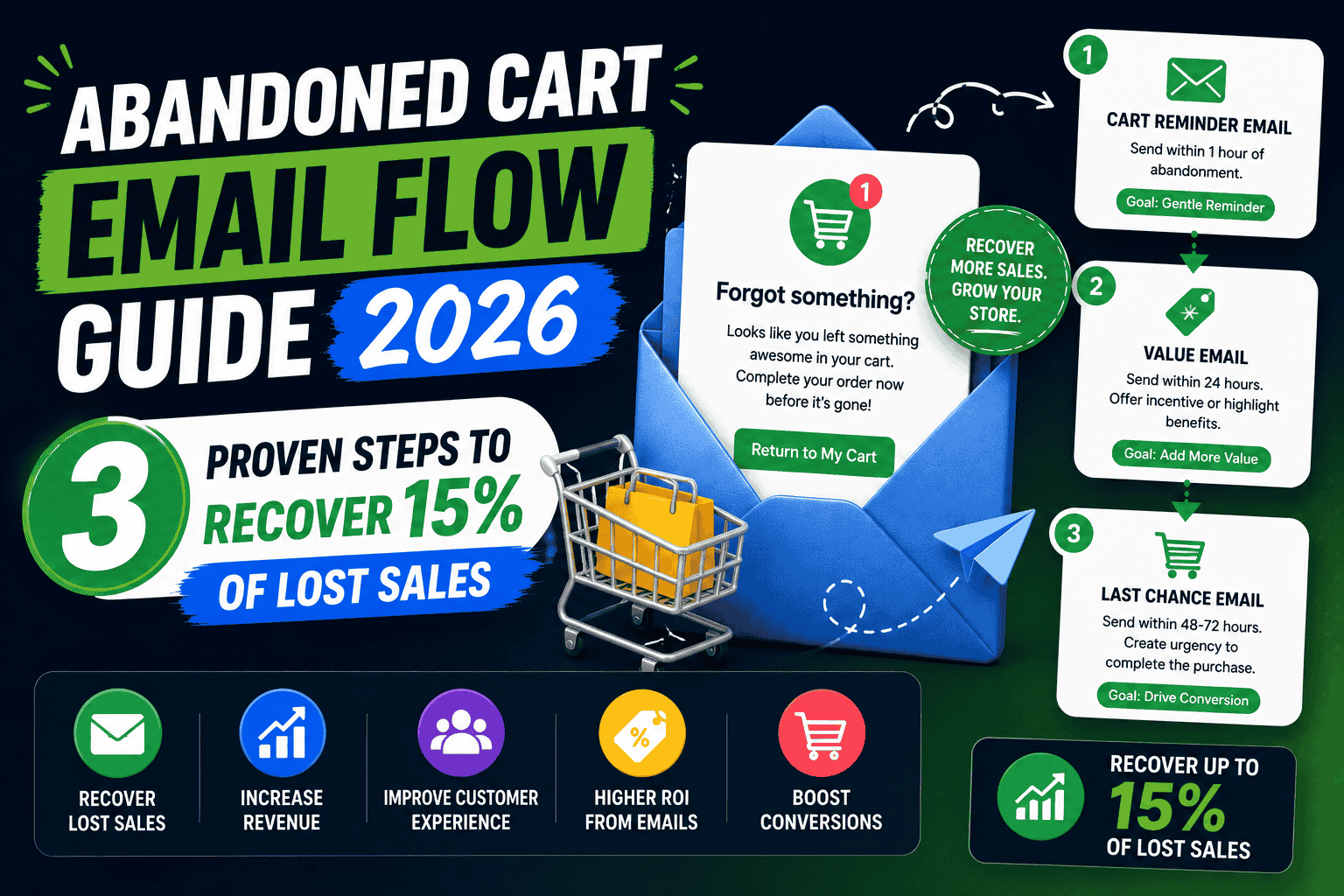
Short answer: send the first email 30-60 minutes after abandonment (the first hour converts 3-5x better than hours 2-4), follow with a second email around the 18-24 hour mark and a third roughly a day after that, keep the first email discount-free, and introduce incentives gradually starting with email 2. A 3-email sequence is the standard that balances recovery rate against deliverability risk. Below, I’ll walk through the full structure.
Why Abandoned Cart Emails Outperform Almost Everything Else
Abandoned cart emails achieve an average open rate of approximately 45%, more than double the 15-20% average for standard promotional emails. On Klaviyo specifically, average open rates run around 50.5%, with the top 10% of senders reaching 65.34%. The reason is straightforward: unlike a cold promotional blast, this email reaches someone who already demonstrated real purchase intent — they picked a product, added it to their cart, and started checkout. You’re not generating interest from scratch; you’re recovering interest that already existed minutes or hours ago.
This is also why abandoned cart flows consistently produce the highest revenue per recipient of any automated email type — around $3.65 per recipient on average per Klaviyo’s 2026 data, well above other lifecycle automations. The shopper has already done the hard work of deciding what they want; your job is just removing whatever friction or distraction pulled them away before they finished.
Timing: The Single Biggest Lever You Have
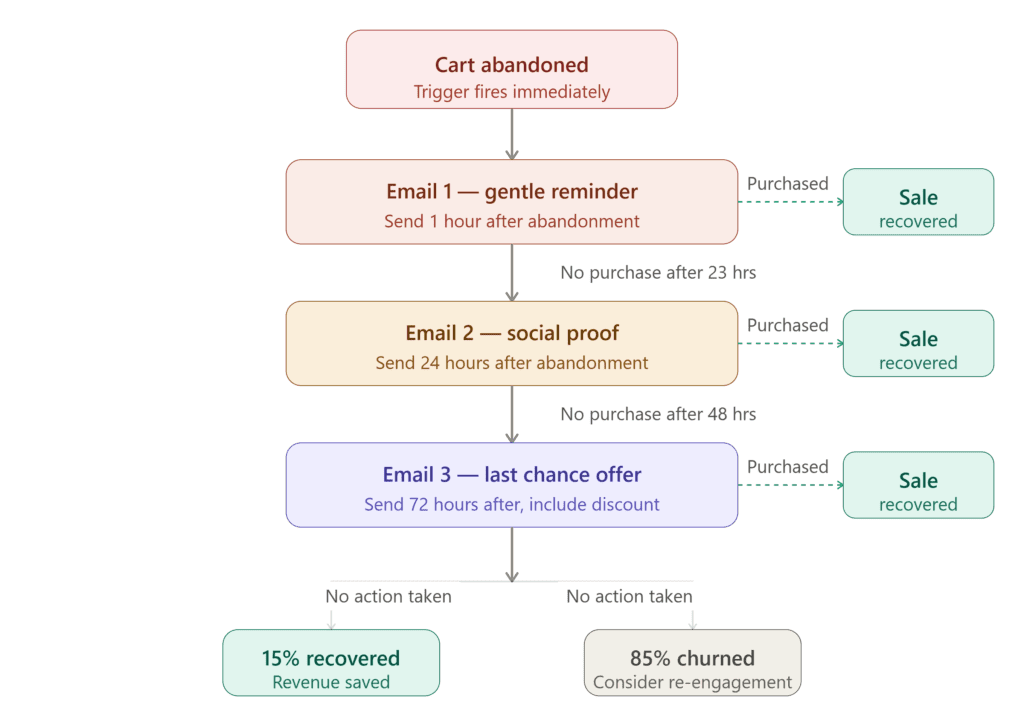
Email 1: 30-60 Minutes After Abandonment
This is the most important timing decision in the entire flow. Data consistently shows the first hour after abandonment converts 3-5x better than hours 2-4 — the customer’s session is still warm, and the product is still mentally front-of-mind. Wait until the next day, and you’re competing with everything else that’s landed in their inbox since.
A 30-45 minute delay is the commonly recommended sweet spot. It’s long enough to avoid feeling like you’re watching the customer’s every move in real time, but short enough to catch them before intent decays. It also gives a natural self-correcting buffer: if the customer completes the purchase on their own within that window, the email simply doesn’t fire.
Email 2: Around the 18-24 Hour Mark
The second email catches shoppers who didn’t act on the first reminder. By this point the urgency framing shifts slightly — this is typically where a gentle incentive (free shipping, a small percentage off) gets introduced for the first time, paired with social proof or specific product benefits rather than just a repeat of email 1’s reminder.
Email 3: Roughly a Day After Email 2
The third and typically final email is where stronger incentives or clearer urgency (a code expiring soon, limited stock if genuinely true) can appear. Across 497 brands and 756 abandoned cart emails analyzed in one industry study, the average sequence length was just 1.52 emails — a majority of brands use only a single follow-up, and relatively few go beyond three. This means a well-built 3-email sequence already puts you ahead of most competitors simply by existing.
If you’re choosing a platform to build this flow in, see our Best Email Marketing Tools for Shopify 2026 guide — Klaviyo and Omnisend both include pre-built abandoned cart templates with conditional logic for cart value and customer segment.
The Late-Night Abandonment Problem
A fixed delay creates an obvious problem: a cart abandoned at 11 PM plus a 30-minute delay means an email arriving at 11:30 PM, buried under everything else by the time the customer wakes up. The fix is restricting your flow to a sending window (roughly 6 AM to 9 PM local time), with evening hours — specifically around 7-8 PM — often showing the strongest open rates, since that’s when shoppers are off work and have the mental space for browsing decisions. If a cart is abandoned outside this window, delay the first send until the window opens rather than firing immediately.
Abandoned Cart Email Flow Guide: Should Email 1 Include a Discount?
Generally, no — and this is one of the more consistent findings across industry data. Leading with a discount in the very first message trains a segment of your customer base to deliberately abandon carts in order to trigger a coupon, which erodes margin on purchases that would have happened anyway.
A sensible structure: keep email 1 discount-free, relying instead on a clear reminder, the specific product images and details, and any relevant value propositions (free returns, fast shipping, warranty). Introduce a gentle incentive in email 2 if needed, and reserve your strongest offer for email 3, especially in product categories where you’re running a longer sequence. This escalation pattern captures easy conversions early without training your full audience to expect a discount on the first message every time.
One nuance worth testing: segmenting new customers from returning, loyal ones, and applying different incentive timing to each. A first-time visitor abandoning their only cart might warrant a different approach than a repeat customer who already knows your brand and is more likely to return without a discount at all.
Practical Use Case: Sequence Length by Product Type
Fast, Low-Stakes Purchases (Apparel, Accessories, Consumer Electronics Under $100)
A 3-email sequence is the benchmark here. These categories have quick purchase cycles and relatively transparent pricing — a timely reminder, an objection-handling follow-up, and a final nudge are typically sufficient since the product isn’t being deeply researched or compared at length.
Higher-Consideration Purchases (Furniture, Electronics Over $200, Outdoor/Sports Equipment)
These categories often benefit from a 4-email sequence. Fit, feature, and sizing questions add friction that a pure reminder-and-discount approach doesn’t resolve, so an extra message addressing sizing guides, warranty details, or user reviews can meaningfully improve recovery without simply repeating the same urgency message.
Luxury and High-Consideration Categories (Jewelry, Premium Beauty)
These categories see the steepest cart abandonment rates (luxury and jewelry around 82.84% in recent data) but also the most room for a storytelling-led approach. Leading with brand narrative and trust signals rather than discounts or urgency tends to perform better here — a luxury customer responding to a panic-driven discount code undermines the premium positioning the brand is trying to maintain.
Benchmarks: What “Good” Actually Looks Like
Context matters enormously here, since raw numbers without it are easy to misread. Across the broader market, most brands recover only 3-5% of abandoned carts with a single email. A well-timed 2-3 email sequence typically recovers 5-14%, and high-performing flows exceed 15-20%. On Klaviyo’s full dataset, the average conversion rate sits at 10.7%, with anything below 5% signaling a flow that needs rework and anything above 15% putting you in the top tier.
Revenue per recipient (RPR) is arguably the more useful metric to anchor on than conversion rate alone, since a flow with a slightly lower conversion rate but a higher average order value can still generate more total revenue. Klaviyo’s benchmark sits at $3.65 per recipient on average, with elite performers reaching $28.89 — nearly 8x the average. If your flow is converting reasonably but RPR is low, the issue may be discount depth (too generous, eating into margin) rather than the flow’s structure.
Subject Lines and Content That Actually Convert
The subject line is the first gate — if nobody opens, nothing else in the email matters. Keep it simple and specific rather than clever: name the product, reference the cart, and state the next step clearly. You don’t need cleverness; you need clarity.
Scarcity, used honestly, is a reliable conversion tactic — 44% of abandoned cart emails analyzed in one study used some form of scarcity language, whether tied to the cart no longer being reserved, an expiring offer, or limited stock. Humor, by contrast, is not a reliable tactic; it’s unpredictable what individual recipients will find funny, and it’s much harder to test systematically than a straightforward scarcity or value message.
Inside the email itself, show the actual abandoned items — photos, names, and prices — so the customer doesn’t have to recall what they were looking at. Use a single, clear call-to-action button rather than several competing options, and make sure that button is thumb-friendly and visible without scrolling on mobile, since over 40% of all emails are opened on a phone.
Critical Guardrails: Suppression and Frequency Caps
Two technical details separate a well-run flow from one that quietly damages customer trust.
Exit the flow immediately on purchase. If a customer completes their purchase — even on a different device or through a different channel than where they abandoned — the flow needs to detect that and stop sending. Continuing to email someone about a cart they already checked out from is one of the fastest ways to damage trust and trigger unsubscribes. Server-side purchase event tracking, rather than relying solely on client-side browser data, closes this gap more reliably.
Cap total frequency across channels. If you’re running abandoned cart recovery across both email and SMS, make sure the combined frequency doesn’t overwhelm the customer — use one channel as primary and the other only for high-intent or high-value carts specifically, rather than firing both simultaneously for every abandonment.
Abandoned Cart Email Flow Guide: When to Add SMS to the Flow
SMS can meaningfully boost recovery, but it’s best reserved for high-intent or high-value carts rather than applied universally — the higher perceived intrusiveness of a text message means it should be earned by a larger potential payoff. If you do add SMS, check current platform and regional rules carefully; in the US, for example, cart abandonment texts are generally expected to be sent within 48 hours of the triggering event and limited to one message per recipient, with strict adherence to local quiet hours.
How This Fits Into Your Broader Automation Strategy
Abandoned cart recovery shouldn’t be the only automated flow in your email program, even though it’s typically the highest-converting one. A new subscriber who never makes it to checkout in the first place needs a different kind of nurturing entirely — see our Best Welcome Email Sequences 2026 guide for the equivalent framework on building trust and engagement before someone even reaches the cart stage.
Together, a strong welcome sequence and a strong abandoned cart flow cover the two highest-leverage moments in a customer’s early relationship with your store: the first impression, and the moment just before a lost sale. Most stores that build only one of these two flows are leaving a comparable amount of recoverable revenue on the table in the other.
Fixing the Root Cause, Not Just the Symptom
Recovery emails address abandonment after it happens, but the most successful stores also work on reducing how often it happens in the first place. Mandatory account creation before checkout dissuades roughly 24% of shoppers from completing a purchase — offering guest checkout removes that friction directly. Technical issues during checkout (slow load times, broken mobile layouts, confusing payment steps) also drive abandonment that no follow-up email can fully recover, since the underlying experience problem persists for the next visitor too.
Treat your abandoned cart flow and your checkout optimization as two sides of the same problem rather than separate projects — the flow recovers what’s already lost, while checkout fixes prevent the loss from happening as often.
A Worked Example: 3-Email Flow for a $60 Apparel Cart
Here’s how the structure above translates into an actual sequence for a mid-range clothing brand, where the shopper abandoned a $60 cart containing two items.
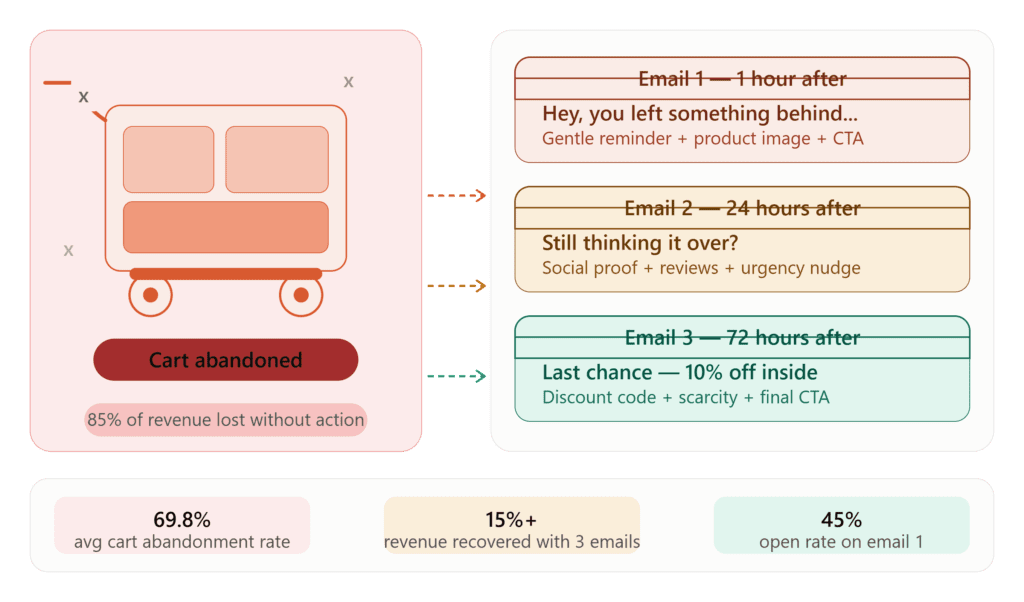
Email 1 (35 minutes after abandonment): “Still thinking it over?” — product photos and names pulled directly from the cart, a single “Complete your order” button, and a brief line about free returns. No discount, no urgency language. This email exists purely to remove the friction of “I forgot what I was looking at.”
Email 2 (20 hours later): “Free shipping on your cart, today only” — same product images, now with a gentle, genuinely time-limited incentive. This email also includes two or three short customer reviews of the specific items in the cart, addressing the “is this actually good quality” hesitation that often underlies a stalled purchase.
Email 3 (roughly 44 hours after abandonment): “Your cart expires soon — here’s 10% off” — the strongest offer in the sequence, paired with honest scarcity (“this code expires in 24 hours”) rather than fabricated urgency. By this point, two prior touches have already addressed the “I forgot” and “is this worth it” objections, so this final email’s job is simply giving a last, clear reason to act now rather than never.
Notice that the discount only appears once, in the final email, and at a modest 10% — enough to tip a hesitant buyer without training the customer base to expect a coupon on every abandoned cart going forward.
Setting This Up in Your Platform
Most dedicated ecommerce email platforms include pre-built abandoned cart templates that handle the trigger logic (cart created, checkout started, purchase not completed within X time) automatically, so you’re mainly customizing timing, content, and incentive placement rather than building the underlying automation logic from scratch.
For platform-specific setup guidance and pricing, see our Best Email Marketing Tools for Shopify 2026 guide, which covers Klaviyo, Omnisend, and GetResponse’s ecommerce automation specifically. Our Omnisend Review 2026 also covers hands-on testing of its abandoned cart flow builder and conditional splits by cart value.
Whichever platform you use, prioritize server-side event tracking for the purchase-completed trigger over relying solely on client-side browser tracking. This closes the gap where a customer completes checkout via a different device, a saved payment link, or after closing and reopening their browser — scenarios where client-side-only tracking can falsely continue sending recovery emails to someone who already bought.
Final Verdict
Abandoned cart email is, by a wide margin, one of the highest-leverage automations in ecommerce, and the data is remarkably consistent across every source: a well-built 3-email sequence sent at the right times recovers meaningfully more revenue than the single generic reminder most stores still rely on. The difference between a 2% recovery rate and a 15%+ recovery rate isn’t a creative problem — it’s a structural one, built on timing, sequence length, and disciplined incentive placement.
Start with the basics: a discount-free first email at 30-60 minutes, a second email around 18-24 hours later with a gentle incentive, and a third roughly a day after that with your strongest offer if needed. Layer in evening send-time windows, proper purchase suppression, and segment-specific incentive timing once the basic structure is proven. Then track revenue per recipient, not just conversion rate, since that’s the number that actually reflects what this flow is doing for your bottom line.
Related Reading
- Best Email Marketing and Automation Tools 2026 (full roundup)
- Best Email Marketing Tools for Shopify
- Omnisend Review 2026
- Drip Review 2026
1. How fast should I send the first abandoned cart email?
Within 30-60 minutes of abandonment. Data shows the first hour after abandonment converts 3-5x better than hours 2-4, since the customer’s session is still warm and the product is still front of mind. Waiting until the next day means competing with everything else in their inbox.
2. How many emails should an abandoned cart sequence have?
A 3-email sequence is the standard benchmark for most product categories, balancing recovery rate against deliverability risk. Fast, low-stakes purchase categories can use 3 emails; higher-consideration categories (furniture, premium electronics) may benefit from 4. Most brands actually only send 1-2 emails, so even a well-built 3-email flow puts you ahead of most competitors.
3. What is a good abandoned cart email conversion rate?
Klaviyo’s 2026 data across 183,000+ brands puts the average conversion rate at 10.7%. Below 5% signals a flow that needs rework. Above 15% puts you in the top tier. Revenue per recipient (RPR) averages $3.65, with top performers reaching $28.89.
4. Should the first abandoned cart email include a discount?
Generally, no. Leading with a discount trains customers to deliberately abandon carts to trigger a coupon, eroding margin on purchases that would have happened anyway. A common structure keeps email 1 discount-free, introduces a gentle incentive in email 2, and reserves the strongest offer for email 3.
5. What time of day gets the best abandoned cart email open rates?
The evening window, roughly 6 PM to 9 PM local time, with a clear peak around 7-8 PM. This aligns with when shoppers are off work and have the mental space for personal browsing decisions. Restricting sends to this window also avoids emails arriving late at night and getting buried by morning.
6. Does SMS improve abandoned cart recovery?
It can, but it’s best reserved for high-intent or high-value carts rather than every abandonment, since SMS is more intrusive than email. Regional rules also apply — in the US, cart abandonment texts are generally expected within 48 hours of abandonment and limited to one message per recipient, respecting local quiet hours.
7. Why is revenue per recipient more important than conversion rate?
A flow with a lower conversion rate but a higher average order value can generate more total revenue than one with a higher conversion rate but lower-value recovered carts. Revenue per recipient (RPR) captures this nuance directly, while conversion rate alone can be misleading when comparing flows across different product price points.
8. What should I do if my abandoned cart flow has a low conversion rate?
First, check timing — a delayed first send is the most common cause of underperformance. Next, check whether the flow exits properly on purchase and isn’t sending to customers who already converted. Finally, review incentive placement; both too little incentive and overly generous early discounts can hurt overall recovery and revenue per recipient respectively.





I am Ashish Yadav a software engineer and AI tools researcher with over five years of practical experience working with real-world systems and automation. I am founder of CognifyFuture, where I analyzes, tests, and breaks down AI tools with a focus on what actually works—not what’s trending.
My content is built on hands-on usage, not theory. Instead of generic advice, I focuses on real implementation—how AI tools can be used to automate tasks, improve efficiency, and solve any specific business or individual problems.
Through CognifyFuture, My aims is to eliminate confusion around AI by delivering clear, honest, and actionable insights that help users make smarter technology decisions.