
You’re not running an enterprise marketing team so why does every email platform comparison talk like you are?
Most “best email marketing platform” content is written for marketers who already know exactly what they need. A small business owner usually needs something different: a platform simple enough to actually use consistently, priced sensibly at a small list size, with just enough automation to cover the basics without a steep learning curve. The “most powerful” platform on paper is often the wrong choice if it sits unused because it’s too complex for a one-or-two-person operation to maintain alongside everything else running the business.
I looked at this specifically through a small business lens not enterprise, not pure content creator, but an actual local or online small business to answer the questions that matter for that situation:
- What does a small business actually need versus what’s overkill?
- Which platforms balance simplicity and capability without overwhelming a non-marketer?
- How much should a small business expect to budget for this?
- What’s genuinely essential versus a nice-to-have at small scale?
Short answer: MailerLite and Brevo both consistently fit the small business sweet spot well simple enough to learn quickly, with genuine automation included even on lower-cost or free tiers. GetResponse is a strong fit if you specifically want built-in funnel or webinar tools alongside email. ActiveCampaign fits once you’ve outgrown simplicity and specifically need CRM-level contact management alongside email. Below, I’ll break down what actually matters at small business scale.
What Small Businesses Actually Need (and What’s Overkill)
Before comparing specific platforms, it’s worth being honest about what a typical small business genuinely needs versus what sounds impressive in a feature list but rarely gets used.
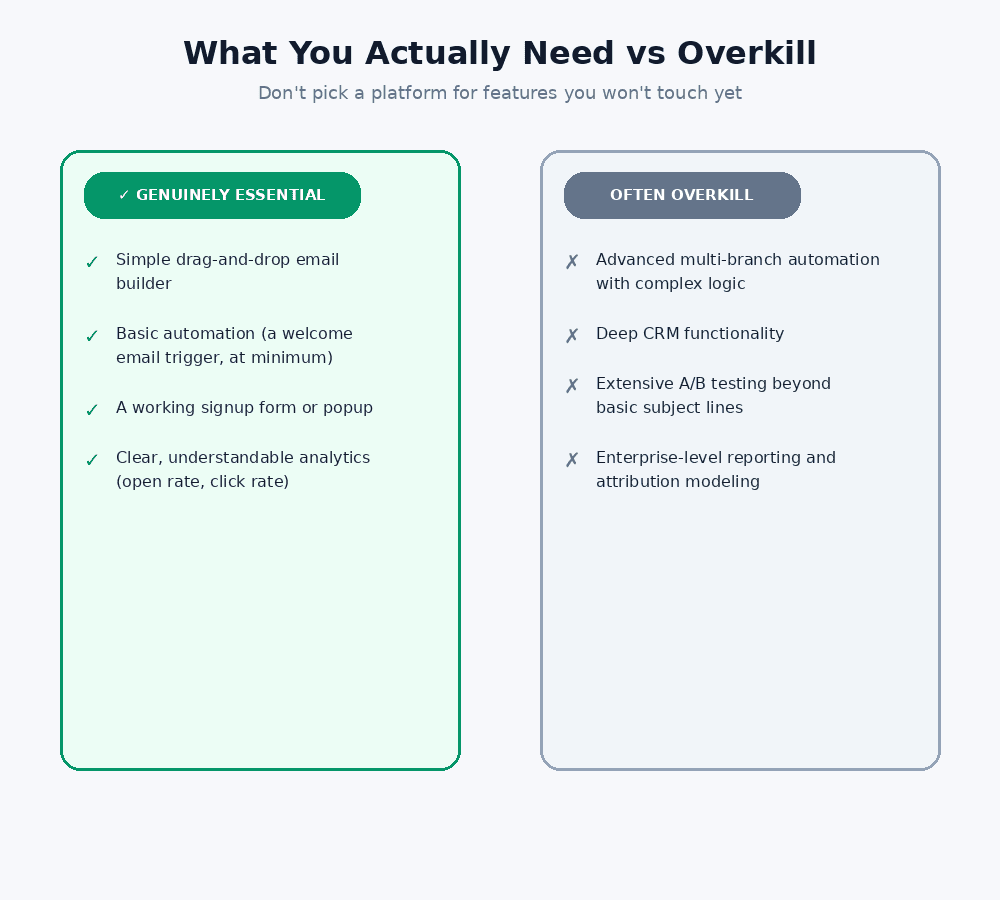
Genuinely essential: a simple drag-and-drop email builder, basic automation (at minimum, a welcome email trigger), a working signup form or popup, and clear, understandable analytics (open rate, click rate not a dozen advanced metrics you’ll never look at).
Often overkill at small scale: advanced multi-branch automation with complex conditional logic, deep CRM functionality, extensive A/B testing tools beyond basic subject line tests, and enterprise-level reporting and attribution modeling. These aren’t bad features they’re simply premature for a business that’s still building its list and basic sending habits.
The practical implication: don’t pick a platform based on its most advanced feature, since you likely won’t touch it for a while. Pick based on how quickly you can actually get a welcome email and a simple newsletter running, since that’s where the real early-stage value is.
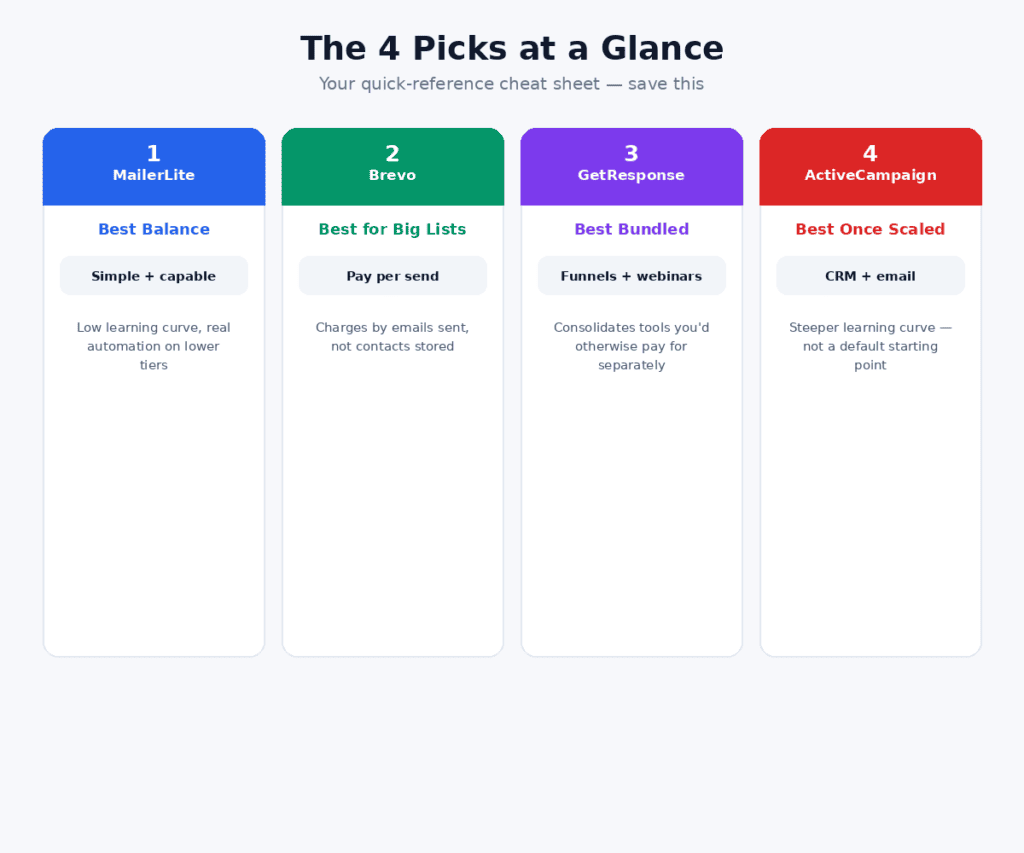
1. MailerLite Best Balance of Simplicity and Capability
MailerLite consistently comes up as a strong small business fit because its interface is genuinely simple without feeling stripped-down or limited in a way that creates problems as you grow. The automation builder is visual and easy to understand even for someone with no prior email marketing experience, and the platform doesn’t bury basic features behind a confusing menu structure.
Read our full MailerLite Review 2026 for a complete breakdown of pricing and features.
Best for: a small business that wants to get up and running quickly without a steep learning curve, while still having real automation and landing page tools available as needs grow.
2. Brevo Best If Your List Is Larger Than Your Sending Frequency
Many small businesses accumulate customer and contact lists faster than they actually send campaigns a local service business might have hundreds of past customers but only send a few promotional emails a year. Brevo’s pricing model, based on emails sent rather than contacts stored, directly rewards this common small business pattern.
See our Brevo vs Mailchimp 2026 comparison for the full pricing model breakdown.
Best for: a small business with a sizable existing contact list (past customers, inquiries, contacts collected over time) that doesn’t email frequently, where contact-based pricing would charge for stored contacts that rarely receive a campaign anyway.
3. GetResponse Best If You Want Funnels or Webinars Bundled In
If your small business does occasional webinars, runs simple sales funnels for a specific offer, or wants these capabilities without paying for and learning a separate dedicated tool, GetResponse’s bundled approach can be a genuinely efficient fit, consolidating several marketing functions into one platform and one subscription.
Read our full GetResponse Review 2026 for the complete feature and pricing breakdown.
Best for: a small business that specifically wants webinar hosting or funnel-building bundled with email, rather than managing separate tools for each function.
4. ActiveCampaign Best Once You’ve Outgrown Simplicity
ActiveCampaign is a strong platform, but it’s worth being honest that its CRM-level contact management and more sophisticated automation builder represent a steeper learning curve than the other options here. It earns a place on this list specifically for small businesses that have outgrown a simpler tool and genuinely need to track contact relationships and sales pipeline alongside email marketing, not as a default starting point.
Read our full ActiveCampaign Review 2026 for the complete picture.
Best for: a growing small business that specifically needs combined CRM and email functionality, and has the time to invest in learning a more sophisticated platform.
Should You Start on a Free Plan?
For most small businesses just getting started, yes starting on a genuinely usable free plan is a sensible way to build sending habits and confirm email marketing is worth the eventual paid investment before committing to a monthly cost.
See our Best Free Email Marketing Tools 2026 guide for a detailed comparison of which free plans actually include real automation versus which are too limited to be practically useful.
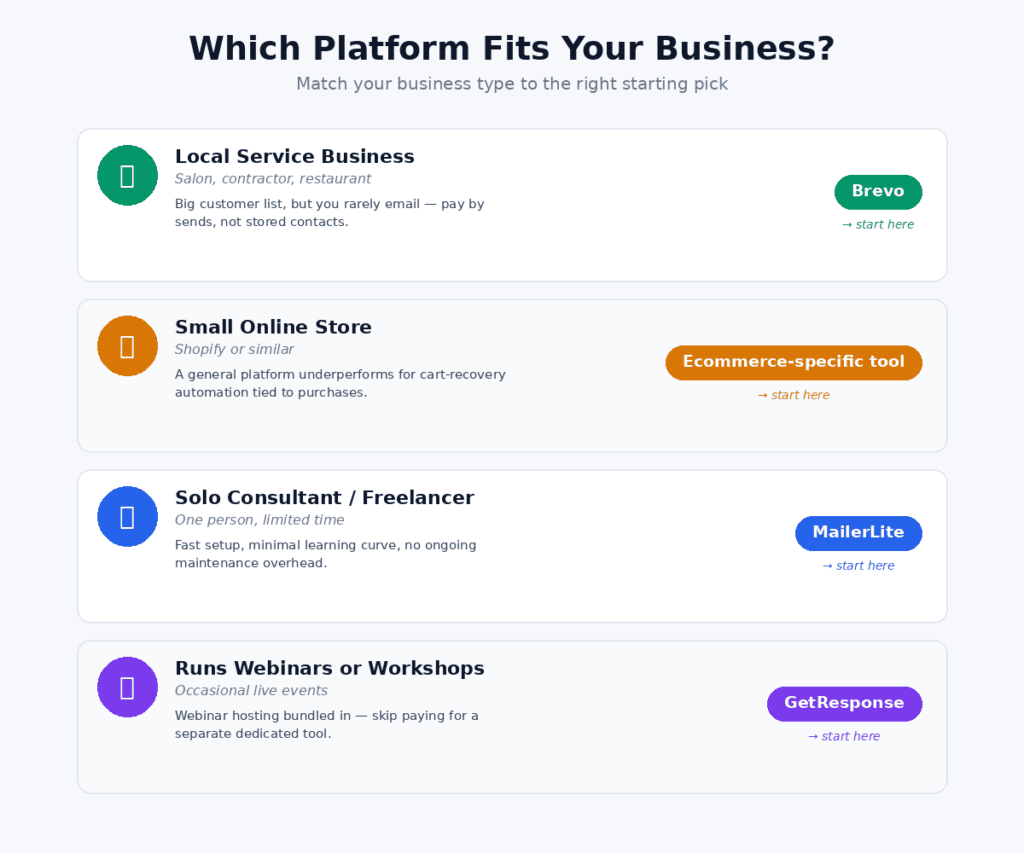
Practical Use Case: Matching Platform to Small Business Type
A Local Service Business (Salon, Contractor, Restaurant)
Brevo’s send-based pricing tends to fit well here, since these businesses commonly build a sizable customer list over time but send relatively infrequently a monthly promotion or seasonal update rather than weekly campaigns.
A Small Online Store
If you’re on Shopify or a similar platform, an ecommerce-specific tool will generally outperform a general small business platform for automation tied to purchase behavior.
See our dedicated Best Email Marketing Tools for Shopify 2026 guide for that specific situation.
A Solo Consultant or Freelancer
MailerLite’s simplicity is usually the right fit here, since a solo operator needs to set up email marketing quickly without a significant ongoing time investment to learn or maintain a more complex platform.
A Small Business That Also Does Webinars or Workshops
GetResponse’s bundled webinar functionality saves both money and the complexity of managing a separate dedicated webinar tool alongside your email platform.
A Realistic Budget Expectation
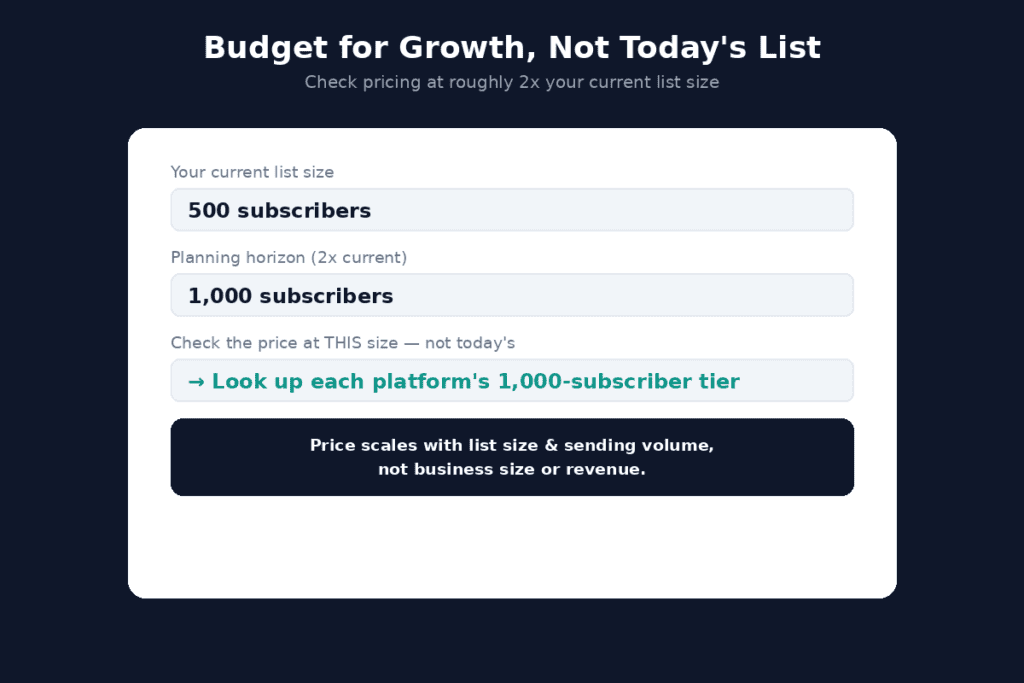
Most small businesses can run a genuinely functional email marketing program for a modest monthly cost once past a free plan’s limits, generally well under what a single part-time marketing hire would cost, given how much of the work (sending, basic automation, list management) the platform itself handles. The specific price scales primarily with list size and sending volume rather than business size or revenue, so a small business with a modest list typically pays meaningfully less than a larger operation regardless of which specific platform is chosen.
Budget for growth, not just your current list size check each platform’s pricing at a list size roughly double your current one, since that’s a more realistic planning horizon than pricing based solely on where you are today.
Getting Started Without Overcomplicating It
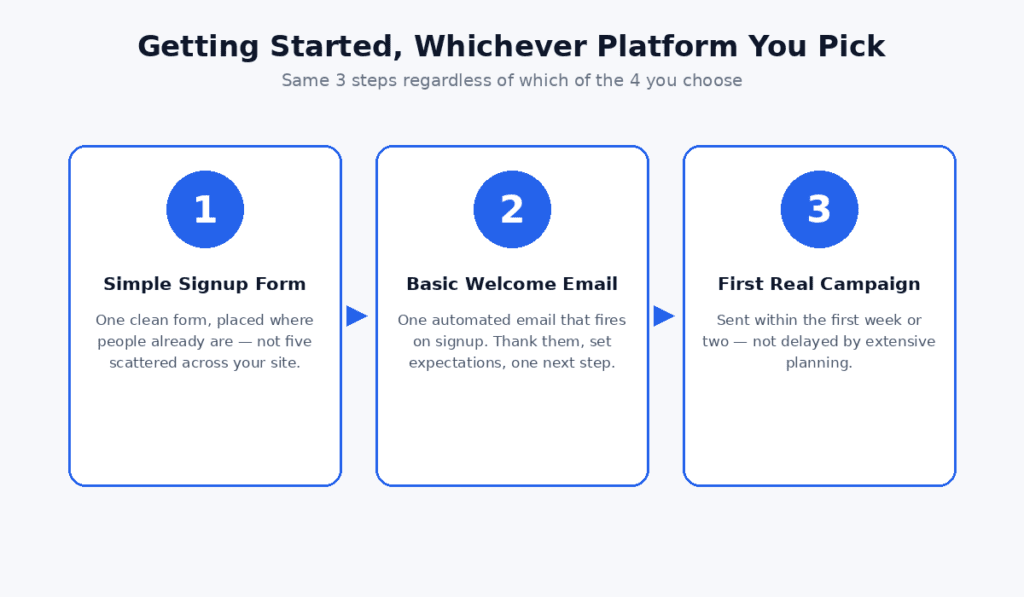
Whichever platform you choose, the actual first steps are the same regardless of small business type: a simple signup form, a basic welcome email, and your first real campaign sent within the first week or two rather than delayed by extensive planning.
Our Email Marketing for Beginners 2026 guide covers this exact step-by-step path in more detail if you’re starting completely from scratch.
Final Verdict
For most small businesses, the right email platform isn’t the one with the most advanced features u it’s the one simple enough to actually use consistently while still covering the genuine essentials: a working signup process, a basic welcome automation, and clear, understandable performance data. MailerLite and Brevo both fit this profile well for most small businesses, with the specific choice between them often coming down to whether your list size or your sending frequency is the more relevant cost driver for your particular situation.
Reserve GetResponse for when bundled funnels or webinars genuinely matter to your business, and ActiveCampaign for once you’ve outgrown simpler tools and specifically need CRM-level contact management. Start on a free plan if one fits your situation, build the basic sending habit first, and let your actual usage and growth not a feature list tell you when it’s time to move to something more sophisticated.
1. What is the best email marketing platform for a small business?
MailerLite and Brevo both consistently fit the small business sweet spot well, balancing simplicity with genuine automation. GetResponse suits businesses wanting bundled funnels or webinars. ActiveCampaign fits once a business has outgrown simpler tools and needs CRM-level contact management.
2. Do small businesses need advanced automation features?
Usually not right away. Basic automation (a welcome email trigger, at minimum) covers most small business needs early on. Advanced multi-branch automation with complex conditional logic is often premature for a business still building its list and basic sending habits.
3. Should a small business start on a free email marketing plan?
Generally yes, for businesses just getting started. A genuinely usable free plan lets you build sending habits and confirm email marketing is worth the eventual paid investment before committing to a monthly cost.
4. Which email platform is best for a local service business with a large but infrequently-emailed list?
Brevo’s send-based pricing model (charging by emails sent rather than contacts stored) tends to fit well here, since local service businesses commonly build sizable customer lists over time but send relatively infrequently.
5. How much should a small business budget for email marketing?
Most small businesses can run a functional program for a modest monthly cost once past a free plan’s limits, with price scaling primarily by list size and sending volume rather than business size. It’s worth budgeting based on a list size roughly double your current one for realistic planning.
6. Is ActiveCampaign a good choice for a small business just starting out?
Not usually as a starting point. ActiveCampaign’s CRM-level contact management and sophisticated automation builder represent a steeper learning curve, making it a better fit for a small business that has already outgrown a simpler platform rather than a default first choice.
7. Should a small ecommerce business use a general small business email platform or an ecommerce-specific one?
An ecommerce-specific platform generally outperforms a general small business tool for automation tied directly to purchase and browsing behavior, such as abandoned cart recovery, if the business operates on a platform like Shopify.
8. What are the first steps a small business should take to start email marketing?
A simple signup form, a basic welcome email automation, and a first real campaign sent within the first week or two, rather than delaying for extensive planning. The platform choice matters less than actually getting these basic elements running consistently.





I am Ashish Yadav a software engineer and AI tools researcher with over five years of practical experience working with real-world systems and automation. I am founder of CognifyFuture, where I analyzes, tests, and breaks down AI tools with a focus on what actually works—not what’s trending.
My content is built on hands-on usage, not theory. Instead of generic advice, I focuses on real implementation—how AI tools can be used to automate tasks, improve efficiency, and solve any specific business or individual problems.
Through CognifyFuture, My aims is to eliminate confusion around AI by delivering clear, honest, and actionable insights that help users make smarter technology decisions.