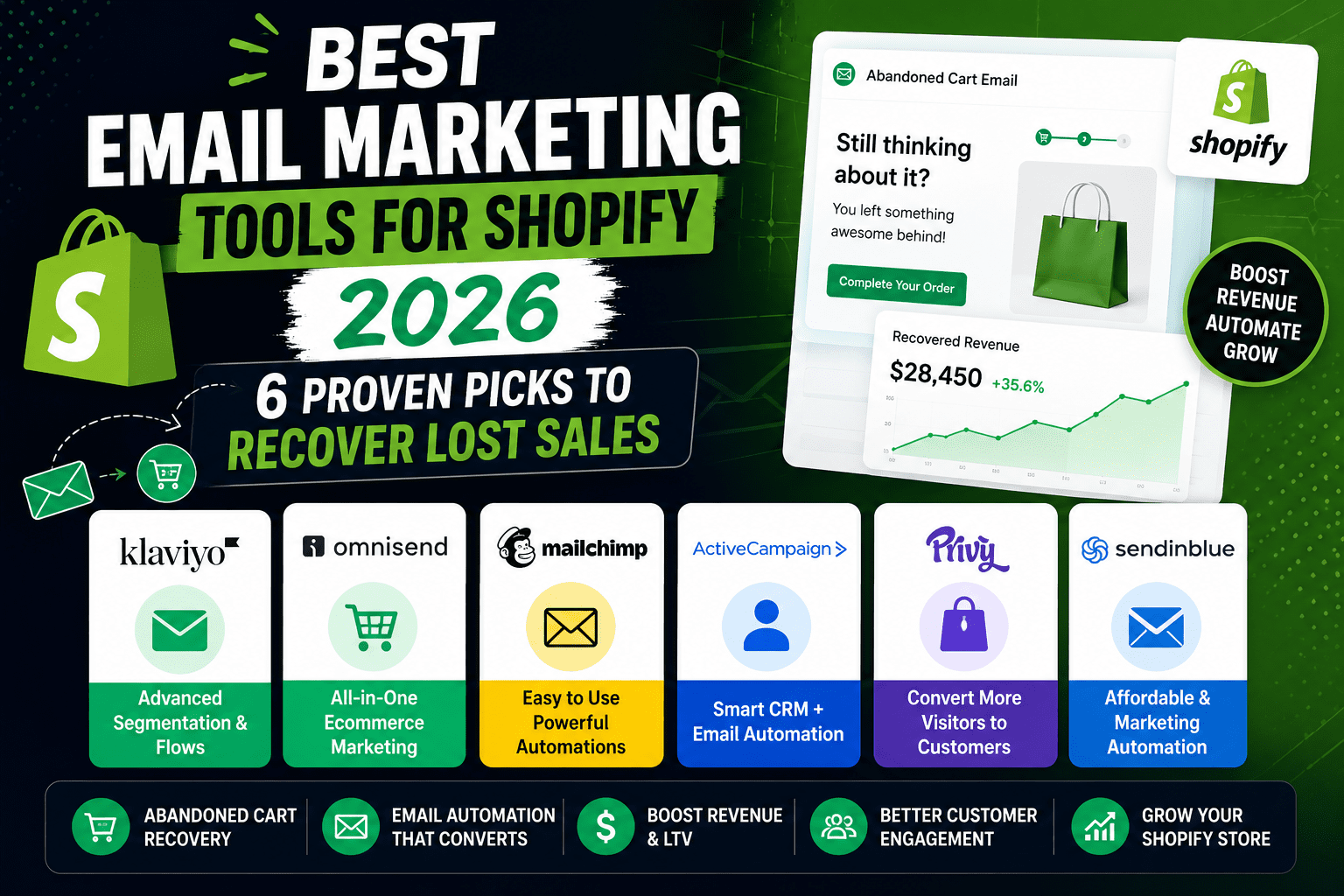
Traffic is coming in. Products are getting viewed. People are even adding things to their cart. So why aren’t the sales matching the visits?
If you’re running a Shopify store, the gap between “people who showed interest” and “people who actually bought” is almost never a traffic problem — it’s an email problem. Shopify’s own native email tool is fine for beginners, but stores doing meaningful revenue consistently see better results from a dedicated email platform built around ecommerce data, not generic newsletter sending.
The reason this gap exists is almost always the same: a generic email tool treats every subscriber identically, sending the same newsletter on the same schedule regardless of what that person actually did on your store. As per Best Email Marketing Tools for Shopify, A subscriber who added a $200 item to their cart and abandoned it 20 minutes ago needs a fundamentally different message than someone who just joined your list from a homepage popup. Platforms built specifically for e-commerce are designed around exactly that distinction.
I went through the platforms that actually integrate deeply with Shopify — not just “support” it through a generic Zapier connection, but sync product catalogs, order history, and browsing behavior in real time — to answer the questions Shopify merchants are actually asking:
- Which platform recovers the most abandoned carts, and how much does that actually cost?
- Is Klaviyo’s reputation as “the best” worth its steeper learning curve and pricing?
- When does Shopify’s free native email tool stop being enough?
- Which platform fits a store that’s just starting out vs one doing $50k+/month?
Short answer: Klaviyo has the deepest Shopify integration and the most sophisticated segmentation, and is the default choice for growing stores serious about email revenue — but it gets expensive quickly and has a real learning curve. Omnisend offers the best balance of ecommerce-specific automation, multichannel (email+SMS+push), and price for stores not yet at Klaviyo’s scale. Shopify’s native email tool is genuinely fine for stores under roughly $10k/month. Below, I’ll break down exactly where each platform fits.
Why Generic Email Tools Underperform for Shopify Stores
Before getting into specific platforms, it’s worth understanding why this category exists separately from general email marketing tools at all. A newsletter platform like Mailchimp or MailerLite sends great-looking emails, but it doesn’t natively know that a specific subscriber viewed a specific product three times, added it to cart, and abandoned it 40 minutes ago.
Ecommerce-specific platforms sync that data automatically — every product view, add-to-cart, and completed order — and use it to trigger automations and build segments without manual setup. That’s the entire reason this category of tool exists, and it’s why a generic email platform, however good its design tools are, tends to underperform a purpose-built one for a store’s bottom line.
1. Klaviyo — Best for Deep Segmentation and Serious Ecommerce Revenue
Klaviyo is the platform most growing Shopify stores eventually consider, and for good reason: it connects directly with Shopify to pull in customer data, purchase history, and browsing behavior in real time, then uses that data to build campaigns, automated flows, and segments with a level of sophistication other platforms don’t fully match.
- Segmentation: Build segments by lifetime value, predicted next purchase date, or browsed-but-not-purchased categories — genuinely advanced targeting most competitors can’t replicate
- Pre-built flows: Mature flow editor with ready-made automations for abandoned cart, browse abandonment, post-purchase, and win-back campaigns
- Pricing: Free for up to 250 contacts and 500 emails/month; paid plans start around $20/month and scale with list size
- Integration breadth: Syncs with 350+ platforms beyond Shopify, including most CRMs and other ecommerce tools
Best for: Established stores with meaningful order volume who want the deepest possible segmentation and are willing to invest time learning the platform. Stores switching to Klaviyo commonly report 30-50% increases in email-attributed revenue within six months, largely from automations and segments that simply weren’t possible on their previous platform.
Trade-off: The interface rewards time invested in mastering it, but that same depth means a steeper learning curve for beginners. Costs also scale up quickly as your list grows — budget accordingly once you’re past a few thousand contacts.
2. Omnisend — Best Multichannel Option (Email + SMS + Push)
If you want email, SMS, and push notifications working together without managing separate vendors for each, Omnisend bundles all three into one platform with cross-channel automation flows.
- Cross-channel flows: Build sequences like “send email, then if not opened within 24 hours, follow up with SMS” — without juggling separate platforms
- Product picker: The drag-and-drop email editor pulls products directly from your Shopify catalog, speeding up campaign creation significantly
- Predictive analytics: Recent updates assign likely-to-buy scores to subscriber profiles based on browsing frequency and purchase history
- Fast deployment: Pre-built ecommerce automation workflows are among the quickest to launch in this category
Read our full Omnisend Review 2026 for hands-on testing of abandoned cart recovery and revenue attribution.
Best for: Growing stores that want SMS and push alongside email without Klaviyo’s pricing or learning curve, and that value fast setup over maximum segmentation depth.
Trade-off: Integration breadth (200+ apps) is solid but doesn’t match Klaviyo’s 350+, and segmentation, while strong, doesn’t go quite as deep as Klaviyo’s most advanced targeting options.
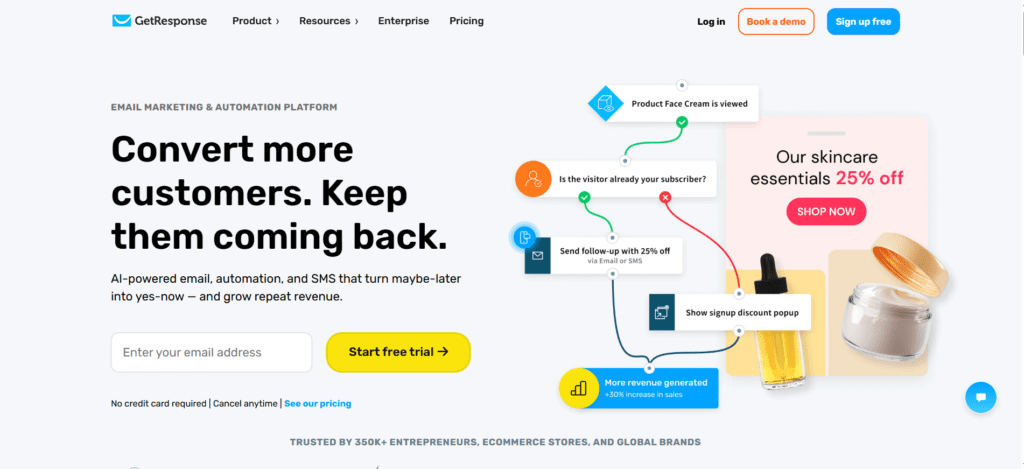
3. GetResponse — Best Affordable Option Before You’re Ready for Klaviyo
If Klaviyo or Omnisend’s pricing feels premature for where your store is right now, GetResponse offers genuinely sophisticated automation at a lower entry cost — useful for proving ROI on email marketing before committing to a pricier platform.
- Ecommerce features on the Marketer plan: Abandoned cart recovery, product recommendations (via its Recostream acquisition), and promo code campaigns
- Conversion funnels: Built-in funnel templates that work well for product launches and limited-time offers
- Lower entry cost: More accessible pricing than Klaviyo or Omnisend for a store still validating its email strategy
Read our full GetResponse Review 2026 for the complete pricing and automation breakdown.
Best for: New or smaller Shopify stores that want to prove email marketing is worth investing in before paying for Klaviyo or Omnisend’s ecommerce-specific depth.
Trade-off: Ecommerce automation, while solid, isn’t as deeply Shopify-native as Klaviyo or Omnisend’s purpose-built integrations — you’ll likely outgrow it as your store scales.
4. Brevo — Best for Large Customer Lists With Infrequent Sends
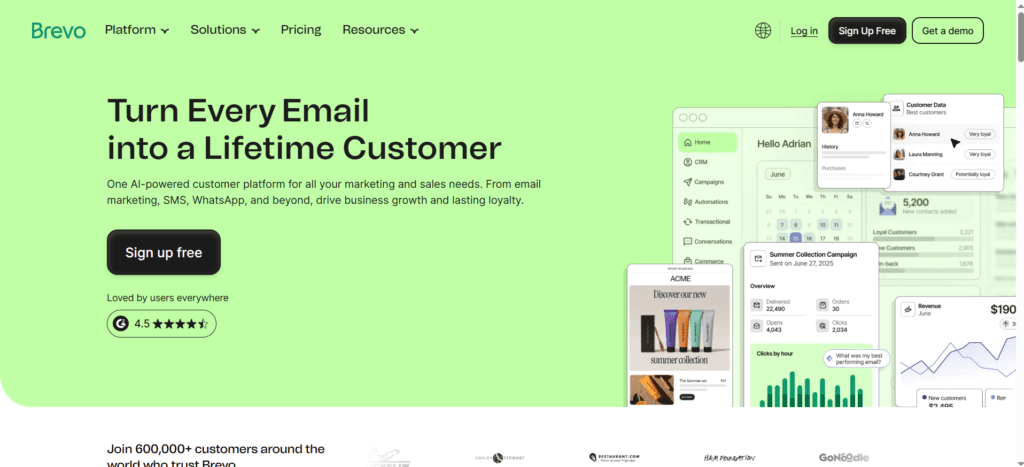
Most Shopify stores accumulate large customer lists over time but only send 2-4 campaigns per month. If that describes your store, Brevo’s pay-per-send pricing (rather than per-contact) can save hundreds of dollars compared to contact-based platforms.
- Unlimited contacts: Store your entire customer list without per-contact fees — you only pay for emails actually sent
- Multi-channel: Native SMS and WhatsApp alongside email, useful for order updates and promotions
- Transactional email included: Order confirmations and shipping notifications can run through the same platform as marketing email
See our Brevo vs Mailchimp 2026 comparison for the full pricing model breakdown.
Best for: Stores with large historical customer databases (tens of thousands of past customers) that send infrequently — the per-send pricing model directly rewards this pattern.
Trade-off: Ecommerce-specific automation and segmentation are less sophisticated than Klaviyo or Omnisend’s purpose-built ecommerce tools.
5. ActiveCampaign — Best for Stores That Also Need a CRM
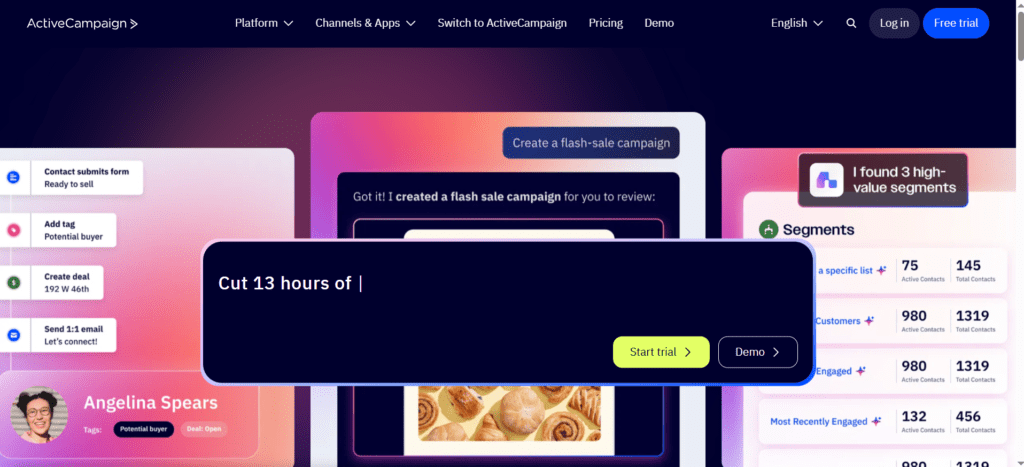
If your Shopify store has a B2B wholesale component, a high-touch customer service operation, or any element of relationship-driven sales alongside direct-to-consumer ecommerce, ActiveCampaign’s combined automation and CRM is worth considering over pure ecommerce-email platforms.
Read our full ActiveCampaign Review 2026 for automation and CRM testing details.
Best for: Stores with a hybrid B2C/B2B model, or any Shopify business where customer relationships extend beyond pure transactional email into sales conversations.
Trade-off: Less Shopify-native than Klaviyo or Omnisend — you’re trading some ecommerce-specific depth for CRM capability most pure ecommerce stores won’t need.
6. Shopify Email (Native) — Best for Stores Just Starting Out
Shopify’s built-in email tool deserves an honest mention: for stores under roughly $10k/month in revenue, it’s a genuinely capable free option that doesn’t require a separate subscription or integration setup.
It covers basic campaigns, simple automation (welcome series, abandoned checkout), and pulls product data directly since it’s native to the platform. The catch is that as your store grows, the segmentation, automation depth, and reporting don’t scale the way a dedicated platform’s would — stores doing $10k+/month consistently see 3-5x more email revenue after migrating to a dedicated platform, through better automation and segmentation that the native tool doesn’t offer.
Best for: Brand-new stores validating their product-market fit before investing time and money into a dedicated email platform.
Trade-off: You’ll likely need to migrate once your order volume and list size grow past early-stage numbers — treat it as a starting point, not a long-term solution.
Best Email Marketing Tools for Shopify: Practical Use Case: Matching Store Size to Platform
A New Store, Pre-Revenue to $5k/Month
Start with Shopify Email or GetResponse’s lower tiers. At this stage, the priority is testing whether email marketing meaningfully impacts your specific store — not maximizing every possible automation feature. Set up a basic welcome series and abandoned cart sequence, and monitor whether email-attributed revenue justifies a more sophisticated (and pricier) platform.
A Growing Store, $5k-$50k/Month
This is Omnisend’s sweet spot — sophisticated enough automation to meaningfully grow email revenue, multichannel options (SMS, push) without managing separate vendors, and pricing that doesn’t yet require Klaviyo’s investment. If you have a large historical customer list with low send frequency, also seriously evaluate Brevo’s per-send pricing at this stage.
An Established Store, $50k+/Month
At this scale, Klaviyo’s segmentation depth and predictive analytics typically pay for themselves — the revenue lift from genuinely advanced targeting (likely-to-buy scores, lifetime value segments, predicted next purchase date) outweighs the platform’s higher cost and learning curve for a store with meaningful order volume to optimize against.
Quick Decision Guide
- “I’m just starting out” → Shopify Email, then graduate when you outgrow it
- “I want the deepest segmentation and don’t mind the learning curve” → Klaviyo
- “I want email + SMS + push without managing three vendors” → Omnisend
- “I want to test ROI before paying Klaviyo prices” → GetResponse
- “I have a huge customer list but send rarely” → Brevo
- “I need a CRM alongside ecommerce email” → ActiveCampaign
The Metrics That Actually Matter for Shopify Email
Once you’ve chosen a platform, it’s worth knowing which numbers actually indicate health versus which are vanity metrics that look good but don’t correlate with revenue.
Email-attributed revenue as a percentage of total store revenue is the single most useful number to track over time. For most ecommerce stores using a dedicated platform, this typically lands somewhere between 15-30% once flows are mature; if you’re well below that after a few months, it’s worth auditing your flow setup rather than assuming email “doesn’t work” for your store.
Abandoned cart recovery rate matters more than overall open rate, since it directly measures whether your highest-intent automation is converting. Industry benchmarks generally fall in the 5-15% recovery range (of abandoned carts that result in a completed purchase after the email sequence); below that range signals your offer, timing, or copy needs adjustment, not necessarily your platform.
List growth rate relative to unsubscribe rate tells you whether your popup and checkout opt-in strategy is sustainable. A list that’s growing but churning quickly through unsubscribes usually indicates a mismatch between what you promised at signup (a discount code, say) and what subscribers actually receive afterward (too-frequent promotional emails).
What to Look for When Evaluating Any Shopify Email Platform
Real-Time Data Sync, Not Batch Updates
The best platforms sync product views, cart additions, and orders in real time, letting an abandoned cart email trigger within minutes rather than hours. Ask specifically about sync frequency before committing — a delay of even a few hours can mean the difference between catching a customer while they’re still in a buying mindset and missing the window entirely.
Pre-Built Flow Quality, Not Just Flow Quantity
Every platform in this list advertises “pre-built automation flows,” but the quality varies. Look specifically at whether abandoned cart flows include multiple follow-up emails with different incentive structures (a reminder, then a discount, then urgency), rather than a single generic email.
Revenue Attribution Reporting
A platform that can tell you “this automation generated $4,200 in attributed revenue last month” is far more useful than one that only reports opens and clicks. This reporting is what lets you make confident decisions about where to invest more automation effort, and it’s a meaningful differentiator between ecommerce-specific platforms and generic email tools.
Growing Your List: Popups, Checkout Opt-Ins, and SMS Capture
None of these platforms matter much without a list to send to, so it’s worth addressing list growth specifically for Shopify stores before moving to migration.
Checkout Opt-Ins Are Your Highest-Converting Source
Shopify’s checkout includes a native email marketing consent checkbox, and this is typically the highest-converting list-building source available to a store — the customer is already in a buying mindset and has already provided their email for order confirmation. Make sure whichever platform you choose syncs this consent properly; Klaviyo and Omnisend both handle this natively through their Shopify apps.
Popups and On-Site Capture
Exit-intent and scroll-triggered popups remain effective for capturing visitors who haven’t reached checkout. Most platforms in this list include native popup builders, though dedicated popup-first apps (like Privy) sometimes offer more sophisticated targeting rules if popups are a major part of your list-growth strategy specifically.
SMS Capture Requires Separate Consent
If you’re using Omnisend or Brevo’s SMS features, remember that SMS marketing consent is legally separate from email consent in most jurisdictions — a customer checking “email me about offers” hasn’t automatically agreed to text messages. Build separate, explicit SMS opt-in flows rather than assuming email subscribers want texts too; this also keeps your SMS list higher-intent and improves engagement rates.
Migrating Between Platforms Without Losing Automation History
If you’re moving from Shopify Email or Mailchimp to a dedicated ecommerce platform, the data migration itself is usually the easy part — customer and order data syncs automatically once you install the new platform’s Shopify app, since it’s pulling directly from Shopify’s own database rather than relying on a manual export.
What doesn’t carry over is your automation history and performance data. Past campaign open rates, click data, and flow performance generally don’t transfer between platforms, so you’ll start with a clean slate on analytics even though your customer data arrives intact. Plan to rebuild your core flows (welcome series, abandoned cart, post-purchase) in the first week after migrating, prioritizing abandoned cart first since it typically has the fastest payback.
One practical tip: keep your old platform active (even on a free or minimal plan) for 2-4 weeks after switching, so you can compare performance side by side and catch any sync issues before fully committing to the new platform.
Final Verdict
For most growing Shopify stores, the decision comes down to a straightforward trade-off: Klaviyo’s segmentation depth against Omnisend’s faster setup and multichannel simplicity, with price scaling as the tiebreaker once your list grows large enough that either becomes a meaningful monthly cost.
If you’re not sure which camp you fall into, start with Omnisend or GetResponse — both are accessible enough to implement quickly and will clearly show you, within a billing cycle or two, whether your store’s email revenue justifies moving up to Klaviyo’s deeper (and pricier) capabilities. Don’t skip straight to the most expensive option assuming bigger is automatically better; let your actual data tell you when you’ve outgrown your current platform.
Whatever you choose, the single highest-leverage automation to set up first is abandoned cart recovery — it’s the fastest-implemented, most universally effective automation across every platform on this list, and it’s usually where the clearest revenue impact shows up first.
Related Reading
- Best Email Marketing and Automation Tools 2026 (full roundup)
- Omnisend Review 2026
- Drip Review 2026
- Abandoned Cart Email Flow Guide
1. What is the best email marketing tool for Shopify?
Klaviyo is generally considered the best overall for Shopify due to its deep real-time integration, advanced segmentation, and predictive analytics. However, Omnisend offers a strong balance of ecommerce automation and lower cost for stores not yet at Klaviyo’s scale, and Shopify’s native email tool is genuinely sufficient for stores under roughly $10k/month.
2. Is Klaviyo worth it for a small Shopify store?
It depends on order volume. Klaviyo’s free plan (up to 250 contacts, 500 emails/month) is accessible for small stores, but its real value comes from advanced segmentation and predictive analytics that matter most once you have enough order history to segment meaningfully. Very new stores may get more immediate value from Shopify Email or GetResponse while building that history.
3. How much revenue can email marketing add to a Shopify store?
Stores switching from generic or native email tools to dedicated ecommerce platforms like Klaviyo commonly report 30-50% increases in email-attributed revenue within six months. Stores doing $10k+/month in revenue have reported 3-5x more email revenue after migrating from Shopify’s native tool to a dedicated platform.
4. What’s the difference between Klaviyo and Omnisend for Shopify?
Klaviyo offers deeper segmentation (lifetime value, predicted next purchase date, browsed-but-not-purchased categories) and integrates with 350+ apps. Omnisend bundles email, SMS, and push notifications into unified cross-channel automation flows, integrates with 200+ apps, and tends to be faster to set up with a lower learning curve.
5. Is Shopify’s native email tool good enough?
For stores under roughly $10k/month, yes — it covers basic campaigns and simple automation (welcome series, abandoned checkout) at no additional cost. Stores doing more revenue typically see meaningfully better results from a dedicated platform’s deeper automation and segmentation.
6. Which Shopify email platform is cheapest for a large customer list?
Brevo, for stores with large customer lists that send infrequently. Because Brevo charges per email sent rather than per contact stored, a large list sent to only a few times monthly costs significantly less than contact-based platforms like Klaviyo at the same list size.
7. Do I need SMS marketing in addition to email for my Shopify store?
It depends on your audience and product. SMS typically has higher open rates but lower tolerance for frequency. Omnisend and Brevo both include SMS natively alongside email, letting you test multichannel campaigns without a separate vendor before committing to a dedicated SMS platform like Postscript or Attentive.
8. What’s the most important automation to set up first on Shopify?
Abandoned cart recovery. It’s the fastest to implement across every platform in this category and consistently shows the clearest, most immediate revenue impact, since it targets shoppers who already demonstrated purchase intent rather than requiring you to generate interest from scratch.





I am Ashish Yadav a software engineer and AI tools researcher with over five years of practical experience working with real-world systems and automation. I am founder of CognifyFuture, where I analyzes, tests, and breaks down AI tools with a focus on what actually works—not what’s trending.
My content is built on hands-on usage, not theory. Instead of generic advice, I focuses on real implementation—how AI tools can be used to automate tasks, improve efficiency, and solve any specific business or individual problems.
Through CognifyFuture, My aims is to eliminate confusion around AI by delivering clear, honest, and actionable insights that help users make smarter technology decisions.