
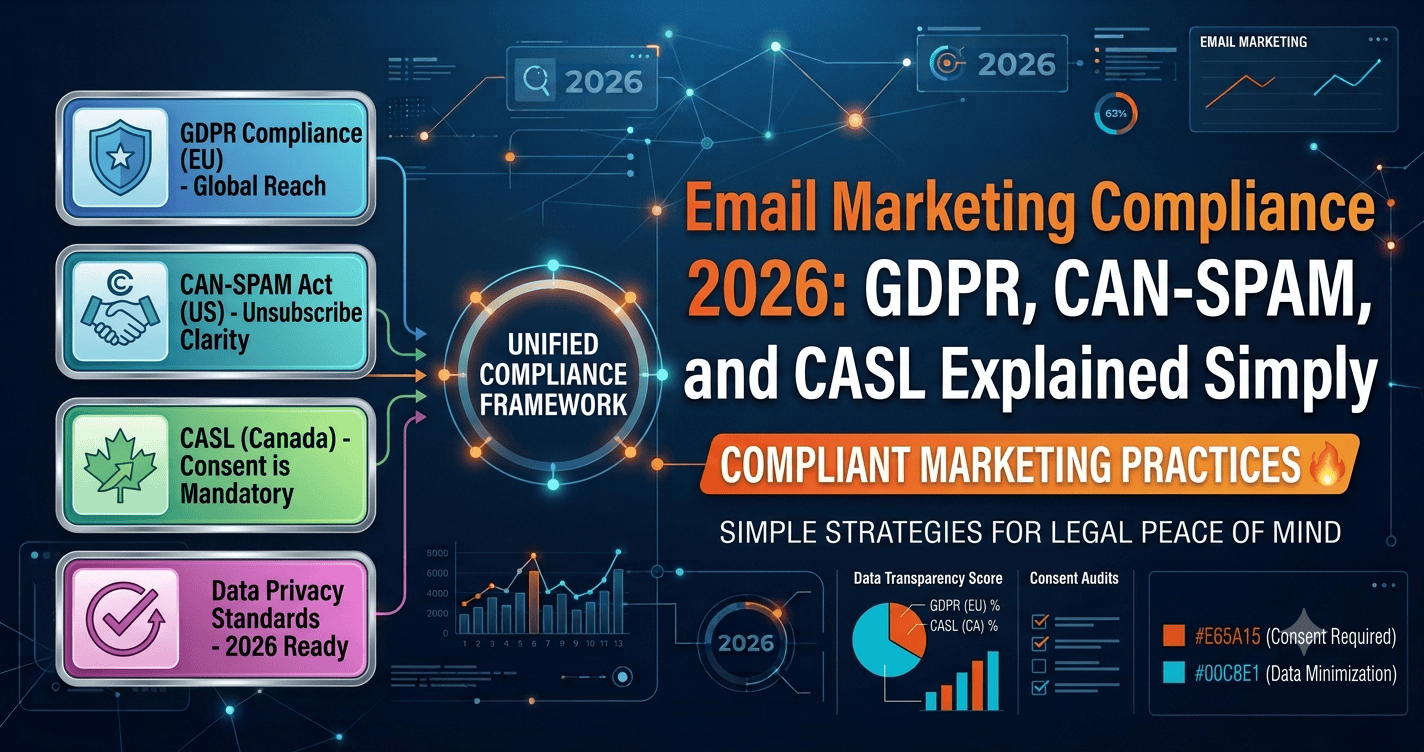
Is your email list actually compliant, or have you just never been checked?
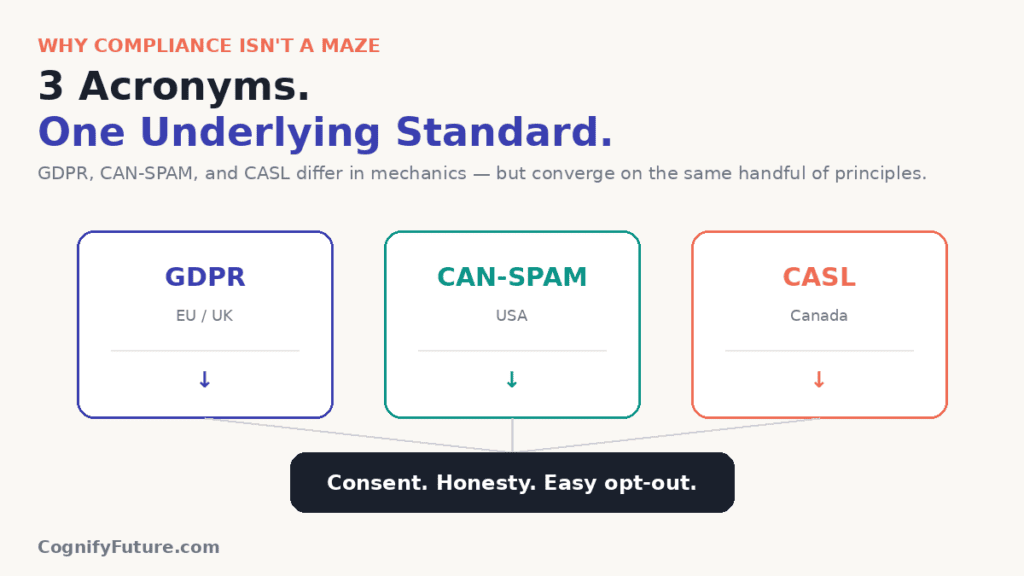
For most small businesses and bloggers, email compliance isn’t about navigating a maze of regulations it comes down to a handful of consistent principles that, once understood, apply across nearly every major framework: get genuine consent before emailing someone, make it easy to leave, and be honest about who you are. The specific acronyms (GDPR, CAN-SPAM, CASL) differ in detail and enforcement mechanism, but they converge on the same underlying expectations far more than most compliance guides make it seem.
I went through Email Marketing Compliance, these regulations actually require in practical terms, separating genuine legal obligations from overcautious advice, to answer the questions that matter for a real sender:
- What does “consent” actually mean across these different frameworks?
- Do you need to worry about GDPR if you’re not based in Europe?
- What are the specific, non-negotiable requirements every sender should meet?
- What happens if you’re not fully compliant how serious is the actual risk?
Short answer: if any of your subscribers are in the EU or UK, GDPR’s stricter opt-in consent standard applies regardless of where your business is based. CAN-SPAM (US) and CASL (Canada) have different specific requirements but share the same core expectations: accurate sender information, no deceptive subject lines, and a working, honored unsubscribe mechanism. Below, I’ll break down what each framework actually requires and what a reasonable compliance baseline looks like in practice.
Disclaimer: This Is Not Legal Advice
Before going further, an important caveat: this guide explains general principles and common requirements across major email regulations, but it isn’t a substitute for legal advice specific to your business, your subscriber locations, and your jurisdiction. If you’re handling sensitive data, operating in a regulated industry, or simply want certainty rather than general guidance, consult a qualified attorney familiar with data privacy and marketing law in the relevant regions.
GDPR: Stricter Consent, and It Applies Based on Subscriber Location, Not Your Business Location
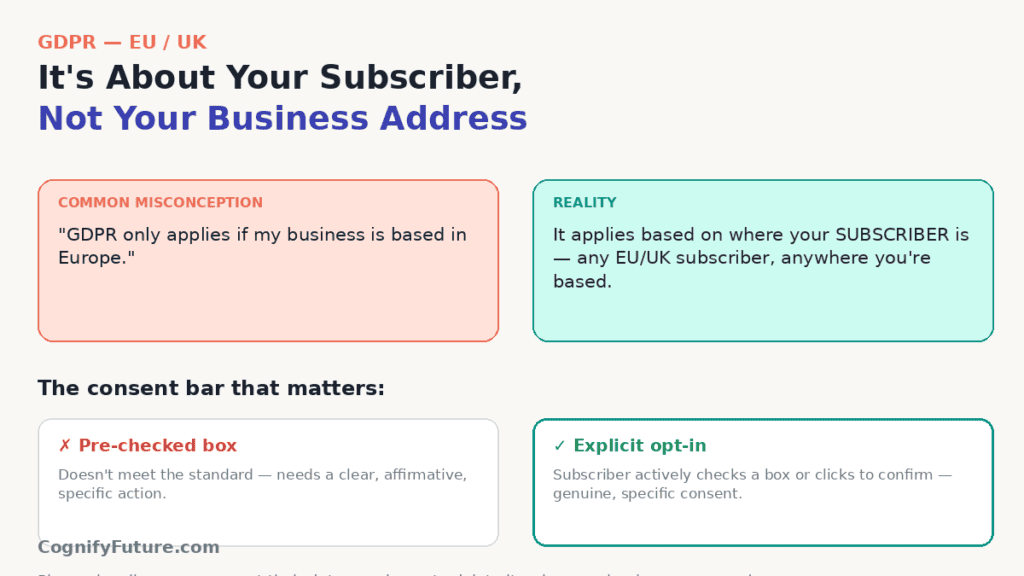
The General Data Protection Regulation (GDPR) is the EU and UK’s data privacy framework, and a common misconception is that it only applies to businesses based in Europe. In practice, GDPR’s reach is generally determined by where your subscribers are located, not where your business is incorporated or operated if you have subscribers in the EU or UK, GDPR’s requirements typically apply to how you collect and handle their data, regardless of where you’re based.
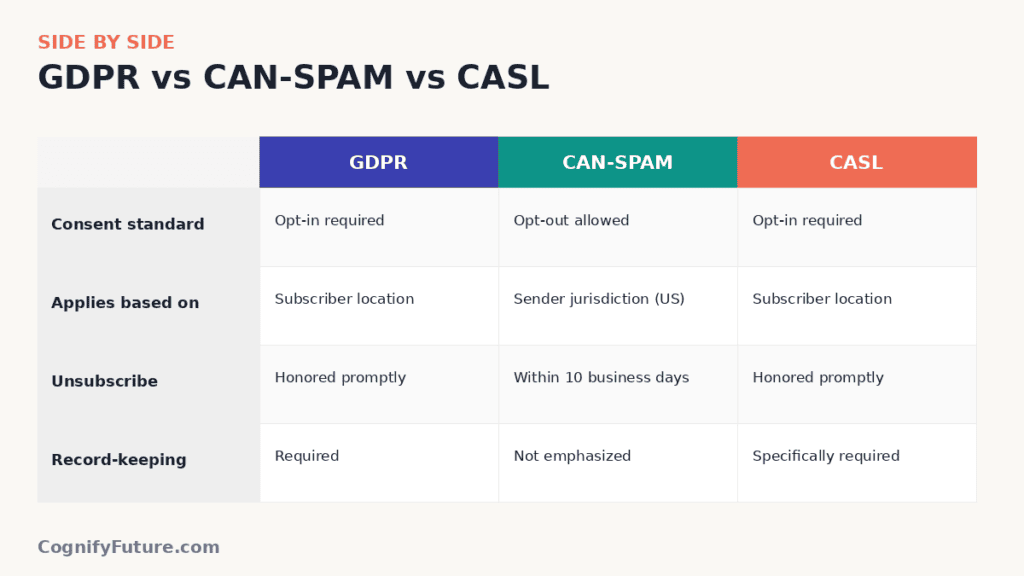
The core practical requirement that differs most from other frameworks is GDPR’s consent standard: it generally requires explicit, opt-in consent before adding someone to a marketing list, rather than allowing an opt-out approach (where someone is added by default and must actively unsubscribe). A pre-checked consent checkbox, or consent bundled vaguely into general terms of service, typically doesn’t meet this standard the consent needs to be a clear, specific, affirmative action.
GDPR also gives subscribers specific rights over their data, including the right to request what data you hold about them and the right to request deletion. Having a straightforward process for honoring these requests, even if you rarely receive them, is part of a reasonable compliance posture if you have any EU or UK subscribers.
CAN-SPAM: The US Standard, Built Around Honesty and Easy Opt-Out
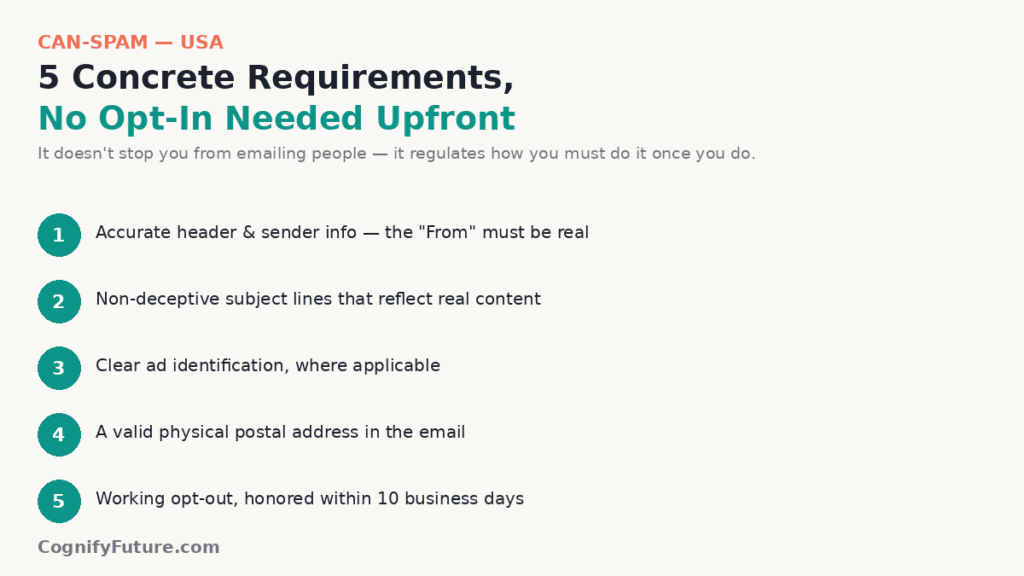
CAN-SPAM, the US federal law governing commercial email, takes a different approach than GDPR it doesn’t require opt-in consent before emailing someone, but it does require specific, concrete obligations once you do send:
- Accurate header and sender information: the “From,” “To,” and routing information must accurately identify who’s actually sending the message
- Non-deceptive subject lines: the subject line must reflect the actual content of the email, not mislead the recipient about what’s inside
- Clear identification as an advertisement, where applicable
- A valid physical postal address included in the email
- A clear, working opt-out mechanism, with opt-out requests honored within 10 business days
Despite the name, CAN-SPAM doesn’t prohibit commercial email broadly it regulates how it must be sent. This is a notably more permissive baseline than GDPR’s opt-in requirement, which is part of why businesses with both US and EU subscribers typically need to apply the stricter GDPR standard across their whole list rather than maintaining two entirely separate consent processes.
CASL: Canada’s Stricter, Opt-In-Based Standard
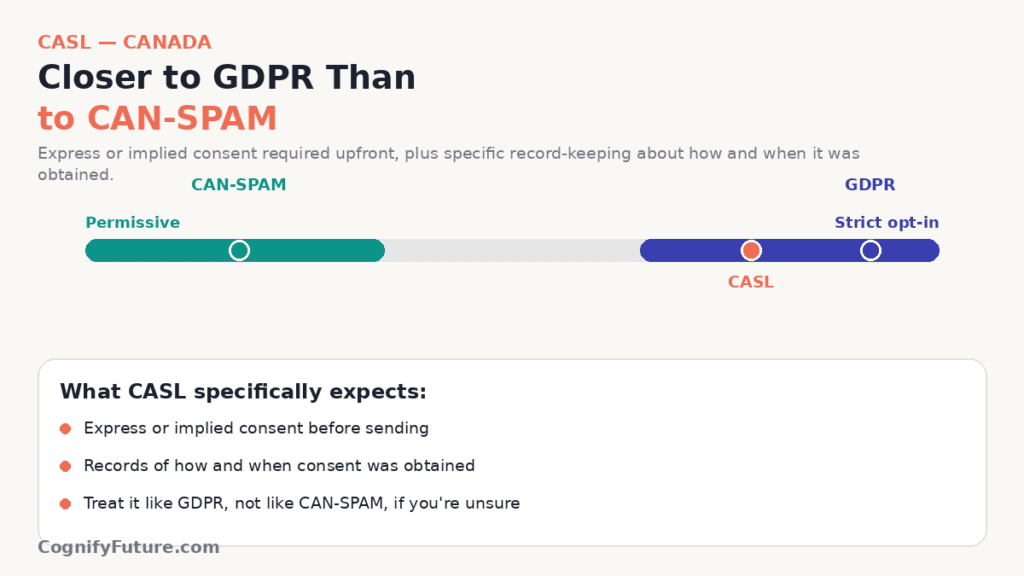
Canada’s Anti-Spam Legislation (CASL) is closer to GDPR’s approach than CAN-SPAM’s, generally requiring express or implied consent before sending commercial electronic messages, with specific record-keeping expectations around how and when that consent was obtained. If you have Canadian subscribers, it’s worth treating CASL’s consent bar as closer to GDPR’s stricter standard than to CAN-SPAM’s more permissive one.
The Common Thread Across All Major Frameworks
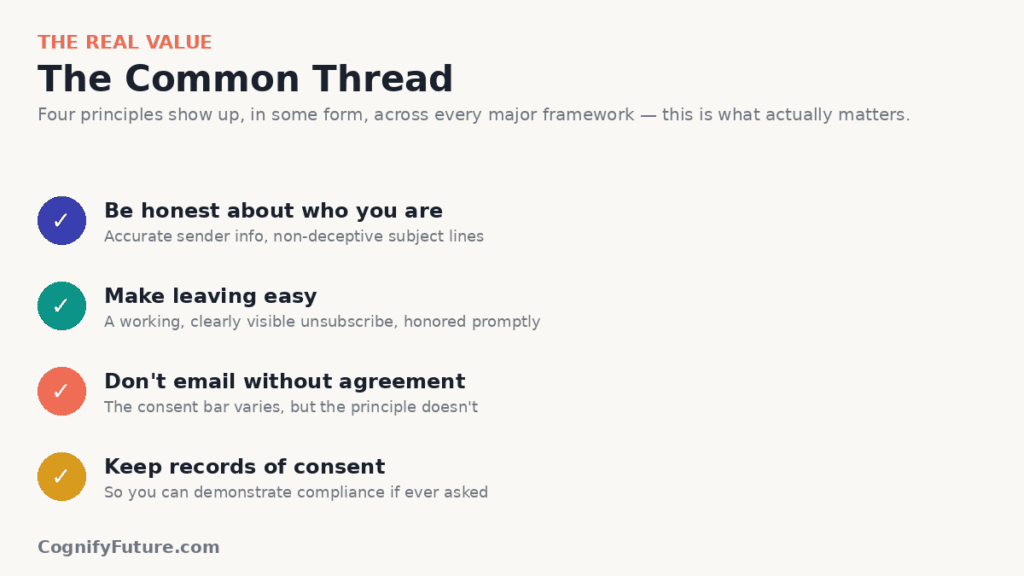
Despite differing in specific mechanics, every major framework converges on the same handful of underlying principles, which is genuinely useful news for a small business trying to build one reasonable compliance posture rather than navigating each regulation as an entirely separate checklist:
- Be honest about who you are. Accurate sender information and non-deceptive subject lines are required, in some form, across every framework discussed here.
- Make leaving easy. A working, clearly visible unsubscribe mechanism, honored promptly, is universal across these frameworks even when the specific honoring timeframe differs.
- Don’t email people who never agreed to hear from you, with the bar for what counts as genuine agreement varying (opt-in required upfront under GDPR and CASL, more permissive but still requiring an easy opt-out under CAN-SPAM).
- Keep records of consent where required, so you can demonstrate compliance if ever asked, rather than relying on memory or assumption about how a given subscriber joined your list.
A Practical Compliance Baseline for Small Senders
If you’re a small business or blog without dedicated legal counsel, building toward the stricter end of these requirements (rather than the minimum any single framework requires) is a reasonable, low-risk approach, since it tends to satisfy the more permissive frameworks automatically while protecting you if your list includes subscribers from stricter jurisdictions you didn’t specifically anticipate.
- Use clear, unambiguous opt-in consent for every signup, rather than pre-checked boxes or vague bundled consent in broader terms
- Keep a record of when and how each subscriber consented, even if it’s just a timestamp and signup source
- Use accurate sender information and a real reply-to address, not a no-reply address that can’t be responded to
- Write subject lines that genuinely reflect the email’s content
- Include a clear, working, one-click unsubscribe option in every commercial email, and honor requests promptly
- Have a simple process ready for handling a data access or deletion request, even if you’ve never received one yet
A working unsubscribe mechanism also directly protects your deliverability see our Why Emails Go to Spam in 2026 guide for how this connects to spam complaint rates and sender reputation.
How This Connects to List Building
Compliance and good list-building practice overlap almost entirely, which is a useful thing to realize: the same genuine, explicit opt-in process that satisfies GDPR’s consent standard also produces a healthier, more engaged list overall, since people who explicitly chose to join tend to engage better than those added through a more passive or assumed consent process.
Our How to Grow an Email List in 2026 guide covers list-building tactics that are compliant by design, since every tactic discussed there relies on genuine, explicit opt-in rather than any of the riskier shortcuts.
What’s the Actual Risk of Non-Compliance?
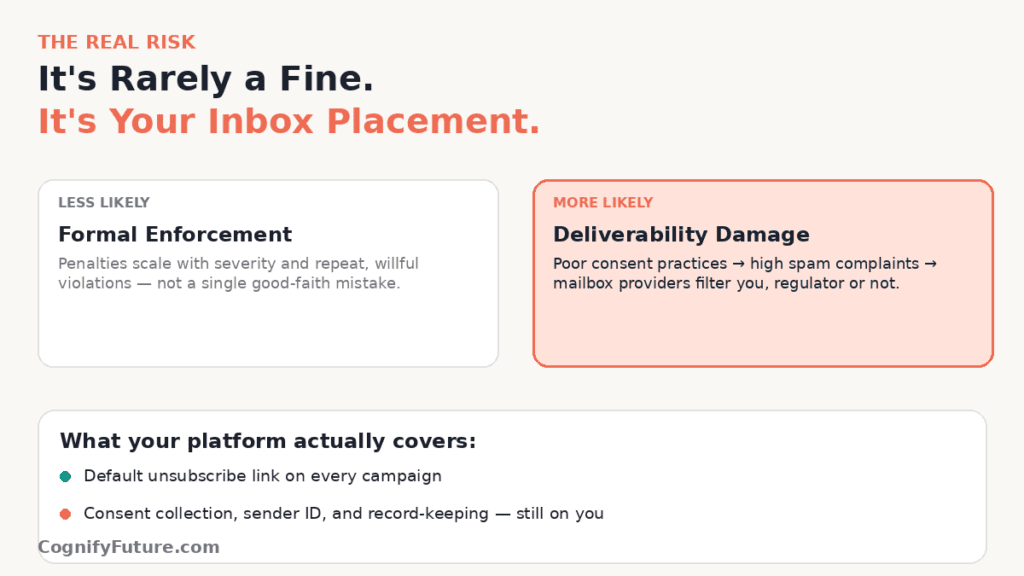
Enforcement and penalty structures vary significantly by framework and jurisdiction, and specific penalty amounts change over time, so it’s worth researching current figures for your specific situation rather than relying on a number that may be outdated. What’s consistent across frameworks is that penalties are generally structured to scale with severity and repeat or willful violations, rather than being purely punitive for a single, good-faith mistake.
For most small businesses operating in good faith with a reasonable compliance baseline in place, the more immediate practical risk isn’t typically formal enforcement it’s the reputational and deliverability damage from poor consent practices showing up as high spam complaint rates, which mailbox providers penalize through filtering regardless of whether a regulatory body ever gets involved.
If Your Platform Handles Some of This For You
Most established email marketing platforms include built-in tooling that handles some compliance mechanics automatically a default unsubscribe link added to every campaign, for instance. This is genuinely helpful, but it’s worth understanding that platform-provided defaults handle some specific requirements, not your entire compliance posture. Consent collection at signup, accurate sender identification, and record-keeping around how consent was obtained are typically still your responsibility to set up correctly, regardless of what your platform automates by default.
Final Verdict
Email compliance across GDPR, CAN-SPAM, and CASL converges on a consistent set of underlying principles more than the differing acronyms and specific mechanics might suggest: be honest about who you are, make leaving easy, and respect the consent standard required by wherever your subscribers actually are, which in practice often means building toward the stricter end (closer to GDPR and CASL’s opt-in standard) rather than the more permissive minimum any single framework technically allows.
For most small businesses, a reasonable compliance baseline isn’t complicated to build, and it overlaps substantially with good list-building and deliverability practice already covered elsewhere. If your situation involves sensitive data, a regulated industry, or genuine uncertainty about your specific exposure, that’s the point to bring in legal counsel rather than relying on general guidance like this.
1. Does GDPR apply to my business if I’m not based in Europe?
Generally yes, if you have subscribers located in the EU or UK. GDPR’s reach is typically determined by where your subscribers are located, not where your business is based or incorporated, so businesses outside Europe with European subscribers usually still need to comply.
2. What’s the difference between GDPR and CAN-SPAM consent requirements?
GDPR generally requires explicit opt-in consent before adding someone to a marketing list. CAN-SPAM (the US standard) doesn’t require opt-in consent upfront but requires a clear, working opt-out mechanism and several honesty-based requirements like accurate sender information and non-deceptive subject lines.
3. Is a pre-checked consent checkbox compliant with GDPR?
Generally no. GDPR’s consent standard typically requires a clear, specific, affirmative action from the subscriber, and a pre-checked box or consent bundled vaguely into broader terms of service usually doesn’t meet that standard.
4. What does CASL require for Canadian email subscribers?
CASL generally requires express or implied consent before sending commercial electronic messages, along with specific record-keeping expectations about how and when consent was obtained. Its consent bar is closer to GDPR’s stricter opt-in standard than to CAN-SPAM’s more permissive approach.
5. What are the universal requirements across GDPR, CAN-SPAM, and CASL?
Accurate sender identification, non-deceptive subject lines, a working and honored unsubscribe mechanism, and respecting whatever consent standard applies to a given subscriber’s location are common threads across all three major frameworks, even though specific mechanics differ.
6. Should I build my email compliance around the strictest standard even if it doesn’t fully apply to me?
It’s a reasonable, low-risk approach for small businesses without dedicated legal counsel, since building toward the stricter end (GDPR and CASL’s opt-in standard) tends to satisfy more permissive frameworks automatically and protects against subscribers from stricter jurisdictions you didn’t specifically anticipate.
7. Does my email platform handle compliance for me automatically?
Partially. Most platforms include some built-in tooling, like a default unsubscribe link, but consent collection at signup, accurate sender identification, and record-keeping around how consent was obtained are typically still the sender’s responsibility to set up correctly.
8. Is this guide a substitute for legal advice on email compliance?
No. This guide explains general, common principles across major email regulations, but isn’t a substitute for legal advice specific to your business, subscriber locations, and jurisdiction. Businesses handling sensitive data or operating in regulated industries should consult a qualified attorney.





I am Ashish Yadav a software engineer and AI tools researcher with over five years of practical experience working with real-world systems and automation. I am founder of CognifyFuture, where I analyzes, tests, and breaks down AI tools with a focus on what actually works—not what’s trending.
My content is built on hands-on usage, not theory. Instead of generic advice, I focuses on real implementation—how AI tools can be used to automate tasks, improve efficiency, and solve any specific business or individual problems.
Through CognifyFuture, My aims is to eliminate confusion around AI by delivering clear, honest, and actionable insights that help users make smarter technology decisions.