
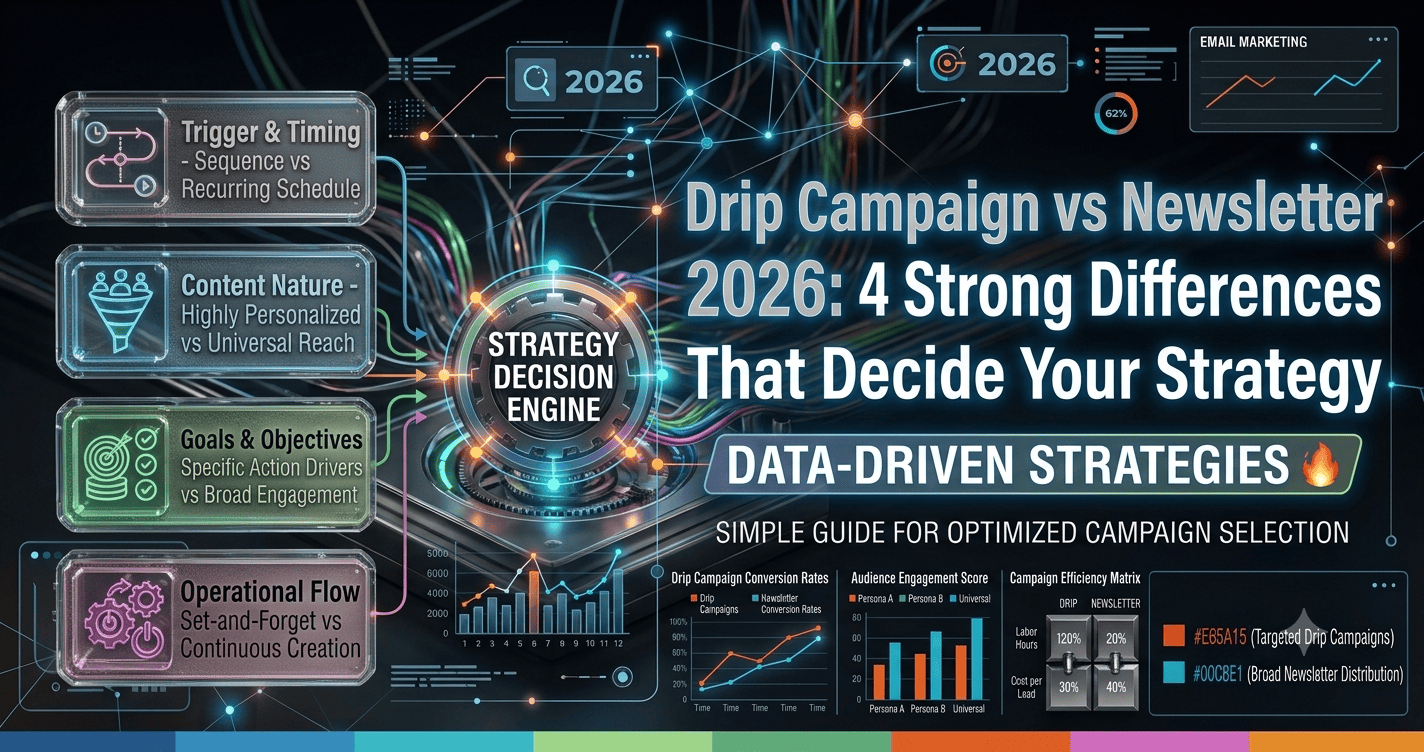
Should that next email be part of an automated drip, or a one-off newsletter send?
The two get confused constantly because both are “emails sent to a list,” but they solve fundamentally different problems: a drip campaign moves someone through a specific, predetermined sequence triggered by their own timeline, while a newsletter delivers shared, timely content to everyone on a list at the same calendar moment. Using one where the other belongs is a common, quietly costly mistake a newsletter trying to do a drip’s job loses the individualized timing that makes drips effective, while a drip trying to do a newsletter’s job either repeats stale content or requires constant rebuilding to stay current.
I went through Drip Campaign vs Newsletter where each format genuinely fits to answer the questions that come up when this distinction feels unclear:
- What exactly separates a drip campaign from a newsletter, structurally?
- Can the same email ever work as both?
- Which one should a new subscriber receive first?
- Do you need both, or can a small business get by with just one?
Short answer: drip campaigns are individually triggered, sequential, and built once to run indefinitely (welcome sequences, onboarding flows, abandoned cart). Newsletters are shared, timely, and built fresh for each send (weekly updates, content roundups, time-sensitive announcements). Most mature email programs use both, with drips handling the predictable, repeatable moments and newsletters handling the ongoing, evolving relationship. Below, I’ll break down exactly where the line falls.
The Core Structural Difference
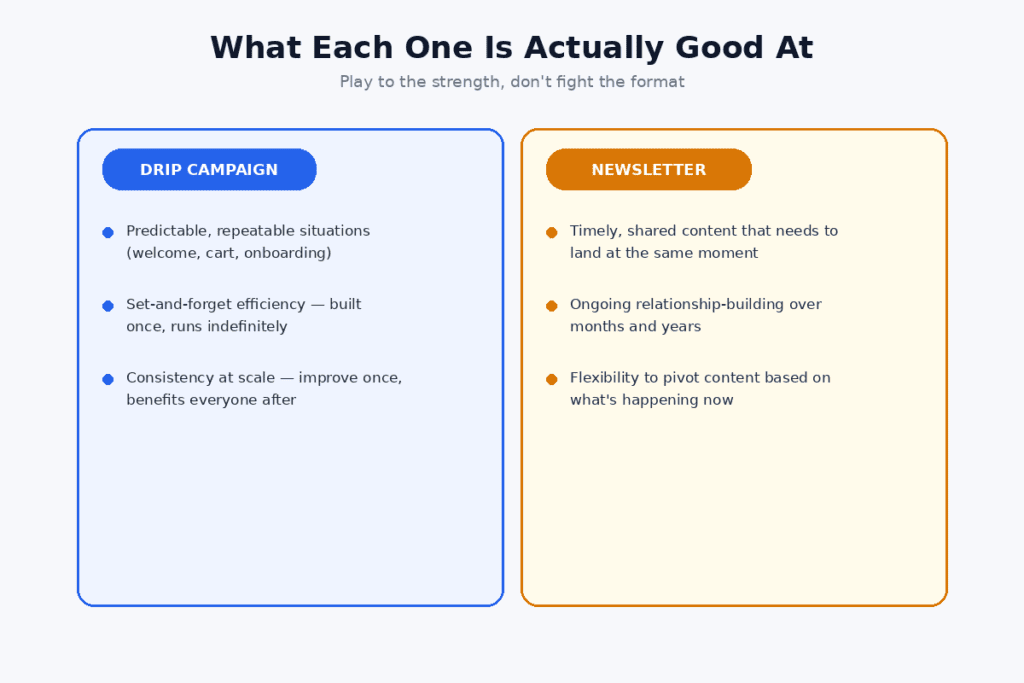
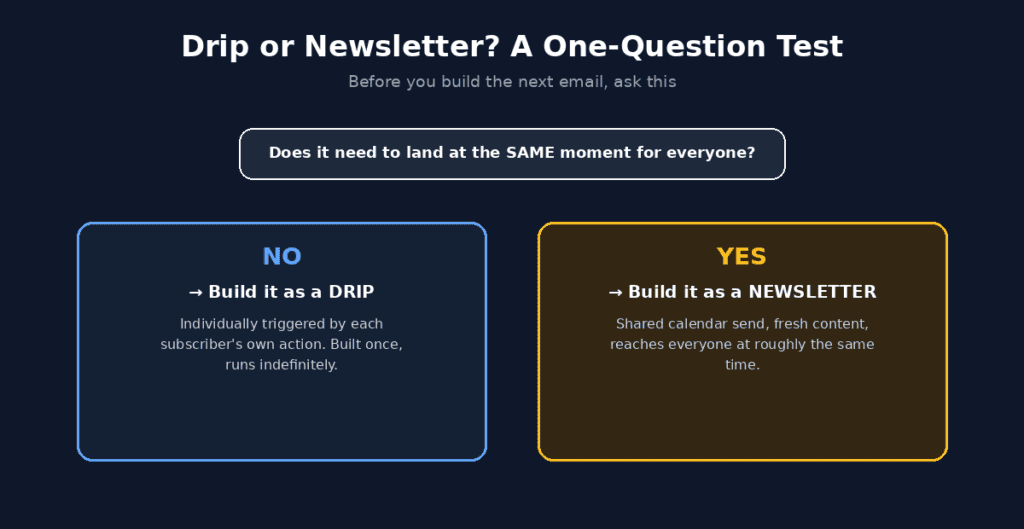
A drip campaign is triggered individually each subscriber starts the sequence relative to their own action (signing up, making a purchase, abandoning a cart), and the content itself rarely changes over time, since it’s built once to handle a predictable, recurring situation. Subscriber A and subscriber B might both be “in” the same welcome drip, but on entirely different calendar days relative to when each of them actually joined.
A newsletter is sent on a shared calendar schedule to everyone on the list (or a segment of it) at the same time, and the content is typically fresh for each send this week’s update, this month’s roundup, a timely announcement. The defining feature isn’t frequency or formality; it’s that the content and timing are shared across recipients rather than individually triggered.
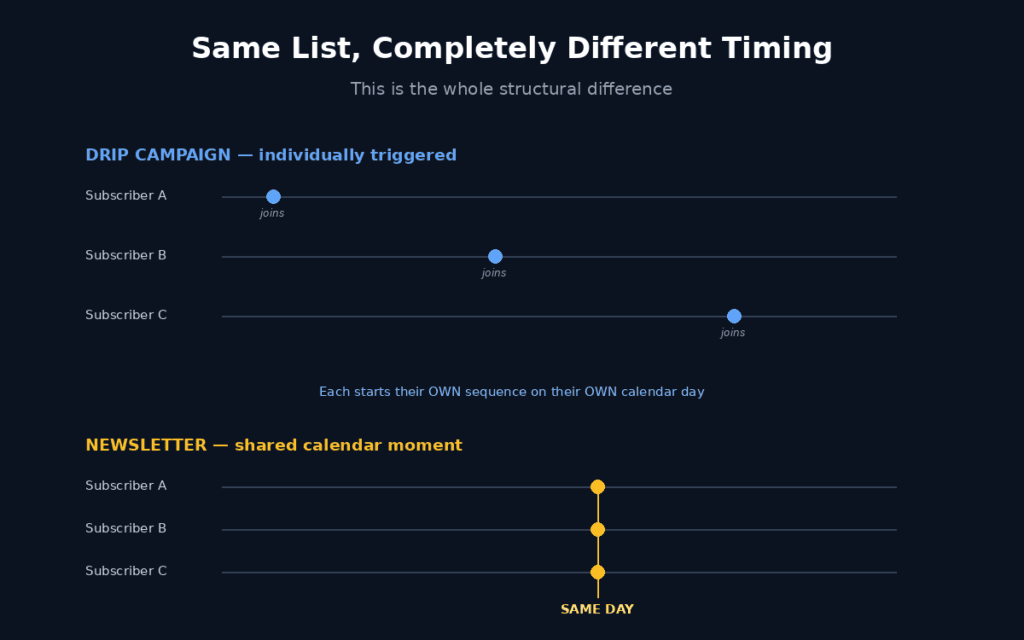
Drip Campaign vs Newsletter : What Drip Campaigns Are Actually Good At
Predictable, Repeatable Situations
A welcome sequence, an abandoned cart flow, a post-purchase follow-up, or a trial-onboarding sequence all describe situations that happen repeatedly, in essentially the same shape, for every new subscriber or customer. Building this once as a drip means it runs indefinitely without ongoing manual effort, consistently delivering the same proven structure to everyone who enters it.
Our Best Welcome Email Sequences 2026 and Abandoned Cart Email Flow Guide 2026 guides cover two of the most common, highest-impact drip campaign types in detail.
Set-and-Forget Efficiency
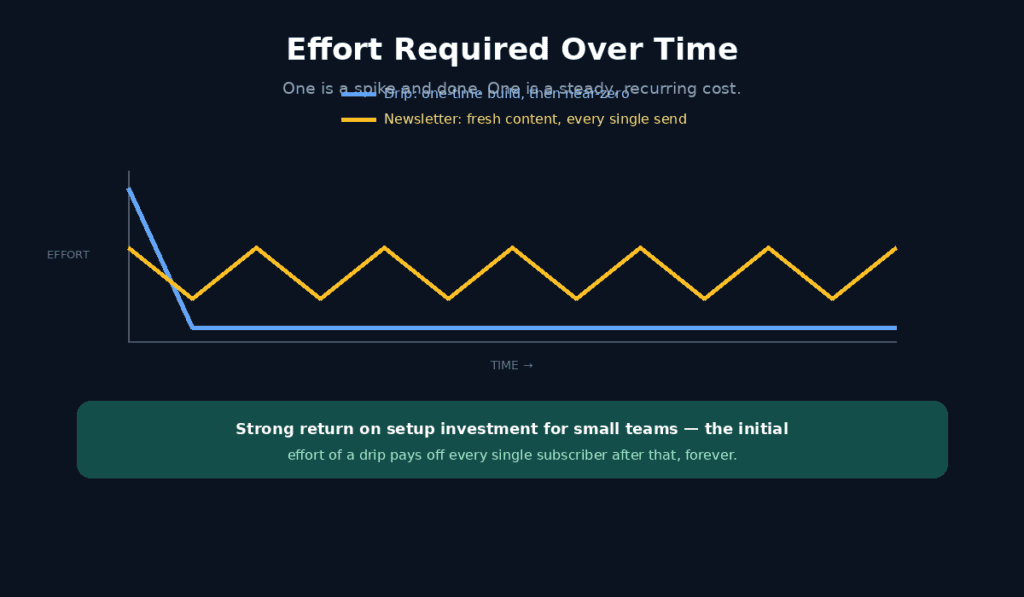
Once a drip is built and tested, it requires far less ongoing maintenance than a newsletter, since the content doesn’t need refreshing for each new entrant the way a newsletter needs fresh content for each new send. This makes drips a strong return on the initial setup investment, particularly for small teams without capacity to produce frequent fresh content.
Consistency at Scale
Every new subscriber receives the same well-tested sequence, which means you can refine and improve it over time based on aggregate performance data, and every future subscriber benefits from those improvements automatically, without you needing to manually apply lessons learned to each new person individually.
What Newsletters Are Actually Good At
Timely, Shared Content
An update about something happening right now, a roundup of recent content, or a time-sensitive announcement all need to reach everyone at roughly the same moment to be relevant, which is precisely what a drip’s individually-triggered, evergreen structure isn’t built for.
Ongoing Relationship-Building
Once a subscriber has moved past the predictable, repeatable early-relationship moments a drip handles well, an ongoing newsletter is what keeps the relationship alive over months and years sharing what’s new, responding to current events relevant to your audience, and generally adapting content to what’s actually happening rather than following a fixed, predetermined script.
Flexibility to Respond and Adapt
A newsletter can pivot its content based on what’s currently relevant, recent feedback, or a sudden need to communicate something specific, in a way a fixed drip sequence structurally can’t without manual intervention to pause or modify the sequence for everyone currently in it.
Can the Same Email Work as Both?
Not really, and trying to force one format into the other’s job usually produces a worse result than committing fully to one structure. A “newsletter” that’s actually just a recurring drip with no real new content quickly starts to feel stale and repetitive to subscribers who’ve been on the list a while, since they’re effectively seeing variations of the same evergreen message indefinitely.
Conversely, trying to make a drip sequence feel timely and current (referencing “this week” or “right now” inside fixed, evergreen drip content) creates a mismatch that becomes obvious and slightly confusing once a new subscriber enters the sequence months after the content was originally written, since the timely-sounding language no longer matches reality.
Which Should a New Subscriber Receive First?
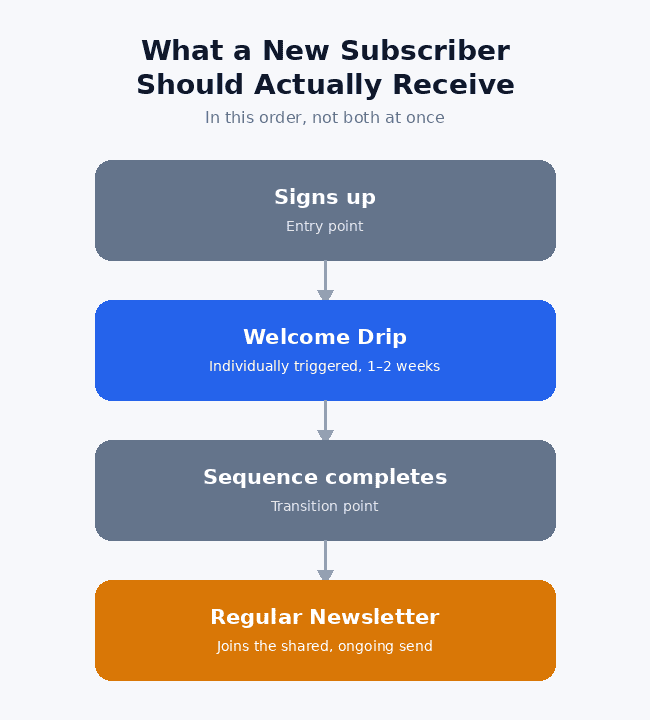
Generally, the drip (specifically, a welcome sequence) should come first, since it’s individually triggered by the signup itself and designed specifically for someone brand new to your list. A reasonable structure: a new subscriber enters the welcome drip immediately upon signing up, and once that sequence completes (typically 1-2 weeks later), they transition into receiving your regular ongoing newsletter alongside everyone else.
This sequencing avoids a common awkward overlap: a new subscriber receiving both a generic newsletter that assumes existing familiarity with your brand and a welcome sequence introducing that same brand, at the same time, with neither feeling quite right for where they actually are in the relationship.
Drip Campaign vs Newsletter : Practical Use Case: Do You Need Both?
A Content-Driven Blog or Publication
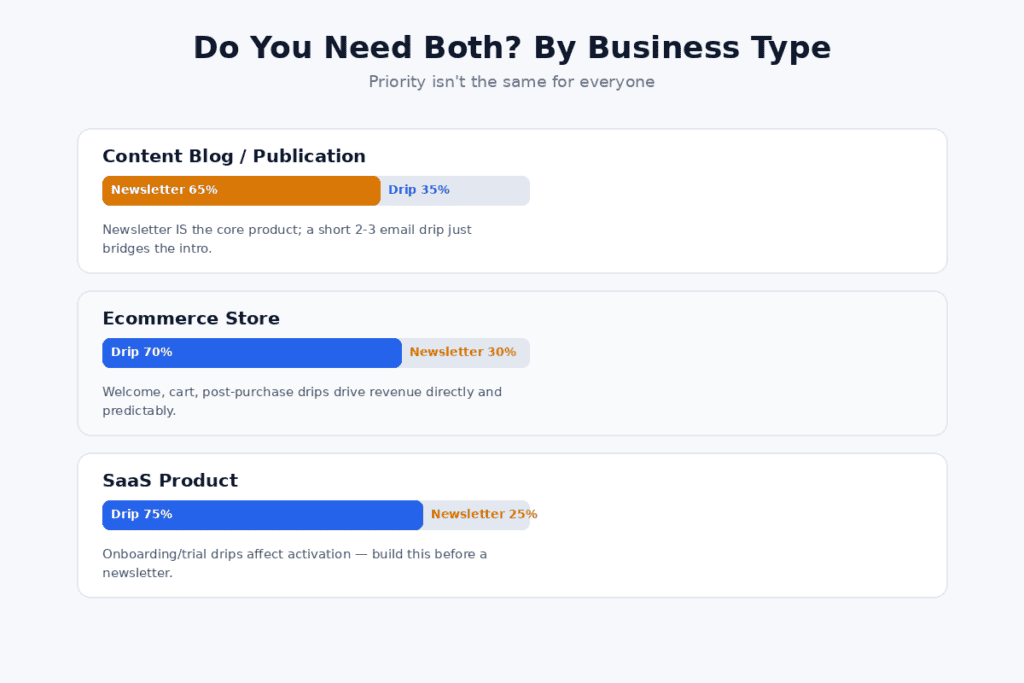
Both matter here, but the newsletter is typically the primary ongoing relationship, with a simpler welcome drip (perhaps just 2-3 emails) serving as a brief introduction before transitioning new subscribers into the regular newsletter rhythm.
An Ecommerce Store
Drips tend to carry more of the practical weight here welcome sequence, abandoned cart, post-purchase since these directly drive revenue in predictable, repeatable ways. A newsletter is still valuable for ongoing engagement and brand-building, but it’s often a smaller piece of the overall email strategy compared to a content business, where the newsletter usually is the core product.
A SaaS Product
Onboarding and trial-related drips tend to be the highest-priority build, since they directly affect activation and conversion in a predictable, repeatable way for every new signup. A newsletter (product updates, feature announcements, customer stories) is valuable for retention and ongoing engagement, but typically secondary in setup priority to getting the onboarding drip right first.
A Hybrid Worth Knowing: RSS-to-Email or Content Digests
Some platforms support a hybrid format that automatically compiles recent content (blog posts, updates) into a recurring email without manual rebuilding for each send. This sits closer to a newsletter in spirit (it’s shared, timely, and reflects current content) but is automated in its assembly, similar to a drip. This can be a useful middle ground for content-heavy sites that want consistent sending without manually composing every single newsletter from scratch, though it generally still benefits from some manual editorial touch rather than running entirely on autopilot.
Final Verdict
Drip campaigns and newsletters solve different problems well, and the confusion between them usually comes from both being “an email sent to a list” at a surface level, while differing completely in timing structure and purpose underneath. Drips excel at predictable, repeatable, individually-triggered moments welcome sequences, onboarding, abandoned cart built once and left to run. Newsletters excel at timely, shared, evolving content that needs to reach everyone at roughly the same moment and adapt to what’s currently relevant.
Most mature email programs eventually use both, with drips handling the early-relationship and transactional moments and a newsletter carrying the ongoing relationship forward afterward. If you’re only running one right now, the predictable-moment drips (especially a welcome sequence) are usually the higher-leverage place to start, given how disproportionately well they tend to perform relative to the one-time setup effort required.
1. What is the main difference between a drip campaign and a newsletter?
A drip campaign is individually triggered by each subscriber’s own action (like signing up) and uses largely fixed, evergreen content. A newsletter is sent on a shared calendar schedule to everyone at the same time, with content that’s typically fresh and timely for each send.
2. Can the same email work as both a drip and a newsletter?
Not effectively. Trying to make a drip feel timely creates a mismatch once new subscribers enter months later and the timely-sounding content no longer reflects reality. Trying to make a newsletter function like a fixed drip tends to feel stale and repetitive to long-term subscribers.
3. Should a new subscriber receive a drip or a newsletter first?
Generally a welcome drip first, since it’s individually triggered specifically for someone new to your list. A common structure has new subscribers complete the welcome drip (often 1-2 weeks) before transitioning into the regular ongoing newsletter alongside existing subscribers.
4. Do small businesses need both drip campaigns and newsletters?
Most mature email programs eventually use both, but priority varies by business type. Ecommerce and SaaS businesses often benefit most from prioritizing drips (welcome, onboarding, abandoned cart) first, while content-driven businesses often treat the newsletter as the primary ongoing relationship.
5. What are good examples of drip campaigns?
Welcome sequences, abandoned cart flows, post-purchase follow-ups, and trial onboarding sequences are common drip campaign examples. All describe predictable, repeatable situations that happen the same way for every new subscriber or customer.
6. What are good examples of newsletter content?
Weekly or monthly updates, roundups of recent content, time-sensitive announcements, and any content that needs to reach everyone at roughly the same moment to remain relevant are well-suited to a newsletter’s shared, timely format.
7. Which is more efficient to maintain, a drip campaign or a newsletter?
Drip campaigns generally require less ongoing maintenance once built and tested, since the same content serves every new entrant indefinitely. Newsletters require fresh content for each send, making them a more ongoing time investment.
8. What is an RSS-to-email or content digest, and how does it fit in?
It’s a hybrid format that automatically compiles recent content into a recurring email without manual rebuilding for each send. It sits closer to a newsletter in spirit (shared, timely) but is automated in assembly like a drip, useful for content-heavy sites wanting consistent sending without composing every newsletter from scratch.





I am Ashish Yadav a software engineer and AI tools researcher with over five years of practical experience working with real-world systems and automation. I am founder of CognifyFuture, where I analyzes, tests, and breaks down AI tools with a focus on what actually works—not what’s trending.
My content is built on hands-on usage, not theory. Instead of generic advice, I focuses on real implementation—how AI tools can be used to automate tasks, improve efficiency, and solve any specific business or individual problems.
Through CognifyFuture, My aims is to eliminate confusion around AI by delivering clear, honest, and actionable insights that help users make smarter technology decisions.