
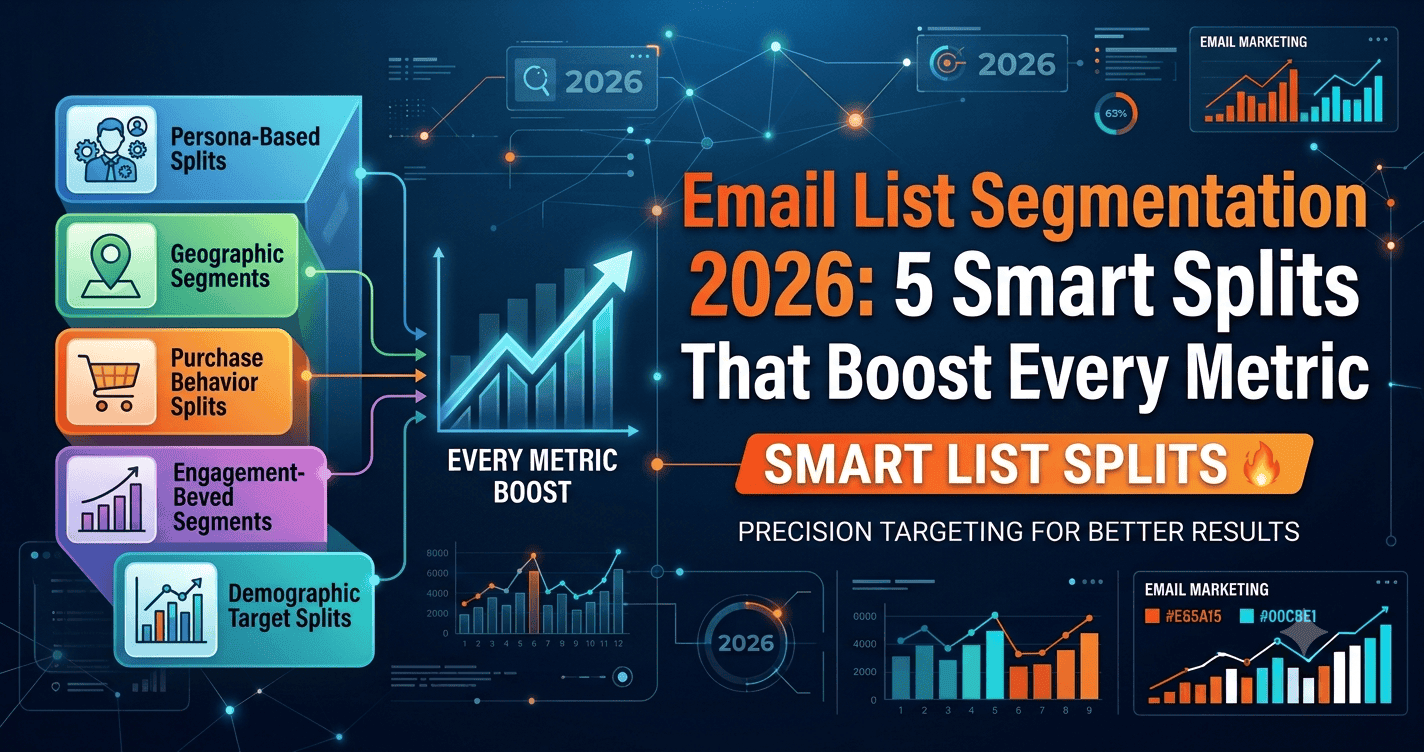
Why does the exact same email perform brilliantly with one part of your list and fall completely flat with another?
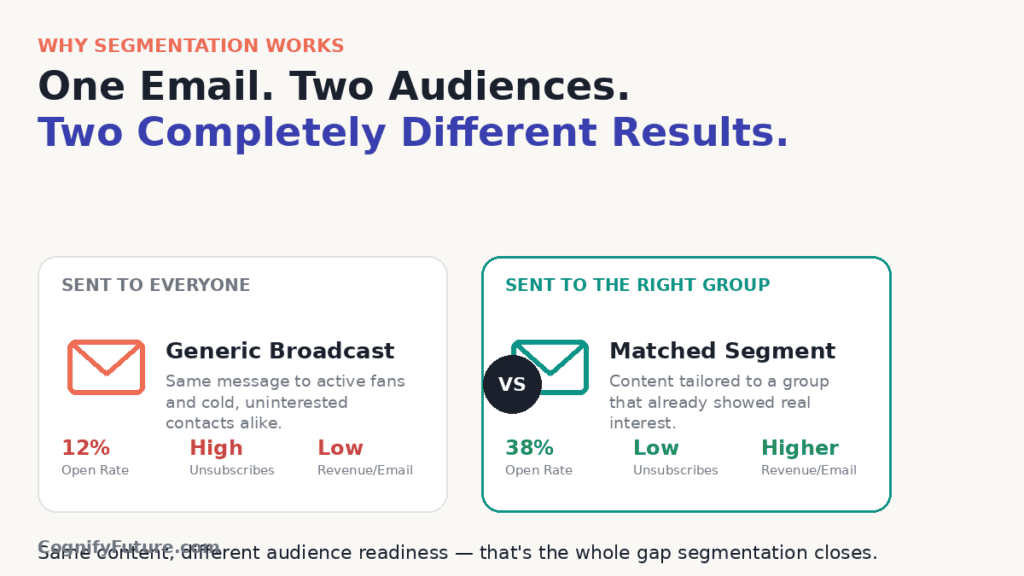
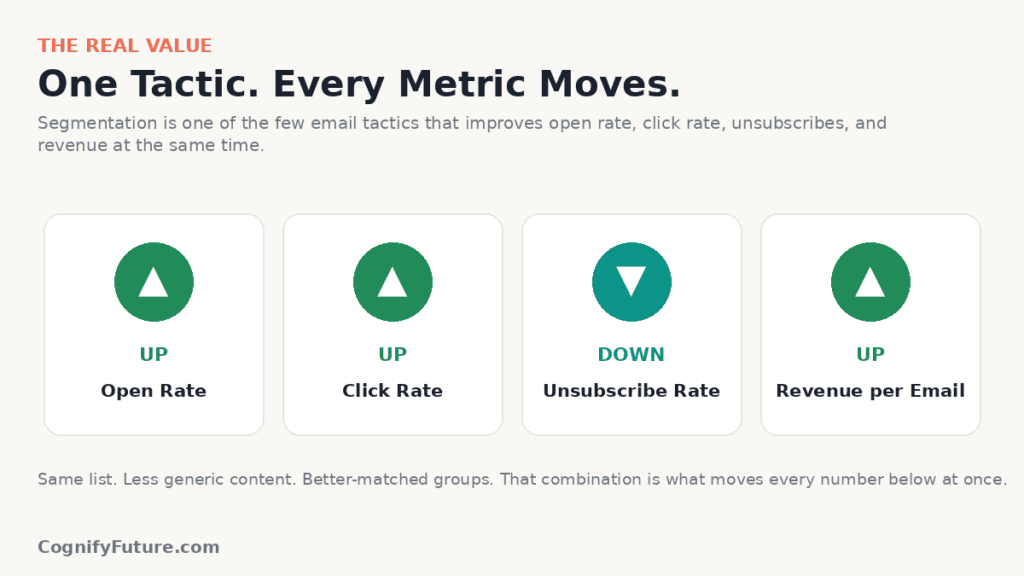
Because that “one part of your list” probably shouldn’t have received the same email in the first place. Segmentation dividing your subscribers into meaningful groups and tailoring what each group receives is one of the few email marketing tactics that consistently moves every major metric at once: higher open rates, higher click rates, lower unsubscribe rates, and better revenue per email, all from sending less generic content to more specifically matched groups.
I went through the segmentation approaches that actually move these numbers, separating genuinely useful splits from overly complex ones that aren’t worth the setup effort, to answer the questions that matter:
- What are the simplest, highest-impact segments to start with?
- How granular should segmentation actually get before it’s diminishing returns?
- What’s the difference between segmentation and personalization?
- How do you actually build segments without a huge list or sophisticated data?
Short answer: start with engagement-based segmentation (active vs inactive subscribers) since it’s the simplest and highest-impact split available to almost any list. Layer in behavioral segments (purchase history, content interests, signup source) once the basics are working. Avoid over-segmenting into dozens of tiny groups before you have the list size or content volume to actually serve them differently. Below, I’ll walk through the segments worth building, in priority order.
Segmentation vs Personalization: A Quick Distinction
These two terms get used interchangeably, but they’re different layers of the same idea. Segmentation is dividing your list into groups and sending different content or campaigns to each group. Personalization is inserting individual-level details (a first name, a specific product recently viewed) into an otherwise shared email template.
Both matter, but segmentation generally has a larger impact on performance, since it changes what content someone receives, not just how it’s addressed to them. A perfectly personalized email with irrelevant content for that subscriber’s interests will still underperform a less personalized but genuinely well-matched, segmented one.
1. Engagement Segmentation: The Simplest, Highest-Impact Split
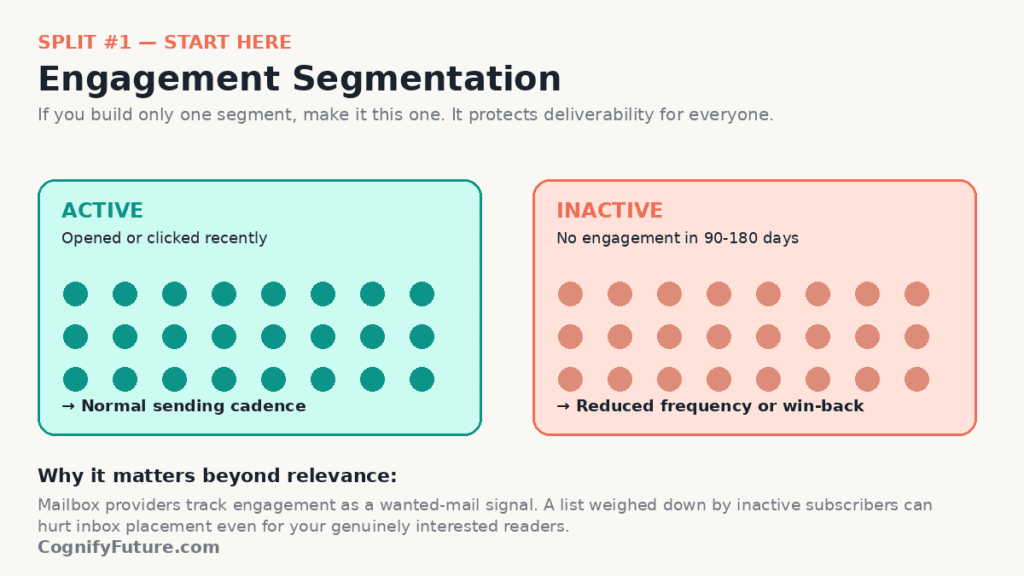
If you build only one segment, make it this one. Divide your list into active subscribers (people who’ve opened or clicked recently) and inactive subscribers (people who haven’t engaged in a meaningful stretch of time, commonly 90-180 days depending on your sending frequency).
This single split has an outsized impact on deliverability, not just relevance. Mailbox providers track engagement as a signal of whether your mail is wanted; a list weighed down by inactive subscribers drags down your overall engagement rate and can hurt inbox placement even for the genuinely interested portion of your list. Sending less frequently (or running a distinct re-engagement campaign) to the inactive segment, while maintaining normal frequency for the active segment, protects deliverability for the subscribers who actually want to hear from you.
If deliverability is a concern alongside segmentation, our Why Emails Go to Spam in 2026 guide covers how engagement signals affect inbox placement in more depth.
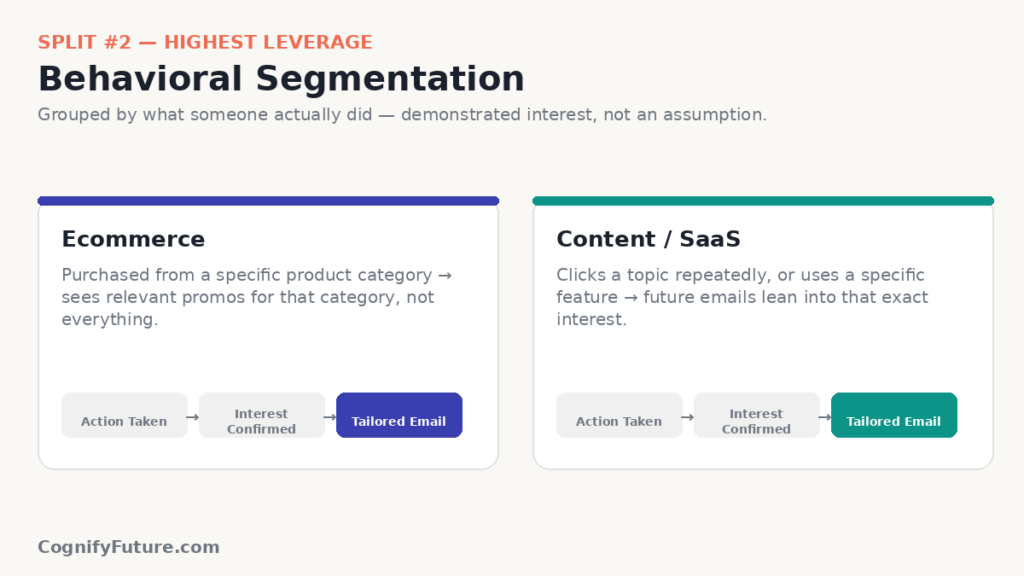
2. Behavioral Segmentation: What Someone Actually Did
Behavioral segments are based on actions a subscriber has taken purchase history, specific pages or products viewed, content categories clicked on, or features used if you’re a SaaS product. This is generally the highest-leverage segmentation type once you have engagement segmentation in place, since it directly reflects demonstrated interest rather than an assumption.
For an ecommerce store, this might mean separating customers who’ve purchased from a specific category from those who haven’t, so a relevant promotion reaches people who’ve already shown interest in that type of product. For a content business, it might mean tracking which topics someone clicks on most, so future emails lean into the subjects that specific subscriber has demonstrated genuine interest in over time.
3. Lifecycle Segmentation: Where Someone Is in Their Relationship With You
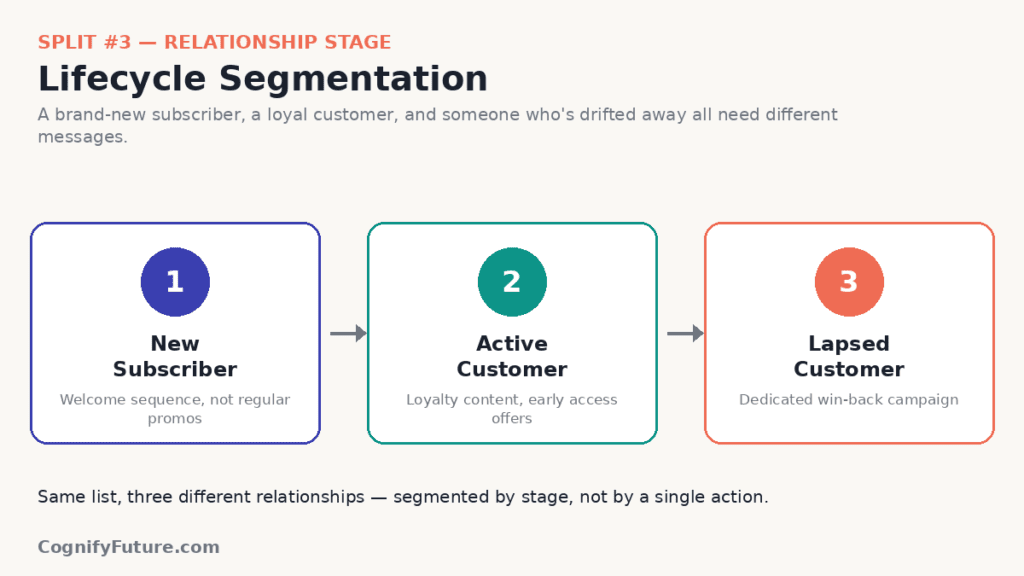
A brand-new subscriber, a long-time engaged customer, and someone who hasn’t purchased in over a year all warrant fundamentally different messaging, even if they’re technically on the same list. Lifecycle segmentation groups subscribers by this relationship stage rather than by a specific action or engagement level alone.
New subscribers typically receive a welcome sequence rather than your regular promotional cadence. Long-time customers might receive loyalty-focused content or early access offers. Lapsed customers (people who haven’t engaged or purchased in a meaningful stretch) often warrant a distinct win-back campaign rather than your standard newsletter, since standard content hasn’t been working for that group already.
4. Source Segmentation: How Someone Joined Your List
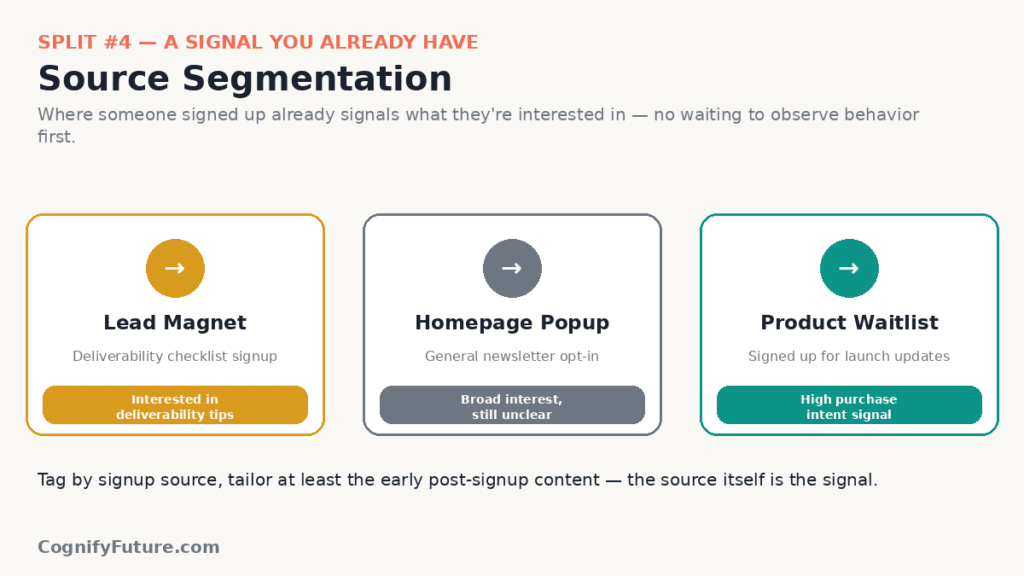
Where someone signed up often signals what they’re actually interested in. A subscriber who joined through a specific lead magnet about email deliverability likely has a different primary interest than one who joined through a general homepage popup. Tagging subscribers by signup source and tailoring at least the early post-signup content accordingly tends to improve relevance without requiring any behavioral data yet, since you don’t need to wait and observe what they do the source itself is already a meaningful signal.
5. Demographic Segmentation: Use Sparingly Unless Genuinely Relevant
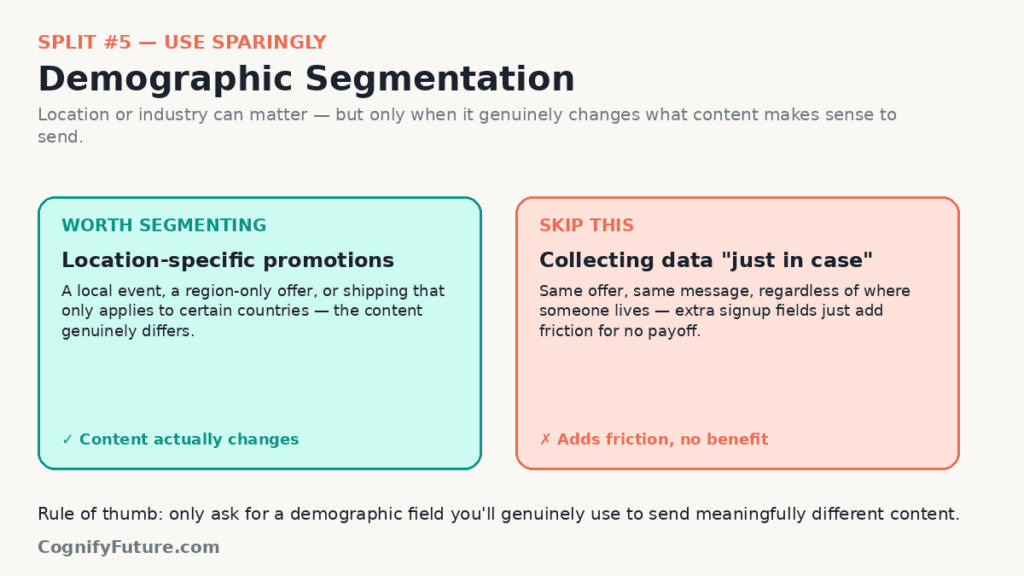
Splitting by location, industry, or other demographic data can be valuable, but only when it genuinely affects what content makes sense to send. A geographic split makes obvious sense for a business with location-specific promotions or events; it adds little value if your offering and messaging are identical regardless of where a subscriber lives.
Resist collecting demographic data just because it’s available or easy to ask for at signup. Every additional field on a signup form is friction that can reduce conversion, so only ask for demographic information you’ll genuinely use to send meaningfully different content.
Practical Use Case: A Simple Starting Segmentation Setup
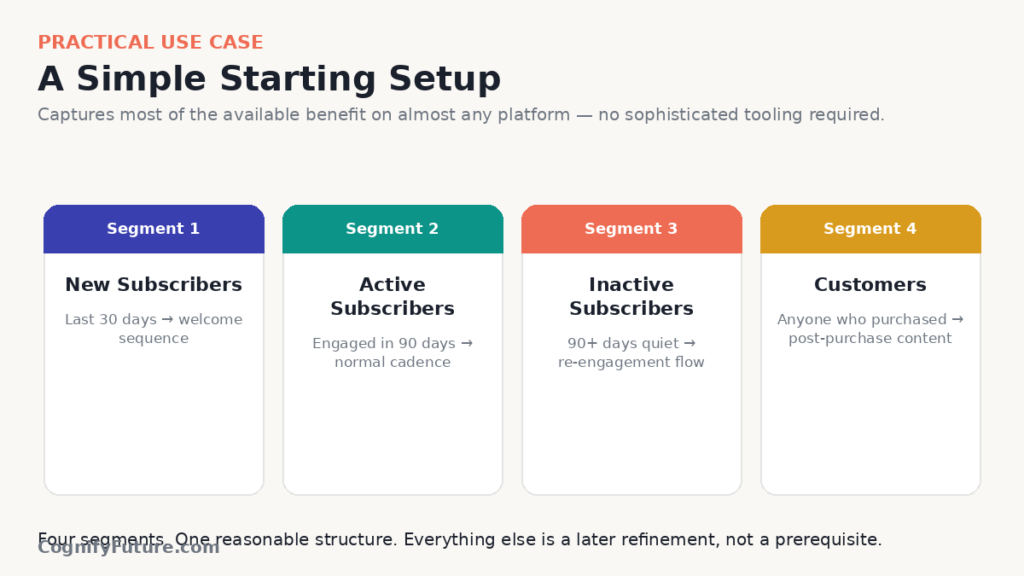
If you’re starting from an unsegmented list and feeling unsure where to begin, this is a reasonable, low-effort first setup that captures most of the available benefit without requiring sophisticated tooling.
- Segment 1 New subscribers (last 30 days): Receiving your welcome sequence rather than regular campaigns
- Segment 2 Active subscribers: Engaged within the last 90 days, receiving your normal sending cadence and content
- Segment 3 Inactive subscribers: No engagement in 90+ days, receiving either a reduced frequency or a dedicated re-engagement campaign instead of standard content
- Segment 4 Customers (if ecommerce): Anyone who’s purchased, receiving post-purchase content and relevant promotions distinct from what non-customers receive
This four-segment structure is achievable on almost any email platform’s basic automation tools, doesn’t require sophisticated behavioral tracking, and addresses the segments most likely to be receiving genuinely mismatched content in an unsegmented list.
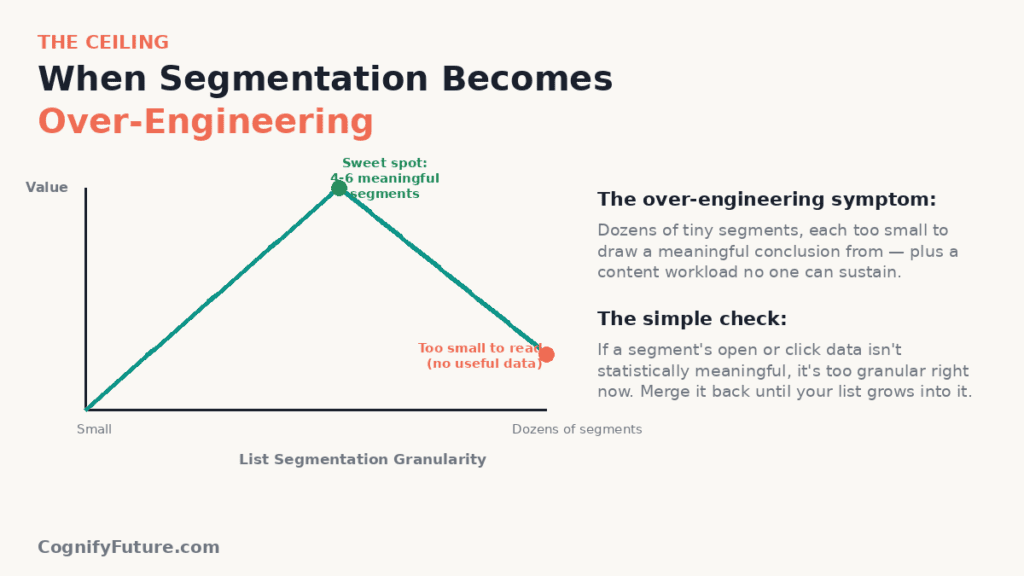
When Segmentation Becomes Over-Engineering
It’s possible to over-segment, and the symptom is usually obvious: dozens of tiny segments, each containing too few subscribers to generate meaningful data about what’s actually working, combined with a content creation burden that’s no longer sustainable since every segment theoretically needs its own tailored version of each campaign.
A useful check: if a segment is too small to draw any statistically meaningful conclusion from its open or click rates, it’s probably too granular to be worth maintaining as a distinct segment right now. Consolidate it into a broader, related segment until your list grows enough that the narrower split becomes genuinely actionable rather than just additional complexity.
How Segmentation Connects to Other Automations
Segmentation isn’t a standalone tactic it’s the foundation that makes several other automations actually effective. A welcome sequence is more effective when new subscribers are clearly segmented from your existing active list, since they need different messaging. An abandoned cart flow is itself a behavioral segment in action, targeting people based on a specific demonstrated action (starting checkout without completing it) rather than sending the same content to your entire list.
See our Best Welcome Email Sequences 2026 and Abandoned Cart Email Flow Guide 2026 guides for two of the most common segmentation-dependent automations in practice.
Platform Considerations for Segmentation
Segmentation capability varies meaningfully between platforms, and this is worth factoring into a platform decision if sophisticated segmentation matters to your specific business. Ecommerce-focused platforms typically offer the deepest behavioral segmentation tied directly to purchase and browsing data, since that’s core to their purpose. General-purpose email platforms vary widely some offer genuinely sophisticated tagging and segment-building tools, while others are limited to basic list splits without much behavioral depth.
If segmentation depth is a priority in your platform choice, our Best Email Marketing Tools for Shopify 2026 guide covers which ecommerce platforms offer the most advanced behavioral segmentation specifically.
Final Verdict
Segmentation is one of the rare email marketing tactics that improves nearly every metric simultaneously, simply by sending more relevant content to better-matched groups instead of the same broadcast to everyone. Start with the simplest, highest-impact split (active vs inactive subscribers), layer in behavioral and lifecycle segments as your list and data mature, and resist the urge to over-segment into dozens of tiny groups before your list is large enough to support that level of granularity.
If you’re starting from a completely unsegmented list, the four-segment structure outlined above (new, active, inactive, customers) captures most of the available benefit without requiring sophisticated tooling or a large time investment to set up. Build from there as you learn what additional splits would genuinely change what content you send, rather than segmenting for its own sake.
1. What is email list segmentation?
Segmentation is dividing your email subscribers into meaningful groups based on shared characteristics, behavior, or engagement level, and tailoring what content each group receives rather than sending the same broadcast email to everyone on your list.
2. What’s the difference between segmentation and personalization?
Segmentation changes what content a group receives based on shared traits or behavior. Personalization inserts individual-level details (like a first name) into an otherwise shared template. Segmentation generally has a larger performance impact since it affects content relevance, not just how an email is addressed.
3. What is the most important segment to start with?
Engagement segmentation (active vs inactive subscribers) is the simplest and highest-impact split available to almost any list. It affects deliverability broadly, since a list weighed down by inactive subscribers can hurt inbox placement even for engaged subscribers.
4. How do I segment my list without sophisticated data or a large list?
Start with a basic four-segment structure: new subscribers (last 30 days), active subscribers (engaged recently), inactive subscribers (no recent engagement), and customers if you sell anything. This requires only basic automation tools available on most platforms, not advanced behavioral tracking.
5. Can you over-segment an email list?
Yes. Dozens of tiny segments, each too small to generate meaningful performance data, combined with an unsustainable content creation burden, is a common over-engineering symptom. If a segment is too small to draw statistically meaningful conclusions from, it’s likely too granular to maintain as distinct right now.
6. What is behavioral segmentation?
Behavioral segmentation groups subscribers by actions they’ve taken, such as purchase history, pages viewed, or content categories clicked. It’s generally the highest-leverage segmentation type after basic engagement segmentation, since it reflects demonstrated interest rather than an assumption.
7. Should I segment by demographic data like location or industry?
Only when it genuinely affects what content makes sense to send, such as location-specific promotions or events. Collecting demographic data just because it’s available adds signup friction without benefit if you won’t actually use it to send meaningfully different content.
8. How does segmentation relate to automations like welcome sequences or abandoned cart flows?
Segmentation is the foundation that makes these automations effective. A welcome sequence works because new subscribers are segmented from the existing active list. An abandoned cart flow is itself a behavioral segment in action, targeting a specific demonstrated action rather than broadcasting to the whole list.





I am Ashish Yadav a software engineer and AI tools researcher with over five years of practical experience working with real-world systems and automation. I am founder of CognifyFuture, where I analyzes, tests, and breaks down AI tools with a focus on what actually works—not what’s trending.
My content is built on hands-on usage, not theory. Instead of generic advice, I focuses on real implementation—how AI tools can be used to automate tasks, improve efficiency, and solve any specific business or individual problems.
Through CognifyFuture, My aims is to eliminate confusion around AI by delivering clear, honest, and actionable insights that help users make smarter technology decisions.