
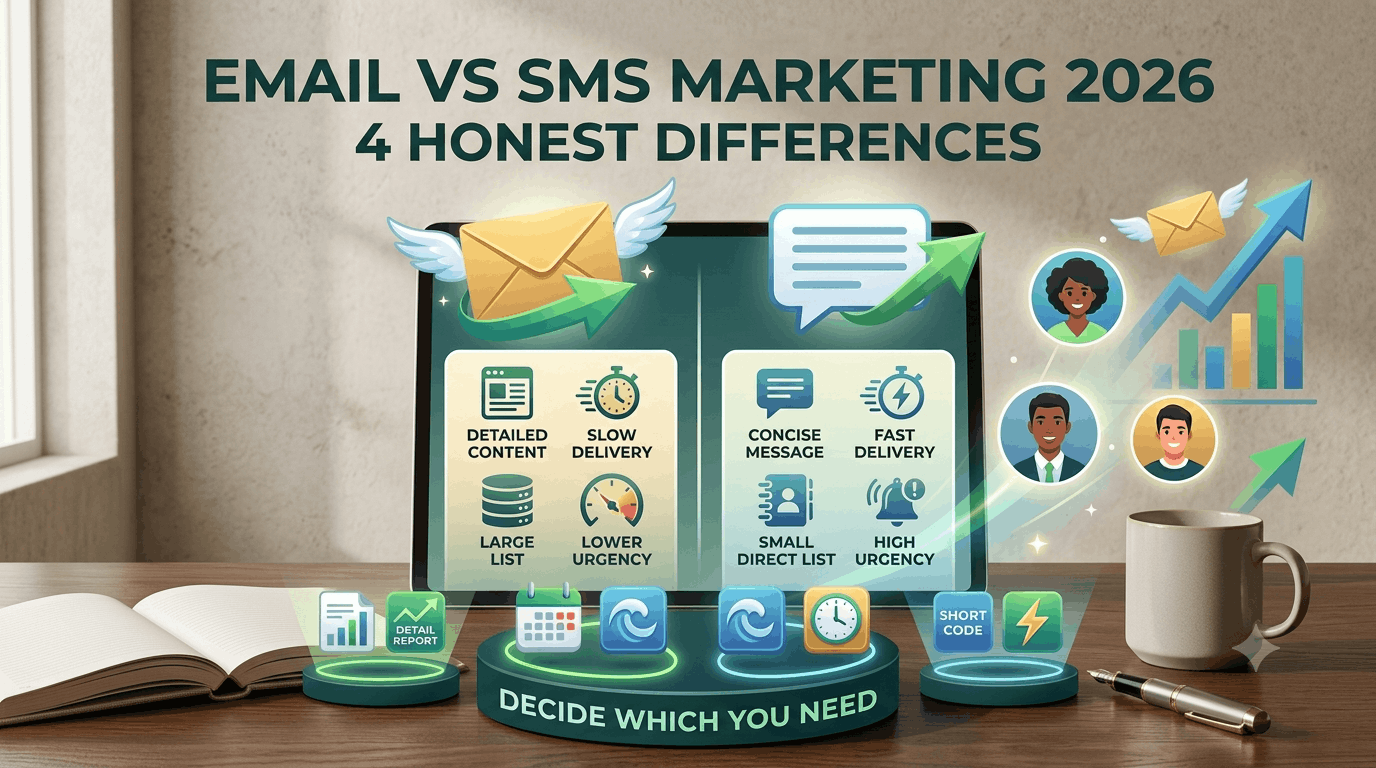
If you only had time to build one channel properly, would it be email or SMS?
The honest answer is that this is the wrong framing for most businesses the two channels are good at fundamentally different things, and the real question is which messages belong on which channel, not which channel to pick exclusively. Email handles depth, storytelling, and lower-urgency nurturing well. SMS handles speed, brevity, and high-urgency moments well. Treating them as competitors rather than complements is one of the more common strategic mistakes in this space.
While Reviewing Email vs SMS Marketing I went through where each channel genuinely outperforms the other, to answer the questions that actually help with this decision:
- What is each channel actually better at, structurally?
- Does SMS really get better open rates than email?
- Which messages should go on which channel?
- What are the consent and compliance differences between the two?
Short answer: SMS gets opened faster and at a higher rate, but tolerates far less frequency and almost no length reserve it for genuinely time-sensitive or high-value moments (shipping updates, flash sales, abandoned cart for high-value items). Email handles everything else better: storytelling, education, regular newsletters, and any message that benefits from more than a sentence or two of context. Most mature businesses eventually run both, with SMS as a smaller, more selectively used channel layered onto a broader email program.
Read Guide for Best Email Marketing and Automation Tools for 2026 – Top 10 Platforms Tested
Email vs SMS Marketing : The Core Structural Difference
Email and SMS aren’t just “the same idea on different channels” they have fundamentally different constraints that shape what each is actually good for. Email supports rich formatting, images, multiple calls to action, and substantial length without losing the reader, since opening an email is a deliberate, low-pressure action. SMS is read essentially instantly on a phone’s lock screen or notification panel, supports no real formatting, and tolerates only a sentence or two before it starts to feel intrusive rather than helpful.
This isn’t a matter of one channel being more “advanced” than the other they’re built for different jobs. Email is closer to a letter; SMS is closer to a tap on the shoulder. Used for the wrong job, each one underperforms badly: a multi-paragraph SMS feels like spam, while a one-line, urgent email gets buried and ignored in a way the equivalent text message wouldn’t be.
Does SMS Really Get Higher Open Rates?
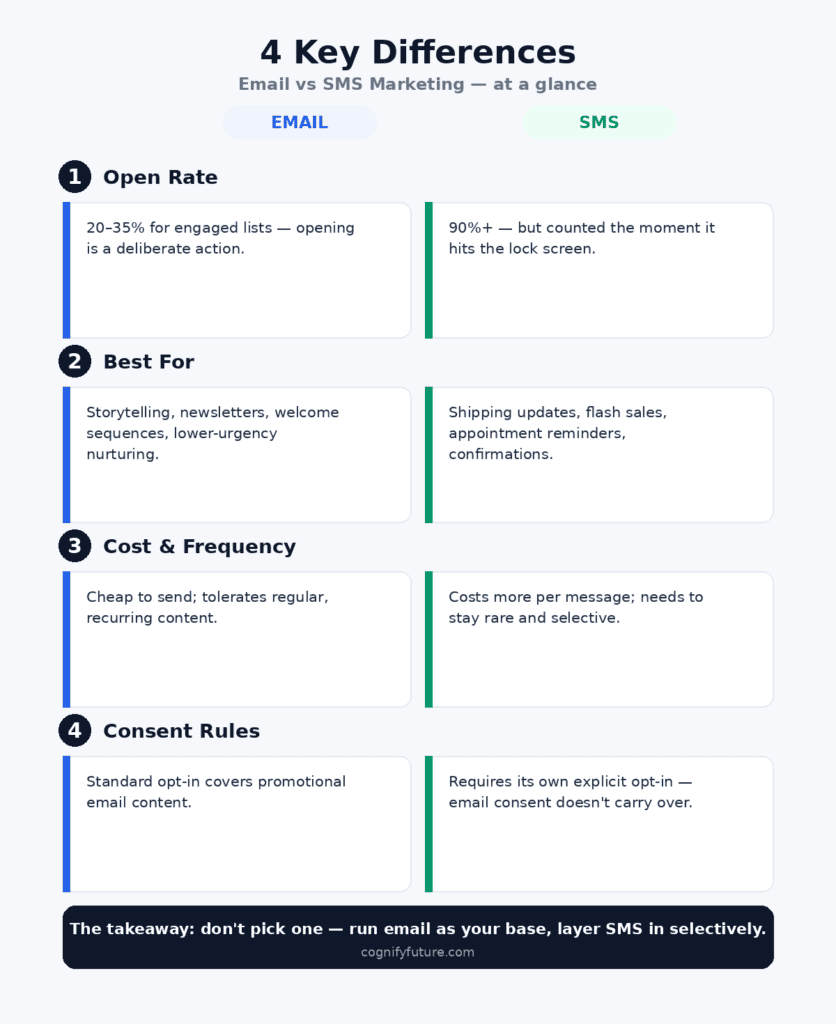
Generally, yes, and significantly so SMS open rates are commonly cited well above typical email open rates, often discussed in the range of 90%+ versus email’s 20-35% for engaged lists. But this comparison is somewhat misleading taken at face value, since “open rate” means something different on each channel: an SMS is functionally “opened” the moment it appears on a lock screen, regardless of whether the recipient actually reads or acts on it, while an email open requires a more deliberate action.
The more useful comparison is read-and-acted-upon rate, which narrows the gap considerably, since SMS’s structural brevity means there’s less room for nuance or persuasion within the message itself. SMS’s real advantage is speed and certainty of visibility, not necessarily a dramatically higher genuine engagement rate once you account for what “open” actually measures on each channel.
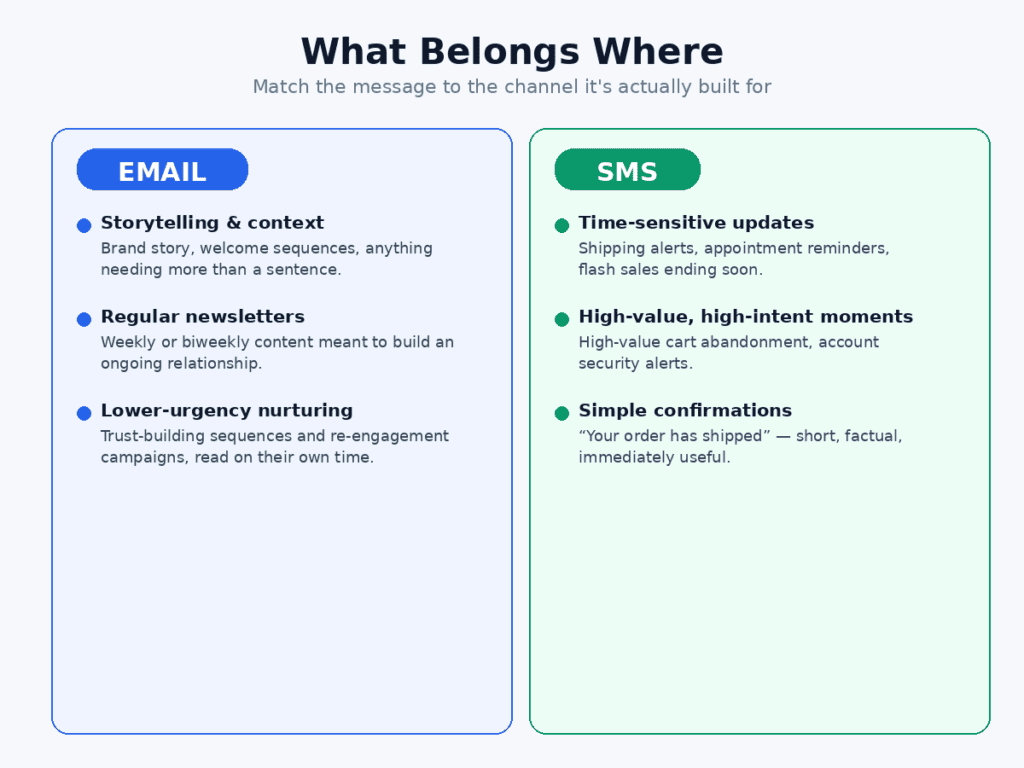
What Belongs on Email
Anything Requiring Context or Storytelling
A welcome sequence explaining your brand story, a newsletter covering a topic in depth, or a product launch with multiple features to explain all need more room than SMS provides. Email’s format supports this naturally; cramming the same content into a string of texts would either fail to convey the necessary context or annoy the recipient with message frequency.
Regular, Recurring Content
A weekly or biweekly newsletter, regular product updates, or any content cadence meant to build an ongoing relationship over time fits email’s tolerance for frequency far better than SMS, which most recipients expect to receive far less often before it starts to feel like an imposition.
Lower-Urgency Nurturing
A welcome sequence building trust over the first two weeks of a subscriber relationship, or a re-engagement campaign for someone who’s gone quiet, both benefit from email’s lower-pressure, more deliberate-reading format, where the recipient engages on their own schedule rather than at the moment a notification interrupts them.
What Belongs on SMS
Genuinely Time-Sensitive Information
A shipping update, an appointment reminder, or a flash sale ending in a few hours all benefit from SMS’s near-instant visibility. If the value of the message decays quickly with time, SMS’s speed advantage genuinely matters in a way it doesn’t for content meant to be read whenever convenient.
High-Value, High-Intent Moments
A high-value abandoned cart (where the potential lost revenue justifies the more intrusive channel) or a major account security alert are reasonable SMS use cases, since the stakes justify interrupting someone’s day in a way a routine promotional message doesn’t.
Our Abandoned Cart Email Flow Guide 2026 covers when adding SMS to a cart recovery flow specifically makes sense, and the regional consent rules that apply.
Simple Confirmations
“Your order has shipped” or “Your appointment is confirmed for 3 PM tomorrow” are perfect SMS content short, factual, immediately useful, and not requiring any of the formatting or length email would otherwise provide.
Consent and Compliance: A Meaningfully Different Bar
SMS marketing consent is legally treated as separate and generally stricter than email consent in most jurisdictions. A customer agreeing to “receive emails about offers” hasn’t automatically agreed to receive text messages, even if they provided a phone number for other purposes like order confirmations. Building a distinct, explicit SMS opt-in flow rather than assuming email subscribers also want texts isn’t just good practice, it’s frequently a legal requirement, and conflating the two consent types is a common, costly mistake for businesses newer to SMS.
SMS also generally carries stricter frequency expectations and quiet-hours requirements than email in many regions, given its more intrusive nature. Before adding SMS to your marketing mix, it’s worth specifically researching the current consent and frequency rules in your operating region rather than assuming email-equivalent rules apply.
Practical Use Case: A Layered Approach
Most mature marketing programs don’t choose one channel exclusively they layer SMS selectively on top of a broader email foundation. A reasonable structure: run your full marketing program (newsletters, welcome sequences, regular promotions, nurture content) on email as the primary channel, and reserve SMS specifically for the subset of high-urgency or high-value moments where its speed genuinely justifies the more intrusive nature and stricter consent requirements shipping updates, high-value cart abandonment, or major time-sensitive offers.
This layered approach captures SMS’s genuine advantages without overusing a channel that degrades quickly in effectiveness (and goodwill) when applied too broadly or too frequently.
Cost Considerations
SMS is also meaningfully more expensive per message than email in almost every pricing structure, since carriers charge for message delivery in a way that doesn’t apply to email sending. This cost difference reinforces the case for selective use: applying SMS broadly across your entire list for every campaign is both a worse experience for recipients and a notably higher cost than the equivalent email send, with limited additional benefit for messages that weren’t genuinely time-sensitive in the first place.
Final Verdict
Email and SMS aren’t competing for the same job they’re suited to different kinds of messages, and the businesses that get the most value from both treat them as complementary rather than choosing one exclusively. Email remains the right home for storytelling, regular content, and lower-urgency nurturing; SMS earns its place for genuinely time-sensitive, high-value moments where speed outweighs the cost and intrusiveness of the channel.
If you’re starting from scratch, build your email program first, since it covers the large majority of marketing communication needs at lower cost and with more flexibility. Add SMS later, deliberately, for the specific subset of messages where its speed genuinely matters, with its own explicit consent flow rather than assuming your existing email list has already agreed to it.
1. Is SMS marketing better than email marketing?
Neither is universally better; they’re suited to different kinds of messages. SMS excels at speed and immediate visibility for urgent, brief messages. Email excels at depth, storytelling, and regular content that benefits from more context than a text message can provide.
2. Does SMS really have a higher open rate than email?
SMS is commonly cited as having open rates above 90% versus email’s 20-35% for engaged lists, but this comparison is somewhat misleading since an SMS is functionally counted as opened just by appearing on a lock screen, while an email open requires a more deliberate action. The genuine engagement gap is narrower than the raw open rate numbers suggest.
3. What types of messages work best on SMS?
Genuinely time-sensitive information (shipping updates, appointment reminders, flash sales ending soon), high-value or high-intent moments (a high-value abandoned cart, security alerts), and simple factual confirmations all suit SMS’s brevity and immediate visibility.
4. What types of messages work best on email?
Anything requiring context or storytelling, regular recurring content like newsletters, and lower-urgency nurturing sequences (welcome series, re-engagement campaigns) all suit email’s tolerance for length and its lower-pressure, deliberate-reading format better than SMS.
5. Can I text my email subscribers without separate consent?
No. SMS marketing consent is legally treated as separate and generally stricter than email consent in most jurisdictions. A customer agreeing to receive promotional emails hasn’t automatically agreed to receive text messages, even if a phone number was provided for other purposes.
6. Is SMS marketing more expensive than email marketing?
Yes, meaningfully so per message, since carriers charge for SMS delivery in a way that doesn’t apply to email sending. This reinforces using SMS selectively for genuinely time-sensitive or high-value messages rather than broadly across an entire list for every campaign.
7. Should a new business start with email or SMS marketing?
Email, in almost all cases. It covers the large majority of marketing communication needs at lower cost and with more flexibility. SMS is best added later, deliberately, for a specific subset of time-sensitive messages once the email program is established.
8. How often can I send SMS marketing messages compared to email?
Far less frequently. SMS’s more intrusive nature means recipients tolerate much lower frequency before it feels like spam, and many regions impose stricter frequency and quiet-hours requirements on SMS than on email marketing.





I am Ashish Yadav a software engineer and AI tools researcher with over five years of practical experience working with real-world systems and automation. I am founder of CognifyFuture, where I analyzes, tests, and breaks down AI tools with a focus on what actually works—not what’s trending.
My content is built on hands-on usage, not theory. Instead of generic advice, I focuses on real implementation—how AI tools can be used to automate tasks, improve efficiency, and solve any specific business or individual problems.
Through CognifyFuture, My aims is to eliminate confusion around AI by delivering clear, honest, and actionable insights that help users make smarter technology decisions.