
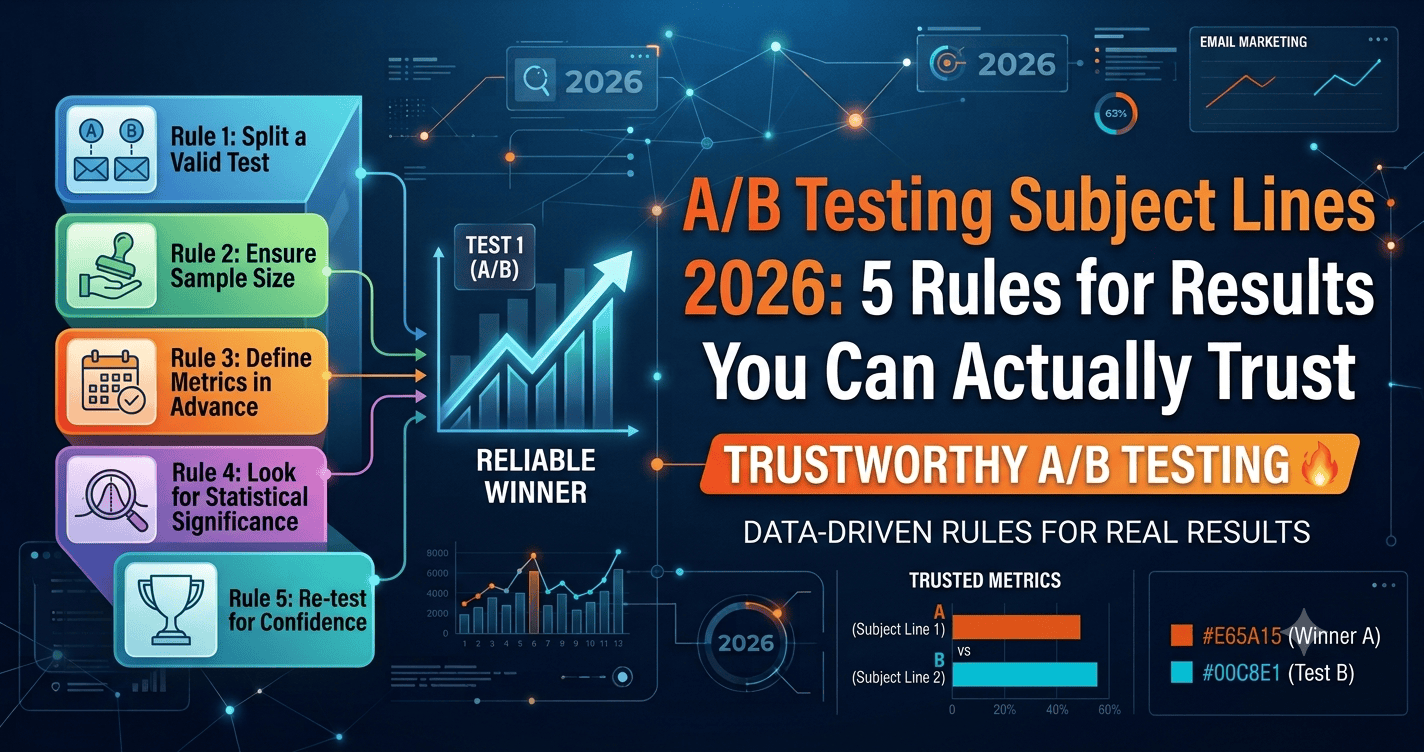
Why does one subject line double your open rate while a nearly identical one barely moves the needle?
Because subject lines are the single highest-leverage, lowest-effort thing you can test in email marketing and most senders either skip testing entirely or test it so sloppily that the results don’t actually mean anything. A/B testing subject lines done properly is genuinely simple, but a few common mistakes (testing too many variables at once, calling a test early, or testing on too small a sample) routinely produce false conclusions that lead to the wrong subject line “winning.”
I went through what actually makes subject line testing valid and useful, separating real signal from statistical noise, to answer the questions that matter:
- How big does your list need to be before A/B testing is actually worthwhile?
- What specific subject line elements are worth testing first?
- How long should a test run before you can trust the result?
- What mistakes make a test’s results meaningless?
Short answer: test one variable at a time (length, personalization, curiosity vs clarity, emoji use), send to a large enough sample that the difference isn’t just random noise, and let the test run long enough to capture a realistic spread of open behavior before declaring a winner. Below, I’ll walk through exactly how to structure a test that produces a result you can actually trust and apply going forward.
A/B Testing Subject Lines : Do You Have Enough Subscribers to A/B Test Meaningfully?
Read Guide for Best Email Marketing and Automation Tools for 2026 – Top 10 Platforms Tested
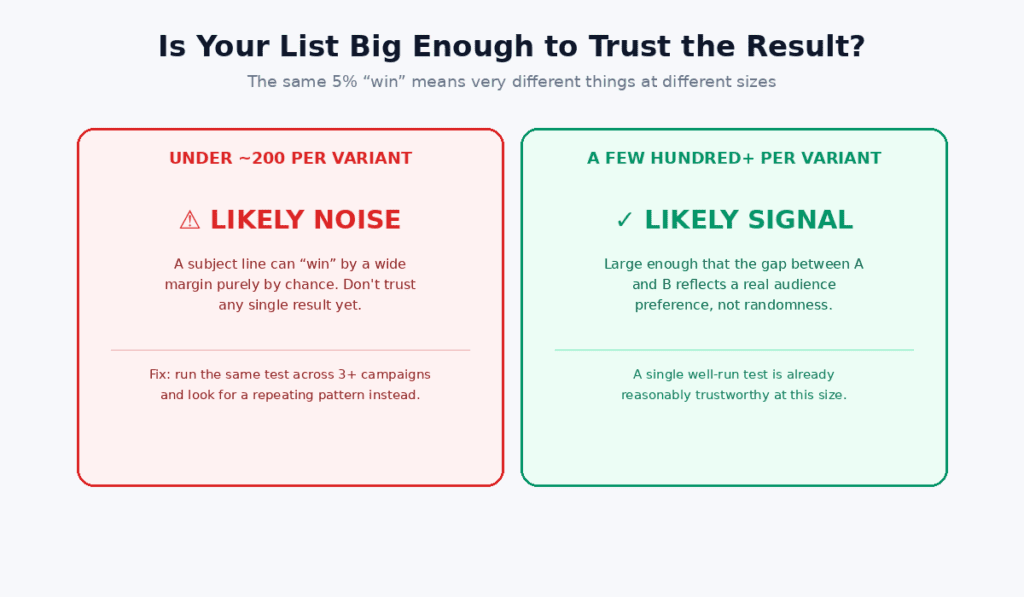
This is worth addressing directly before anything else, since testing on too small a list produces results that look conclusive but are actually just random variation. As a rough guideline, a list under a few hundred active subscribers per variant often won’t generate a large enough sample for the difference between two subject lines to be statistically meaningful you might see one “win” by a wide margin purely by chance.
If your list is still small, that doesn’t mean testing is pointless it means you should expect noisier results and weight any single test’s conclusion less heavily. Running the same type of test repeatedly over several campaigns, looking for a consistent pattern rather than trusting any one result in isolation, is a reasonable way to build confidence even with a smaller list.
Test One Variable at a Time
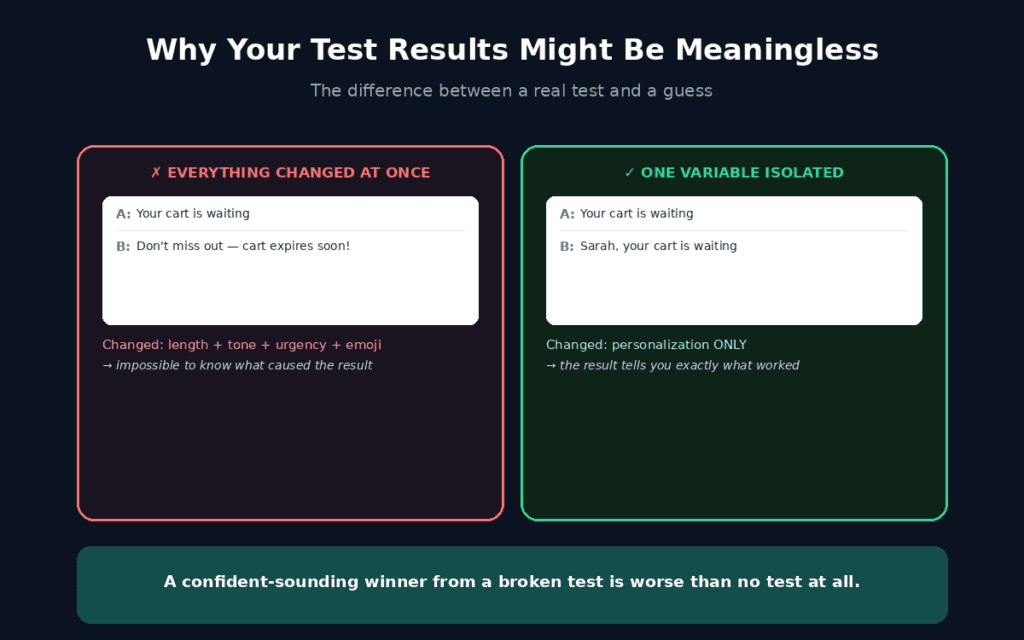
This is the single most common mistake in subject line testing: changing multiple things between version A and version B (length, tone, personalization, and an emoji, all at once) and then declaring the winner “better” without knowing which specific change actually drove the difference.
A valid test isolates one variable while keeping everything else identical. “Your cart is waiting” vs “Sarah, your cart is waiting” isolates personalization specifically. “Your cart is waiting” vs “Don’t miss out your cart expires soon” changes length, tone, and urgency framing all at once, making it impossible to know which element actually caused any difference in performance.
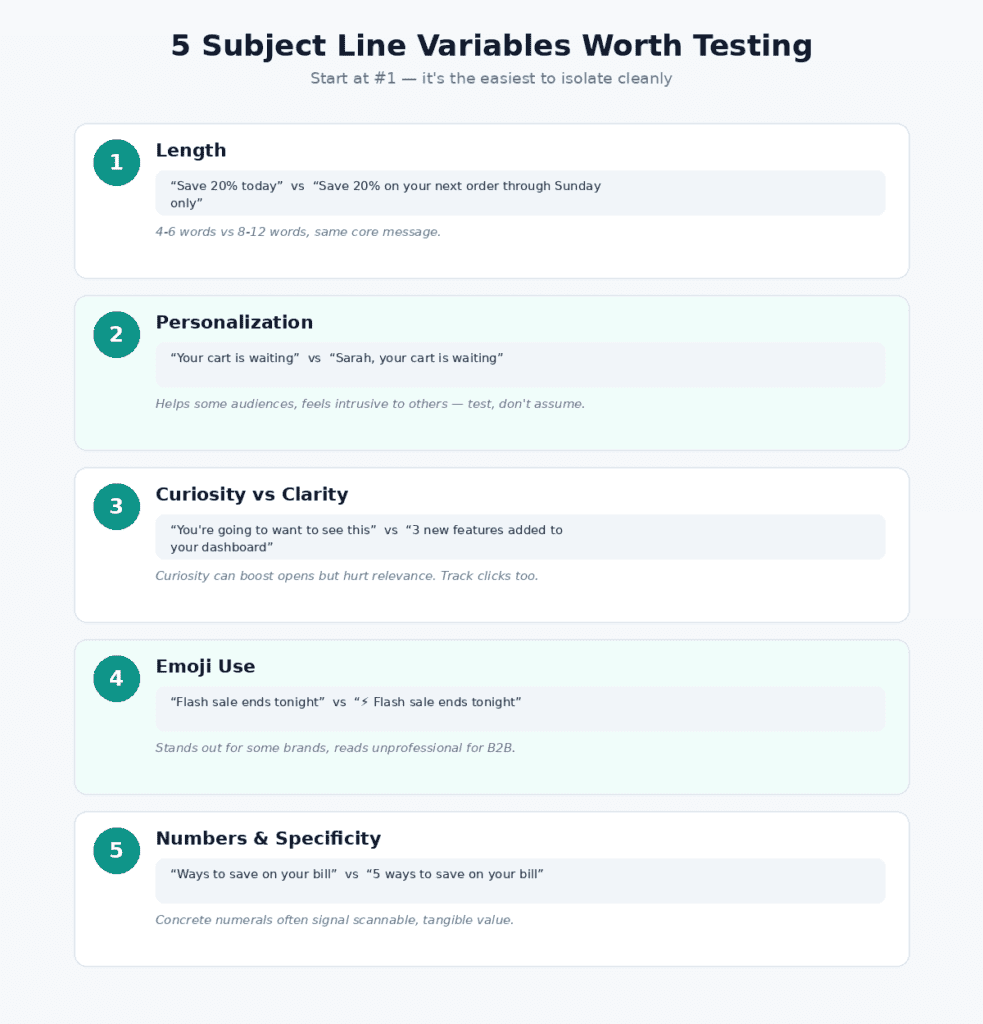
The Specific Elements Worth Testing First
Length
Short, direct subject lines and longer, more descriptive ones perform differently depending on audience and context. Testing a concise 4-6 word subject line against a more detailed 8-12 word version, with the same core message, reveals which length your specific audience responds to this varies enough between audiences that it’s worth establishing for your own list rather than assuming a universal best length.
Personalization
Including a subscriber’s first name in the subject line is a simple, easily testable variable. It doesn’t universally improve open rates for some audiences it does, for others it makes little difference or can even feel slightly intrusive depending on context and industry. Testing this specifically on your own list, rather than assuming it always helps, avoids both leaving a genuine improvement on the table and adding unnecessary complexity if it doesn’t actually move your numbers.
Curiosity vs Clarity
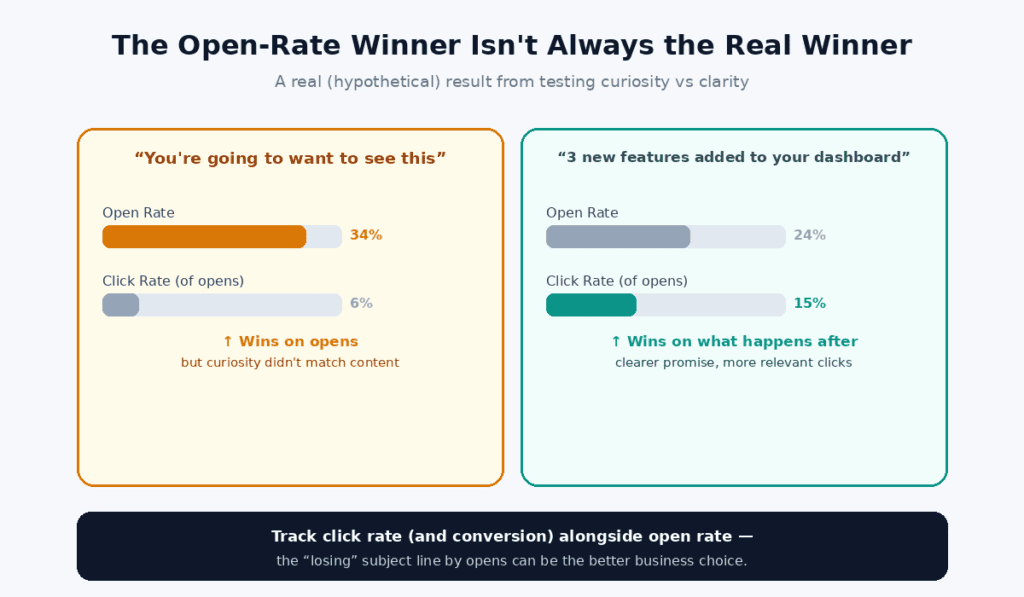
A subject line that creates curiosity without fully revealing the content (“You’re going to want to see this”) versus one that states exactly what’s inside (“3 new features added to your dashboard”) represent genuinely different strategies, not just stylistic variation. Curiosity-driven lines can boost opens but sometimes at the cost of relevance someone who opens out of curiosity but finds content irrelevant to what they expected may be less likely to engage with future emails. Clear, direct lines tend to attract opens from people genuinely interested in the specific content, which can mean a smaller but more engaged open audience.
Emoji Use
An emoji in a subject line can help it stand out visually in a crowded inbox, but it can also read as unprofessional depending on your audience and industry. This is a genuinely audience-specific variable worth testing rather than assuming based on general advice what works for a casual consumer brand may actively hurt credibility for a B2B audience.
Numbers and Specificity
Subject lines with a specific number (“5 ways to…” or “Save 20% today”) versus a more general phrasing of the same idea often perform differently, since numbers can signal concrete, scannable value. Testing whether specific numerals genuinely help your particular audience, rather than assuming the common advice applies universally, is worth the minimal effort it takes to set up.
How Long Should a Test Run?
Calling a test too early is almost as damaging as testing too small a sample, since early opens often skew toward your most engaged subscribers checking email frequently, while less engaged subscribers might open hours or even a day later. If you declare a winner based on the first hour of data, you’re really measuring “which subject line performs best with my most engaged subscribers specifically,” not your full list’s actual behavior.
A reasonable approach is waiting at least several hours, and ideally closer to 24 hours, before evaluating results, depending on your typical open pattern. If your platform supports automatically sending the better-performing version to your remaining list after an initial test window, this captures most of the testing benefit without requiring you to manually wait and decide before every send.
What Open Rate Alone Doesn’t Tell You
A subject line that wins on open rate isn’t automatically the better choice if it doesn’t also lead to good downstream engagement. A curiosity-driven subject line might pull in more opens while a clearer, more specific one generates fewer opens but a notably higher click rate among those who do open in which case the “losing” subject line by open rate might actually be the better choice depending on what you’re optimizing for.
Where possible, track click rate and (if relevant) conversion alongside open rate for any subject line test, rather than treating open rate as the sole measure of success. For a campaign where the ultimate goal is a click or purchase, a subject line that maximizes opens at the expense of relevance is optimizing for the wrong outcome.
Building a Subject Line Testing Habit
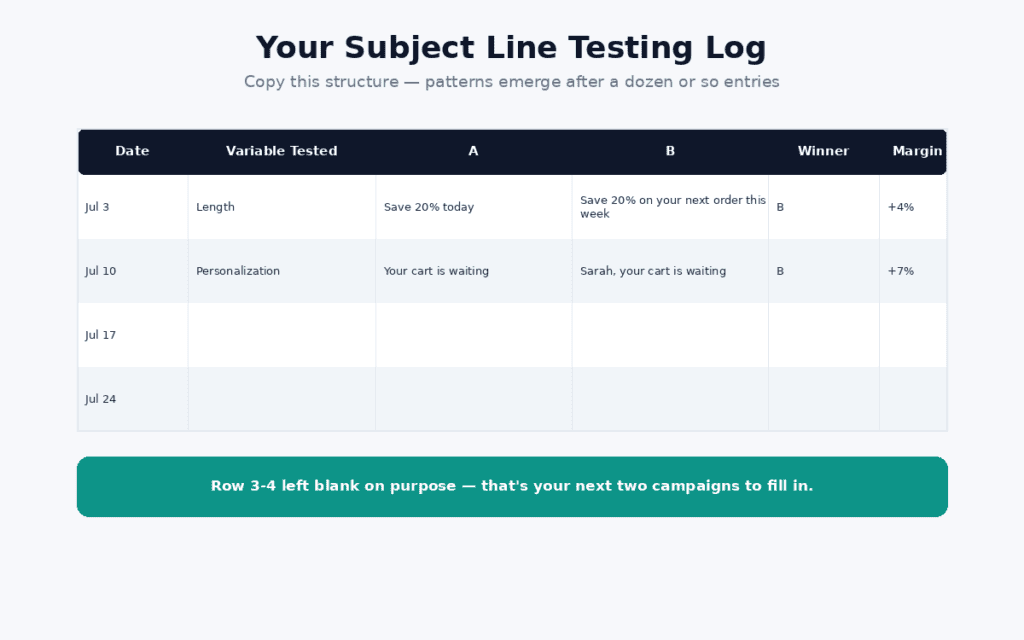
The biggest practical benefit of subject line testing doesn’t come from any single test it comes from accumulating a pattern over many campaigns. Keep a simple running log of what you tested, which version won, and by how much. After a dozen or so tests, patterns specific to your audience usually start to emerge (perhaps your list consistently responds better to shorter, direct subject lines, or perhaps personalization makes a meaningful difference for your specific content type) that are more reliable than any single test’s conclusion in isolation.
This running log also protects against a common failure mode: re-testing the same variable repeatedly without ever building toward a clearer picture of your audience’s actual preferences, because each test’s outcome was never recorded or compared against previous results.
Practical Use Case: A Simple First Test to Run
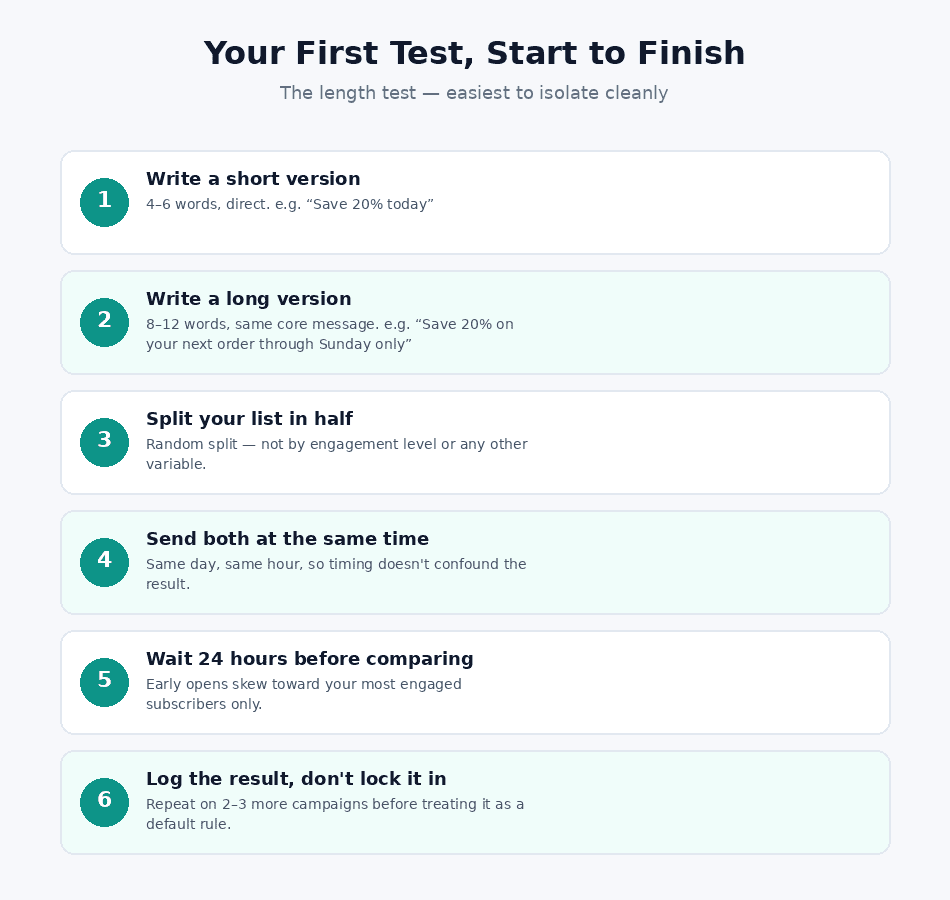
If you’ve never run a subject line test before, start with length, since it’s the easiest variable to isolate cleanly and tends to produce a meaningful, easy-to-interpret difference. Write your next campaign’s subject line two ways: a short, direct version (4-6 words) and a longer, more descriptive version (8-12 words) conveying the same core message. Split your list in half, send each version to one half, and wait at least several hours before comparing open rates.
Whatever the result, don’t treat it as a permanent rule from a single test repeat the same length comparison on your next two or three campaigns to confirm the pattern holds before committing to it as a default approach for your list going forward.
Final Verdict
Subject line testing is genuinely one of the easiest, lowest-effort improvements available in email marketing, but only when done with enough rigor to trust the result: one variable isolated at a time, a large enough sample to avoid random noise, and enough time elapsed before declaring a winner. Skipping any of these three conditions tends to produce a confident-sounding but ultimately meaningless conclusion.
Start with the simplest test (length) on your next campaign, track results in a simple running log across several campaigns rather than trusting any single test, and remember that open rate alone doesn’t tell the whole story a subject line’s real value depends on what happens after the open, not just whether the open happened at all.
1. How many subscribers do I need to A/B test subject lines?
A rough guideline is a few hundred active subscribers per variant to get results that reflect a real pattern rather than random variation. Smaller lists can still test, but should expect noisier results and look for a consistent pattern across several campaigns rather than trusting any single test.
2. What’s the most common mistake in subject line A/B testing?
Changing multiple variables at once (length, tone, personalization, and emoji use, all at the same time) makes it impossible to know which specific change actually drove any performance difference. A valid test isolates exactly one variable while keeping everything else identical between versions.
3. What subject line elements should I test first?
Length, personalization (including a first name), curiosity versus clarity in framing, emoji use, and specific numbers are the most common and easiest elements to test individually. Length is often the simplest starting point since it’s easy to isolate cleanly.
4. How long should I wait before declaring a subject line test winner?
At least several hours, and ideally closer to 24 hours, since early opens often skew toward your most engaged subscribers who check email frequently. Calling a test too early effectively measures only your most active subscribers’ preferences, not your full list’s actual behavior.
5. Should I just look at open rate to determine the winning subject line?
Not exclusively. A subject line that maximizes opens might generate fewer downstream clicks if it relies on curiosity at the expense of relevance. Tracking click rate and conversion alongside open rate gives a fuller picture of which subject line actually serves your campaign’s real goal.
6. Does adding a subscriber’s first name to the subject line always improve open rates?
No, it varies by audience. Personalization helps for some lists and makes little difference, or can even feel intrusive, for others depending on industry and context. It’s worth testing specifically on your own list rather than assuming it universally helps.
7. Should I use emojis in subject lines?
It depends on your audience. Emojis can help a subject line stand out in a crowded inbox for some audiences, while reading as unprofessional for others, particularly in B2B contexts. This is genuinely audience-specific and worth testing rather than following general advice either way.
8. How do I get better at subject line testing over time?
Keep a simple running log of what you tested, which version won, and by how much, across many campaigns. Patterns specific to your audience tend to emerge after a dozen or so tests, and these accumulated patterns are more reliable than trusting any single test’s result in isolation.





I am Ashish Yadav a software engineer and AI tools researcher with over five years of practical experience working with real-world systems and automation. I am founder of CognifyFuture, where I analyzes, tests, and breaks down AI tools with a focus on what actually works—not what’s trending.
My content is built on hands-on usage, not theory. Instead of generic advice, I focuses on real implementation—how AI tools can be used to automate tasks, improve efficiency, and solve any specific business or individual problems.
Through CognifyFuture, My aims is to eliminate confusion around AI by delivering clear, honest, and actionable insights that help users make smarter technology decisions.