
Why does your list growth feel stuck at the same number for weeks, even though your traffic hasn’t dropped?
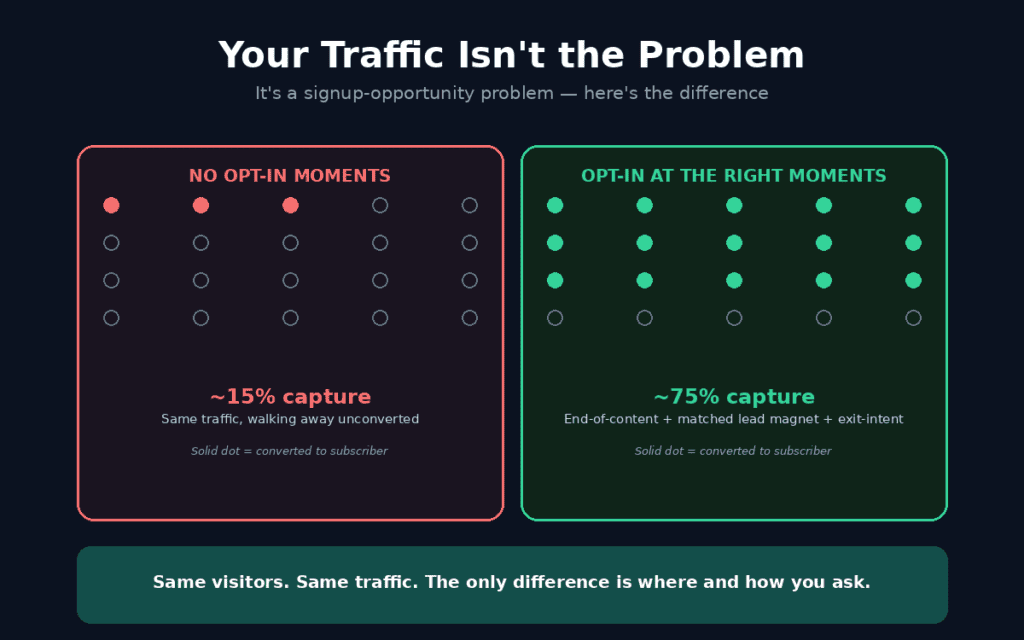
The honest answer is that most stalled list growth isn’t a traffic problem it’s a signup-opportunity problem. Visitors are arriving, but if there’s no compelling, well-placed reason for them to actually hand over their email address, they simply leave without converting into a subscriber. Fixing this is almost always about adding the right opt-in moments and value exchange, not about driving more traffic to a list-building setup that isn’t actually working.
I went through the tactics How to Grow an Email List that genuinely move the needle for list growth, separating what consistently works from what’s mostly noise, to answer the questions that matter:
- Where should opt-in forms actually go on your site for the best conversion?
- Does a lead magnet actually help, or is it overrated advice?
- How aggressive should popups be before they start hurting more than helping?
- What list-growth tactics are genuinely outdated in 2026?
Short answer: place opt-in opportunities at the moments visitors are already most engaged (end of a blog post, during checkout, after a meaningful on-site action) rather than scattering generic forms everywhere. A specific, genuinely useful lead magnet still reliably outperforms a vague “join our newsletter” ask. Exit-intent popups work well when used sparingly and triggered by real signals of leaving, not by a blunt time delay. Below, I’ll walk through the tactics worth your time.
How to Grow an Email List : Why “Just Add a Popup” Isn’t a Complete Strategy
Popups remain one of the most effective individual list-growth tools, but treating “add a popup” as the entire strategy misses the bigger picture: list growth tactics work best layered together at different points in a visitor’s journey, not as a single tool doing all the work. A visitor who ignores a popup might still convert through a well-placed in-content form, or vice versa. The goal is presenting the opt-in opportunity in a few different, well-timed ways rather than relying on one mechanism everywhere.
The Highest-Converting Placement: End of Content
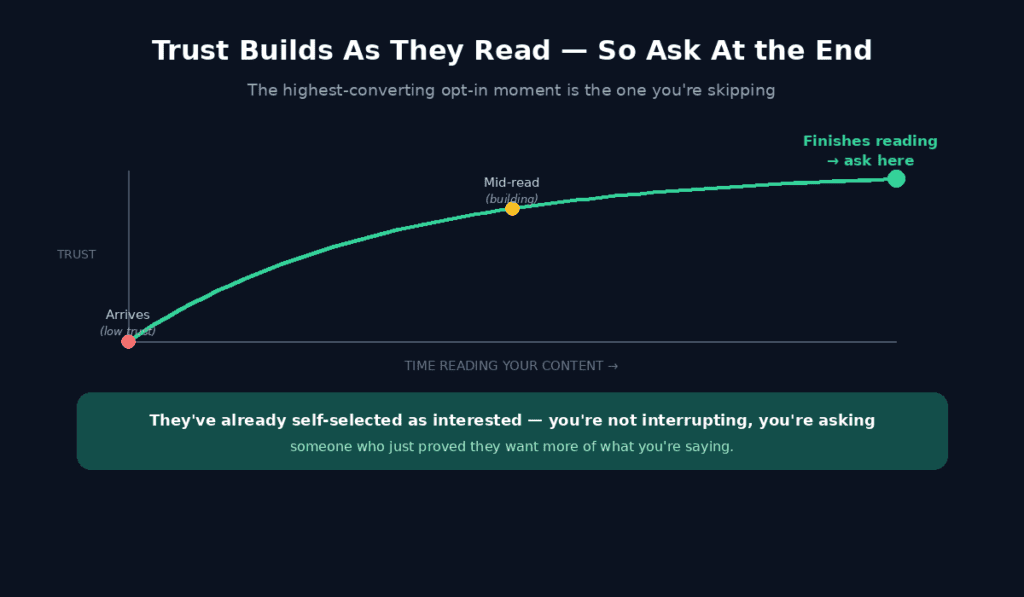
If someone has read your entire blog post or article, they’ve already demonstrated genuine interest in what you have to say this is consistently one of the highest-converting moments to ask for an email address, because you’re asking people who’ve already self-selected as engaged rather than interrupting someone who just arrived.
A simple, specific call-to-action at the end of content (“Get one more tip like this every week” rather than a generic “Subscribe to our newsletter”) tends to outperform more aggressive, earlier-triggered prompts, precisely because the visitor has already invested time and built some trust in your content by the time they reach it.
Lead Magnets: Still Effective, But Specificity Is What Matters
A lead magnet (a free guide, checklist, template, or resource offered in exchange for an email address) is genuinely still one of the most reliable list-growth tactics, but the advice to “just create a lead magnet” oversimplifies what makes one actually work.
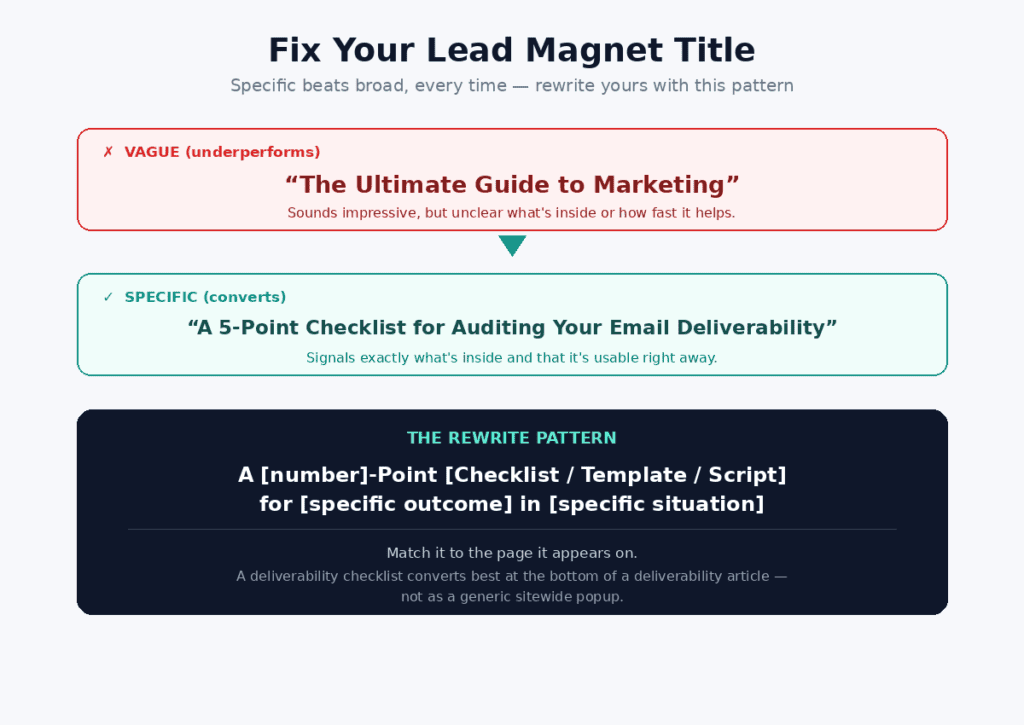
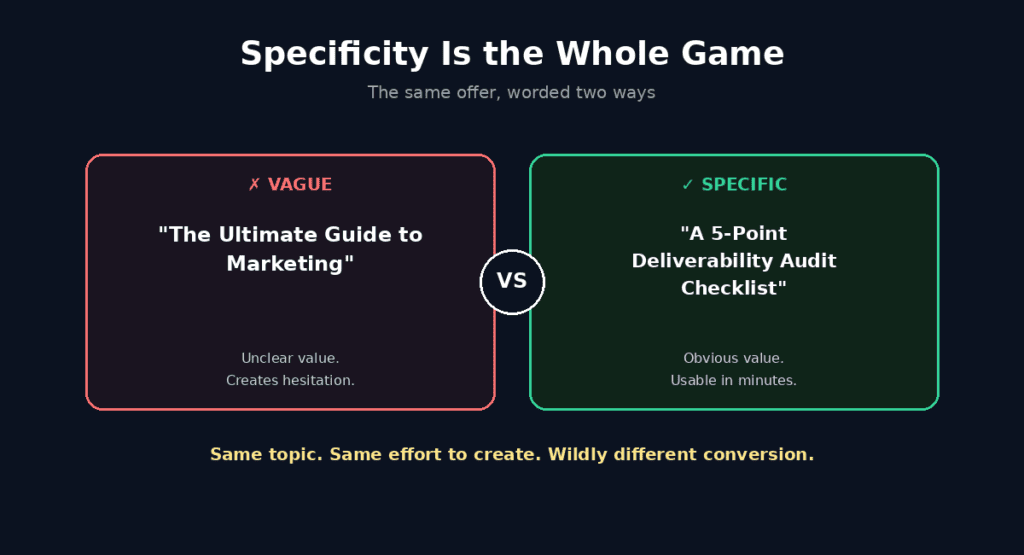
A vague, broad lead magnet (“The Ultimate Guide to Marketing”) tends to underperform a narrow, specific one (“A 5-Point Checklist for Auditing Your Email Deliverability”) because the specific version signals immediate, tangible value the visitor can picture using right away. The broader resource sounds impressive but creates hesitation, since it’s unclear exactly what’s inside or how quickly it’ll be useful.
Match your lead magnet to the specific content someone is reading when they encounter the offer. A lead magnet about email deliverability converts far better when offered at the bottom of a deliverability-focused article than when offered as a generic sitewide popup unrelated to what the visitor is currently reading.
Exit-Intent Popups: Useful When Triggered Correctly
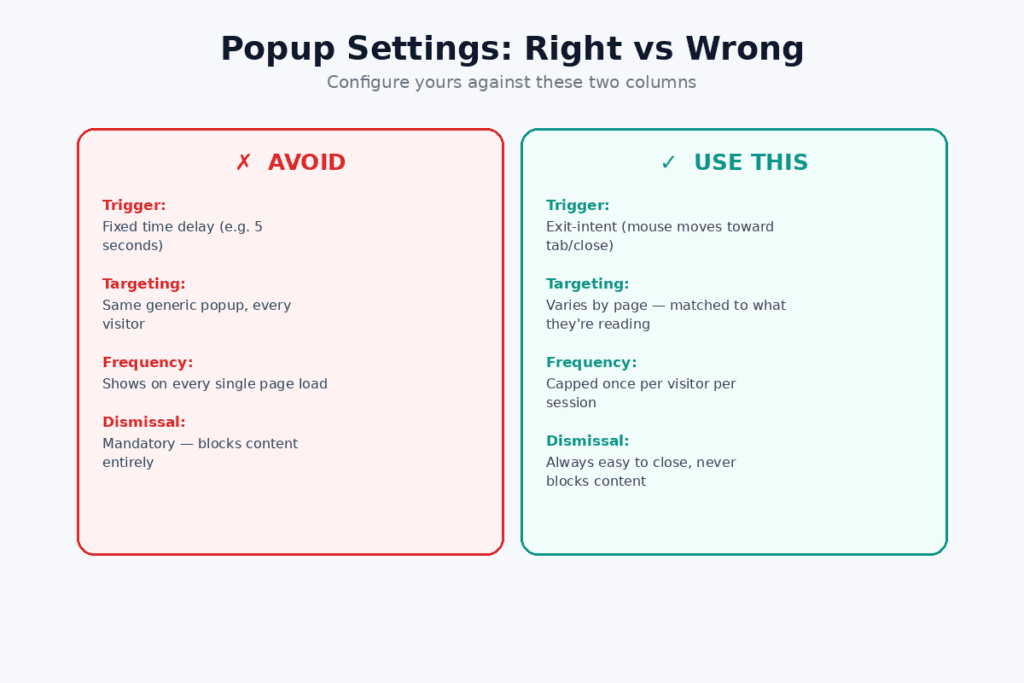
Exit-intent popups (triggered when a visitor’s mouse movement signals they’re about to leave the page or close the tab) tend to convert better than time-delayed popups that interrupt someone mid-read for no clear reason. The logic is straightforward: you’re not interrupting engagement, you’re catching someone at the moment they were leaving anyway, so there’s effectively nothing to lose by making one more offer.
The mistake many sites make is showing the same generic popup to every visitor regardless of what page they’re on or how long they’ve been browsing. A more effective approach varies the offer based on context a first-time visitor might see a general newsletter signup, while someone who’s spent several minutes reading a specific article might see a more targeted, content-relevant lead magnet instead.
Checkout and Transaction Moments (For Ecommerce)
If you run an online store, the checkout flow itself is typically your single highest-converting list-growth opportunity, since the customer is already providing their email address for order confirmation anyway. A clear, simple opt-in checkbox at checkout (never pre-checked by default, depending on your region’s consent requirements) captures subscribers at essentially zero additional friction.
Practical Use Case: List Growth by Business Type
A Content-Driven Blog or Publication
Prioritize end-of-content opt-ins and content-specific lead magnets over generic sitewide popups. Your traffic is already arriving for specific articles, so matching the opt-in offer to what each visitor is actually reading consistently outperforms a one-size-fits-all approach across the whole site.
An Ecommerce Store
Lean on checkout opt-ins as your primary source, supplemented by an exit-intent popup offering a first-purchase discount for visitors who haven’t bought anything yet. The discount-for-email exchange tends to work especially well here because it directly serves the immediate purchase decision, not just a vague future newsletter relationship.
A SaaS or Service Business
A free trial signup or a free tool/calculator related to your product tends to outperform a generic newsletter opt-in, since it captures emails from people who’ve already demonstrated direct interest in solving the specific problem your product addresses, rather than a more general audience.
Tactics That Are Genuinely Outdated in 2026
A few list-growth tactics that used to be common advice are worth actively avoiding now, since they tend to do more harm than good to both growth and deliverability.
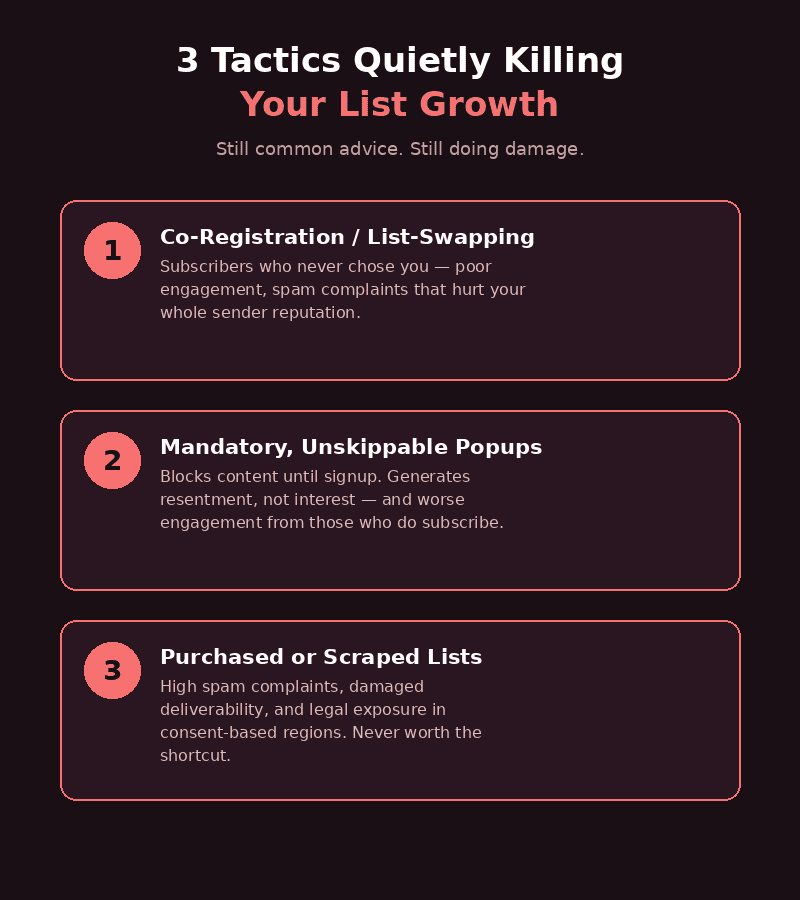
Co-registration and list-swapping (where your signup form also adds people to a partner’s list, or vice versa) generates subscribers who never specifically chose your content, leading to poor engagement and elevated spam complaint rates that can damage your sender reputation broadly, not just for that one campaign.
Mandatory, unskippable popups that block content entirely until someone subscribes or closes the popup tend to generate resentment rather than genuine interest, and the subscribers gained this way often have notably worse engagement than those who opted in more voluntarily.
Any tactic involving purchased or scraped contact lists remains as damaging as ever worth repeating because it’s still tempting advice for anyone impatient with organic growth speed, despite the consistent, severe deliverability and reputation damage it causes.
Growing Your List Through Existing Content and Traffic
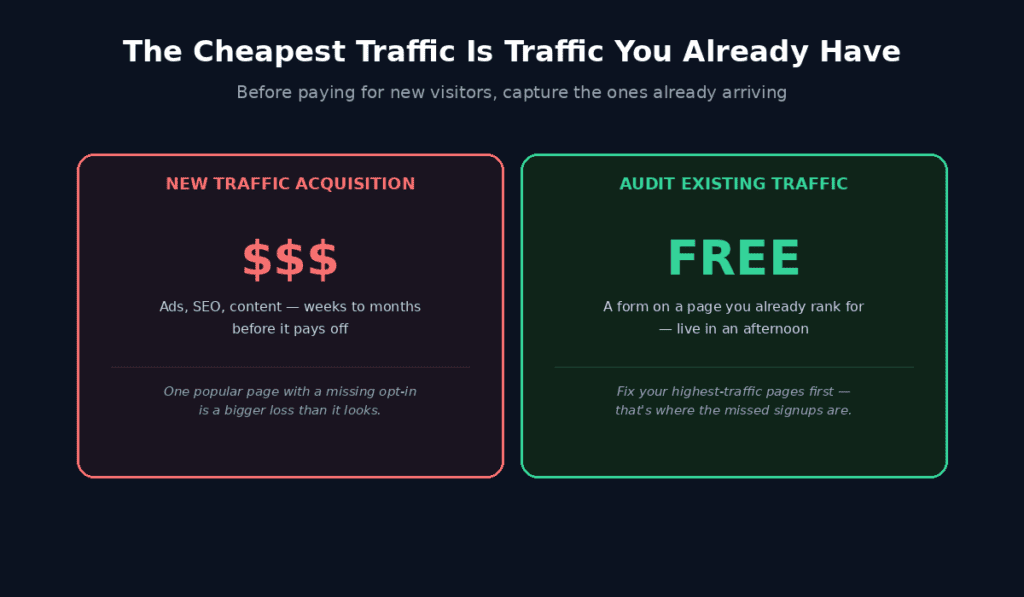
Before investing in new traffic sources specifically to grow your list, audit whether your existing traffic is being captured well. It’s common for a site to have meaningful organic traffic but very few actual opt-in opportunities embedded in that content in which case, adding well-placed forms to already-popular pages will grow your list faster than any new traffic acquisition effort, since you’re capturing visitors who are already arriving rather than paying or working to bring in new ones.
Identify your highest-traffic pages specifically and make sure each one has a relevant, well-matched opt-in opportunity. A single popular page with a poorly matched or entirely missing opt-in is a meaningfully larger missed opportunity than several lower-traffic pages with the same issue.
Social Proof and List Size Transparency
Mentioning subscriber count (“Join 12,000+ readers”) can meaningfully boost opt-in conversion once your list reaches a number that feels genuinely impressive, since it signals to a hesitant visitor that plenty of other people have already found the content worth subscribing to. This tactic works against you, however, if your number is still small in that case, omitting the count entirely (rather than displaying a low number that undermines confidence) tends to convert better than highlighting it.
What to Do Once Subscribers Actually Join
Growing your list is only half the equation what happens immediately after someone subscribes determines whether that growth translates into genuine engagement or a list full of people who forget they ever signed up. A well-structured welcome sequence, delivered promptly, is what converts a new email address into an actual relationship.
See our Best Welcome Email Sequences 2026 guide for the full framework on what to send immediately after someone joins your list.
Final Verdict
List growth that actually lasts comes from matching the right opt-in opportunity to the right moment in a visitor’s journey, not from a single aggressive tactic applied uniformly across your entire site. End-of-content opt-ins, specific (not generic) lead magnets, well-triggered exit-intent popups, and checkout-flow capture for ecommerce all consistently outperform a single generic “subscribe” form scattered everywhere with no context.
Before chasing new traffic specifically to grow your list, audit whether your existing traffic is being captured well for most sites, this is the faster and cheaper path to meaningful growth. And remember that the goal isn’t simply a bigger number; a smaller list of genuinely opted-in, engaged subscribers will outperform a larger one padded with low-quality signups every time it actually matters, whether that’s open rates, click rates, or revenue.
1. Why isn’t my email list growing even though I have website traffic?
Stalled list growth is usually a signup-opportunity problem, not a traffic problem. If there’s no compelling, well-placed opt-in moment, visitors simply leave without subscribing regardless of how much traffic arrives. Auditing your highest-traffic pages for missing or poorly matched opt-ins is usually the fastest fix.
2. What is the best place on a website to add an email signup form?
The end of blog content or articles is consistently one of the highest-converting placements, since visitors who’ve read to the end have already demonstrated genuine interest. For ecommerce, the checkout flow is typically the highest-converting opportunity since the customer is already providing an email address.
3. Do lead magnets still work for growing an email list in 2026?
Yes, but specificity matters significantly. A narrow, specific lead magnet (like a focused checklist) tends to outperform a broad, vague one (like a generic ‘ultimate guide’), since specific offers signal immediate, tangible value the visitor can picture using right away.
4. Are exit-intent popups still effective for list growth?
Yes, when triggered by genuine exit signals (mouse movement toward closing the tab) rather than a blunt time delay that interrupts someone mid-read. Varying the offer based on context, such as which page or article the visitor is on, also improves conversion over a single generic popup shown to everyone.
5. Should I buy an email list to grow faster?
No. Purchased or scraped lists contain people who never opted in, leading to high spam complaint rates, damaged sender reputation affecting deliverability broadly, and potential legal exposure in regions with consent-based email regulations. This remains true regardless of how tempting faster growth seems.
6. Should I show my subscriber count to encourage signups?
Only once it’s a genuinely impressive number. Displaying a count like ‘12,000+ subscribers’ can boost conversion by signaling social proof, but a low number tends to undermine confidence rather than build it, so it’s often better omitted until your list reaches a size that feels meaningful to a new visitor.
7. What list-growth tactics are outdated or harmful in 2026?
Co-registration or list-swapping with partner sites, mandatory unskippable popups that block content entirely, and any use of purchased or scraped contact lists. All three tend to generate poor-quality subscribers with weak engagement and elevated spam complaint rates that damage deliverability.
8. What should happen immediately after someone joins my email list?
A prompt, well-structured welcome email or sequence should follow right after signup. This is what converts a new email address into genuine engagement, since the moment right after subscribing is when a new subscriber’s interest and attention are at their peak.





I am Ashish Yadav a software engineer and AI tools researcher with over five years of practical experience working with real-world systems and automation. I am founder of CognifyFuture, where I analyzes, tests, and breaks down AI tools with a focus on what actually works—not what’s trending.
My content is built on hands-on usage, not theory. Instead of generic advice, I focuses on real implementation—how AI tools can be used to automate tasks, improve efficiency, and solve any specific business or individual problems.
Through CognifyFuture, My aims is to eliminate confusion around AI by delivering clear, honest, and actionable insights that help users make smarter technology decisions.