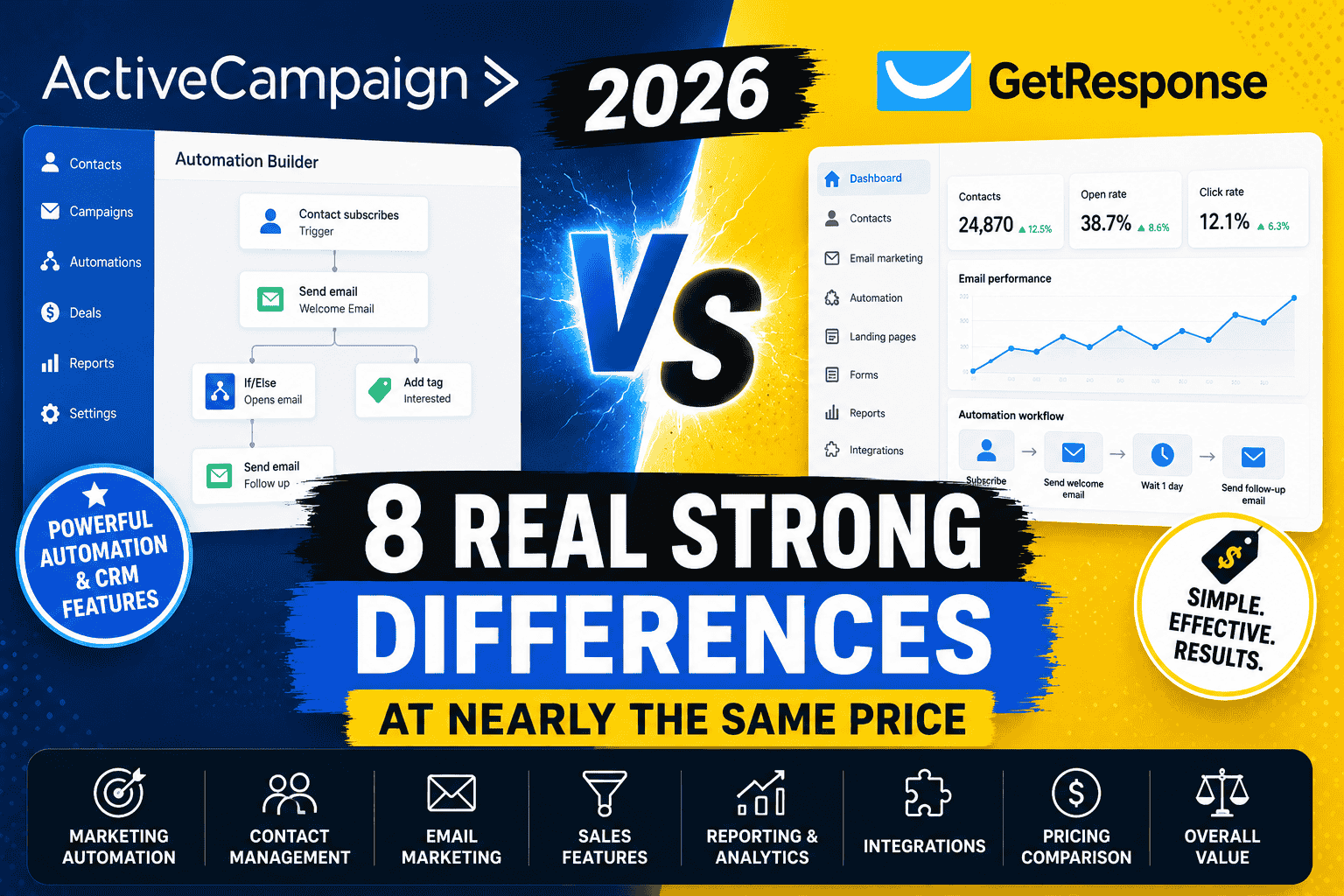
Here’s a strange situation you might find yourself in: two platforms, nearly identical price tags, and completely different answers to “which one should I buy?”
ActiveCampaign entry plan costs about $15/month. GetResponse costs about $16/month. So why does one comparison site call ActiveCampaign “an automation powerhouse” and another call GetResponse “the all-in-one platform that does everything”?
Because at nearly the same price, these two platforms are built around fundamentally different priorities — and the entry-level price tags don’t tell you which one actually fits your business. One is a CRM-and-automation engine that happens to send email. The other is a marketing all-in-one (email, webinars, funnels, courses) that happens to include automation.
I went through both platforms to answer the questions that actually decide this comparison:
- At nearly identical entry prices, what do you actually get with each?
- How does ActiveCampaign’s automation depth compare to GetResponse’s in practice?
- Is GetResponse’s webinar and funnel toolkit worth more than ActiveCampaign’s CRM?
- How do both platforms’ pricing jumps look at 10,000, 25,000, and 50,000 contacts?
- Which one fits a B2B sales-driven business vs a content/ecommerce business?
Short answer: ActiveCampaign is the stronger choice if automation depth and CRM integration are core to your business — its automation builder has more power once you learn it, and its CRM rivals dedicated sales tools. GetResponse is the stronger choice if you want webinars, conversion funnels, and course-selling alongside email in one platform. Both use contact-based pricing that scales in steep jumps, and at higher contact counts (50,000+), ActiveCampaign’s pricing climbs faster than GetResponse’s.
Let’s break down where each platform actually wins.
ActiveCampaign vs GetResponse: Quick Overview
ActiveCampaign, founded in 2003 and headquartered in Chicago, has evolved from a simple email tool into what it now calls a “customer experience automation” platform — built around the idea that email, CRM, and sales activity should all feed the same automation engine.
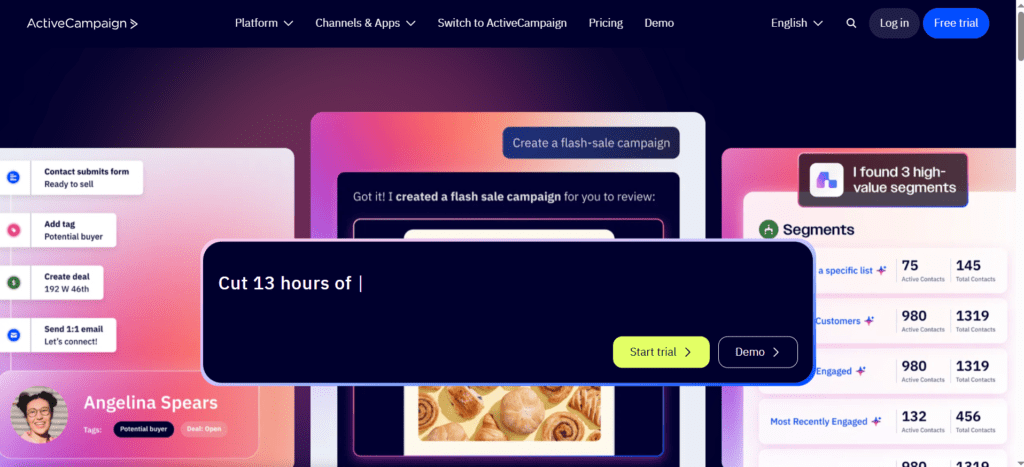
Read our full ActiveCampaign Review 2026 for a complete breakdown of pricing, automation depth, and real business workflows.
GetResponse, founded in Gdańsk, Poland, takes the opposite approach: rather than going deep on one thing, it bundles email, landing pages, conversion funnels, webinar hosting, AI campaign generation, and course-selling into a single all-in-one platform.
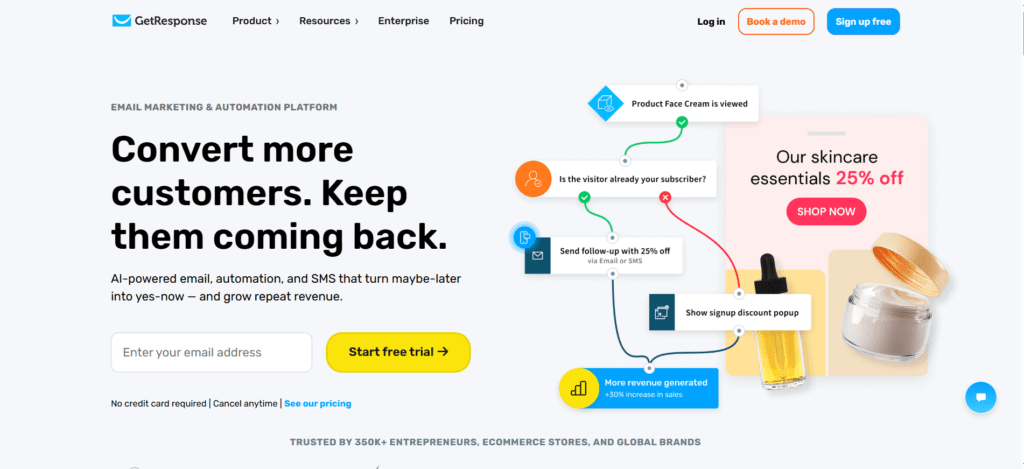
Here’s the high-level split:
- Choose ActiveCampaign if: automation depth and CRM integration are central to how your business operates — especially if sales and marketing need to share data and triggers
- Choose GetResponse if: you want webinars, conversion funnels, course-selling, and AI content tools bundled with email — without paying for separate platforms
Pricing in 2026: The $15 vs $16 Illusion
Entry-Level Pricing Looks Nearly Identical
On paper, ActiveCampaign’s Starter plan begins around $15/month, and GetResponse’s Starter plan begins around $16/month — a difference of $1. Neither platform offers a free plan. If you stopped your research here, you’d reasonably conclude these are interchangeable options.
They’re not. Here’s what each $15-16/month actually buys you:
ActiveCampaign Starter (~$15/month)
Email marketing, basic automation (including multi-step workflows — ActiveCampaign doesn’t gate basic automation behind higher tiers the way some competitors do), forms, and access to ActiveCampaign’s CRM in a limited capacity. The real automation depth — conditional branching, predictive sending, advanced segmentation — expands significantly at the Plus and Pro tiers.
GetResponse Starter (~$16-19/month)
Unlimited email sends, AI content generators (limited to 3 uses), welcome series, landing pages, popups — but critically, only 1 custom automation workflow. To unlock GetResponse’s real automation, conversion funnels, abandoned cart recovery, and webinars, you need the Marketer plan at roughly $59/month — a jump of more than 3x.
This is the key asymmetry in this comparison: ActiveCampaign’s entry tier includes more genuine automation than GetResponse’s entry tier. If automation is your priority and you’re comparing entry prices, ActiveCampaign’s $15 gets you closer to “real automation” than GetResponse’s $16 does.
The Comparable Tier: ~$48-49/Month
The more honest comparison point is where both platforms unlock their real value: GetResponse’s Creator plan (~$48/month annual billing) versus ActiveCampaign’s Starter-to-Plus range (~$49/month). At this price point:
- GetResponse (~$48/month): Email + webinars + conversion funnels + AI campaign generation + course-selling — an all-in-one marketing toolkit
- ActiveCampaign (~$49/month): The most powerful automation engine at this price point, with CRM and lead scoring — but without webinars, funnels, or course tools
Same price, completely different toolkits. Neither is “better” in the abstract — it depends entirely on which toolkit matches your business.
Real Cost at Scale: 10,000 to 50,000 Contacts
Both platforms use contact-based pricing that jumps at thresholds rather than scaling smoothly — but the steepness of those jumps differs.
- 10,000 contacts: Both platforms land in a broadly comparable range at their automation-inclusive tiers, with GetResponse Marketer around $169/month
- 25,000 contacts: GetResponse Marketer jumps to roughly $299/month; ActiveCampaign’s equivalent tier also climbs significantly, with contact-tier jumps that tend to be steeper than GetResponse’s at this range
- 50,000 contacts: This is where ActiveCampaign’s pricing curve becomes noticeably steeper than GetResponse’s — businesses at this scale report ActiveCampaign costs climbing toward $600+/month, while GetResponse’s equivalent tier, though also expensive, tends to land somewhat lower
The practical takeaway: at smaller list sizes (under 10,000), the platforms are close enough in price that feature fit should drive the decision. At larger list sizes (50,000+), ActiveCampaign’s steeper pricing curve means you should budget more carefully — and if you’re at that scale without the revenue to comfortably absorb $600+/month for email alone, that’s a signal to revisit your monetization before your software stack.
Practical Use Case: Which Platform for Which Business?
Scenario 1: A B2B Service Business With a Sales Team (5,000 Contacts)
A consulting firm with a small sales team, tracking deals through a pipeline, wanting email nurture sequences that respond to where a lead sits in that pipeline — send a different follow-up if a deal has been “in negotiation” for 2 weeks versus “just contacted.”
ActiveCampaign’s CRM and automation are built for exactly this. Deal stage changes can trigger email sequences, sales reps get automated task reminders, and lead scoring can prioritize which contacts need attention. This is the scenario ActiveCampaign was designed around.
GetResponse’s CRM-adjacent features exist but are less developed — it’s not built around a sales pipeline the way ActiveCampaign is.
Verdict for this scenario: ActiveCampaign, clearly.
Scenario 2: A Course Creator Running Webinars (4,000 Contacts)
A creator selling a course through live webinars, with an evergreen funnel for replay viewers, AI-assisted promotional emails, and student enrollment management.
GetResponse’s Marketer/Creator tier includes native webinar hosting, conversion funnels for the replay sequence, AI campaign generation, and course enrollment — all in one platform. Replicating this on ActiveCampaign would require integrating 2-3 separate tools (a webinar platform, a course platform, a funnel builder) via Zapier or native integrations, each with its own subscription.
Verdict for this scenario: GetResponse — the tool consolidation alone justifies the choice here.
Scenario 3: An Ecommerce Store Wanting Deep Automation (8,000 Contacts)
A growing ecommerce brand wanting sophisticated, multi-trigger automation — different sequences based on purchase history, browsing behavior, customer lifetime value tiers, and re-engagement campaigns with conditional branching at each step.
ActiveCampaign’s automation builder, while having a steeper learning curve, supports this level of conditional complexity — once mastered, “workflows that feel like magic” according to experienced users. GetResponse’s automation builder is cleaner and faster to learn (a 5-email welcome series in 15 minutes), but the conditions, waits, and actions are comparatively more basic.
For ecommerce specifically, also consider our Omnisend Review 2026, which is purpose-built around revenue attribution for online stores.
Verdict for this scenario: ActiveCampaign if you’re willing to invest time learning the automation builder; GetResponse if you want something usable on day one and your automation needs are moderate.
Feature-by-Feature Comparison
Automation Builder
This is the most consequential difference between the two platforms. GetResponse’s automation builder is described as clean and intuitive — drag, drop, connect, with straightforward conditions, waits, and actions. You can be productive within 15 minutes.
ActiveCampaign’s automation builder has been compared to “a Honda versus a Formula 1 car” — more power, a steeper learning curve, but once mastered, capable of workflows with a level of conditional sophistication GetResponse doesn’t match. If your business genuinely needs that depth (and many don’t), ActiveCampaign’s learning investment pays off. If it doesn’t, GetResponse’s simplicity gets you to a working result faster.
CRM and Sales Features
ActiveCampaign’s built-in CRM (deals, pipelines, tasks, lead scoring) is a genuine sales tool, not just a marketing add-on — it’s commonly used as a lightweight alternative to standalone CRMs for small sales teams.
GetResponse doesn’t have an equivalent. Its contact management supports segmentation and tagging for marketing purposes, but it’s not designed to replace a CRM for a sales team managing deals through stages.
Webinars and Funnels
GetResponse is one of the few platforms in this category with native webinar hosting (up to 100 attendees on Marketer) and conversion funnel templates built directly into the platform.
ActiveCampaign has neither natively. Webinars and funnels would need to be handled by separate tools, connected via ActiveCampaign’s automation as trigger points (e.g., “webinar registration via Zoom triggers an ActiveCampaign automation”).
AI Tools
GetResponse has invested visibly in AI: campaign generators, subject line generators, and AI-powered landing page creation. ActiveCampaign’s “Active Intelligence” branding covers AI-assisted content suggestions and predictive sending, integrated into its automation and CRM context rather than as standalone generation tools.
Ease of Use
GetResponse wins here for most users — the interface is more approachable, and core tasks (sending a campaign, setting up a simple automation) take less time to learn. ActiveCampaign’s interface reflects its deeper feature set: more powerful, but with a learning curve that takes longer to climb, particularly for the automation builder and CRM together.
Integrations, Deliverability, and Support
Integration Ecosystems
ActiveCampaign has one of the larger integration libraries in this category, with particularly strong connections to CRM, ecommerce, and sales tools — Shopify, WooCommerce, Salesforce, and a deep Zapier presence that lets its automation engine act as a hub connecting many other tools together.
GetResponse’s integrations cover the major platforms as well (Shopify, WooCommerce, WordPress, Zapier), with particular strength in ecommerce-specific connections given its Recostream acquisition for product recommendations. Its integration list is solid but doesn’t match ActiveCampaign’s breadth for sales-and-CRM-adjacent tools.
Deliverability
Both platforms have long-established sending infrastructure and don’t have documented deliverability disadvantages relative to each other. Neither publishes the kind of prominent third-party deliverability benchmarks that some competitors (MailerLite, for instance) lead with, but both are mature enough that deliverability is unlikely to be the deciding factor between them — list hygiene practices will matter more than platform choice here.
Customer Support
ActiveCampaign’s support quality is generally rated well, though some reviewers note that as the platform has grown, response times on lower tiers have become less consistent — a common pattern as companies scale.
GetResponse offers live chat across most plans, with the depth of support generally proportional to plan tier — Marketer and above get more responsive support than Starter. Given the breadth of GetResponse’s feature set (webinars, funnels, courses, ecommerce all in one dashboard), support conversations can span a wider range of topics than a more focused platform would require.
Active Intelligence vs GetResponse AI: What’s the Practical Difference?
Both platforms market “AI” heavily in 2026, but the implementations point in different directions, and understanding that difference helps clarify which platform’s AI investment is actually useful for your workflow.
GetResponse’s AI tools are generative — they create things for you: campaign copy, subject lines, and entire landing pages built from setup-question answers. This is most useful when you’re starting from a blank page and want a draft to edit, particularly valuable for solo operators without a copywriter or designer.
ActiveCampaign’s Active Intelligence is predictive and decision-oriented — it analyzes existing contact data and behavior to suggest send times, predict which contacts are likely to convert, and recommend next actions within automations and the CRM. This is most useful once you already have data flowing through the system and want the platform to help you act on it.
In short: if you need help creating content, GetResponse’s AI does more of that work. If you need help deciding what to do with existing contacts and data, ActiveCampaign’s AI is oriented toward that. Neither is a direct substitute for the other, and “which AI is better” depends entirely on which problem you’re trying to solve.
Who Should Use ActiveCampaign?
- B2B businesses with sales teams needing CRM and email automation to share data and triggers
- Businesses with complex, multi-condition automation needs willing to invest time learning a more powerful builder
- Teams replacing a separate CRM who want sales pipeline management bundled with marketing automation
Who Should Use GetResponse?
- Course creators and coaches who want webinars, funnels, and student management bundled with email
- Businesses wanting a faster learning curve with moderate automation needs that don’t require deep conditional branching
- Marketers who want AI content generation integrated across email, landing pages, and campaigns
Who Should Avoid Both?
If you’re a solo creator or small blog and don’t need CRM, webinars, or deep automation, both platforms are likely overbuilt and overpriced for your needs. MailerLite covers newsletters, basic automation, and landing pages at a fraction of either platform’s cost.
And if your list is large but you send infrequently, neither platform’s contact-based pricing rewards that pattern — a send-based platform like Brevo may offer significant savings instead.
For businesses that have outgrown both and need enterprise-grade CRM with marketing automation as one piece of a much larger sales and service platform, HubSpot is worth evaluating, though its pricing jumps from entry to professional tiers are even steeper than ActiveCampaign’s.
Migration: Switching Between the Two
Contact data, tags, and segments export and import cleanly via CSV between both platforms. The harder part is always automation logic: ActiveCampaign’s more complex, conditional workflows generally need to be simplified when moving to GetResponse, since GetResponse’s builder doesn’t support the same depth of branching. Moving from GetResponse to ActiveCampaign is more about rebuilding and expanding — GetResponse’s simpler automations can usually be replicated and then enhanced with ActiveCampaign’s additional capabilities.
If you’re moving from GetResponse to ActiveCampaign specifically to gain CRM functionality, budget time for setting up your sales pipeline structure (deal stages, pipeline views) from scratch — this doesn’t exist in GetResponse to migrate from.
Side-by-Side Summary
- Entry price: ActiveCampaign ~$15/month | GetResponse ~$16/month — nearly identical, very different toolkits
- Free plan: Neither platform offers one
- Automation depth: ActiveCampaign — deeper, steeper learning curve | GetResponse — simpler, faster to learn
- CRM: ActiveCampaign — genuine sales CRM with pipelines | GetResponse — marketing-focused contact management only
- Webinars/Funnels: ActiveCampaign — none natively | GetResponse — native, included on Marketer+
- AI tools: ActiveCampaign — Active Intelligence (predictive, CRM-integrated) | GetResponse — AI content/campaign generators
- At 50,000 contacts: ActiveCampaign’s pricing climbs steeper than GetResponse’s equivalent tier
- Ease of use: GetResponse — more approachable | ActiveCampaign — more powerful, longer learning curve
Final Verdict
After comparing both platforms across pricing, automation depth, and real business scenarios, here’s the honest takeaway: this comparison isn’t really “which is better” — it’s “which problem are you solving.”
If your business runs on a sales pipeline — leads, deals, follow-ups — and you want marketing automation that responds to sales activity, ActiveCampaign’s combination of CRM and automation depth is purpose-built for this, even with its steeper learning curve. The investment in learning the automation builder pays off in workflows that genuinely can’t be replicated elsewhere at this price.
If your business is content, course, or webinar-driven — and you want email, landing pages, funnels, and webinars under one roof without managing 3-4 separate subscriptions — GetResponse’s all-in-one approach at a near-identical entry price delivers more of what you’ll actually use.
The trap to avoid in either direction: don’t choose ActiveCampaign for its CRM and then never set up a pipeline, and don’t choose GetResponse for its webinars and then never host one. Both platforms’ premiums over simpler tools are justified only by the specific features that differentiate them — buy based on what you’ll actually use, not what sounds impressive on the pricing page.
Related Reading
- Best Email Marketing and Automation Tools 2026 (full roundup)
- ActiveCampaign Review 2026
- GetResponse Review 2026
1. Is ActiveCampaign or GetResponse cheaper?
At entry level, they’re nearly identical — ActiveCampaign starts around $15/month and GetResponse around $16/month. However, GetResponse’s entry tier includes only 1 automation workflow, while ActiveCampaign’s entry tier includes more genuine automation. At the ~$48-49/month tier where both platforms become more useful, pricing is again nearly identical but the feature sets differ significantly.
2. Does ActiveCampaign have webinars like GetResponse?
No. ActiveCampaign has no native webinar functionality. GetResponse includes native webinar hosting starting on its Marketer plan (~$59/month), supporting up to 100 attendees, integrated with email automation for promotion and follow-up sequences.
3. Which has a better CRM, ActiveCampaign or GetResponse?
ActiveCampaign, by a significant margin. ActiveCampaign includes a genuine sales CRM with deal pipelines, lead scoring, and task management, commonly used as a lightweight alternative to standalone CRM tools. GetResponse’s contact management is marketing-focused and doesn’t include sales pipeline functionality.
4. Is ActiveCampaign’s automation builder harder to learn than GetResponse’s?
Yes. GetResponse’s automation builder is designed for quick setup — a basic welcome series can be built in about 15 minutes. ActiveCampaign’s automation builder has significantly more depth and conditional logic options, which translates to a steeper learning curve but more powerful workflows once mastered.
5. How does pricing scale at 50,000 contacts for ActiveCampaign vs GetResponse?
Both platforms use contact-based pricing with jumps at thresholds, but ActiveCampaign’s pricing curve tends to be steeper at higher contact counts. Businesses at 50,000 contacts report ActiveCampaign costs climbing toward $600+/month, while GetResponse’s equivalent tier, though also expensive, tends to be somewhat lower.
6. Does either ActiveCampaign or GetResponse have a free plan?
No, neither platform offers a permanently free plan as of 2026. Both offer free trials (typically 14 days) to evaluate the platform before committing to a paid plan.
7. Is GetResponse good for B2B sales teams?
Not as good as ActiveCampaign. GetResponse’s automation can support lead nurturing sequences, but it lacks ActiveCampaign’s deal pipeline, lead scoring, and sales-activity-triggered automation. For B2B teams where marketing automation needs to respond to sales pipeline movement, ActiveCampaign is purpose-built for this; GetResponse is not.
8. Can I migrate from GetResponse to ActiveCampaign (or vice versa)?
Yes, contact data, tags, and segments export and import via CSV cleanly between both platforms. Automation logic requires rebuilding — ActiveCampaign’s more complex workflows need simplifying when moving to GetResponse, while GetResponse’s simpler automations can be replicated and then expanded using ActiveCampaign’s additional capabilities. Moving to ActiveCampaign for CRM functionality requires building a sales pipeline structure from scratch.

About the Author
Ashish Yadav — Founder & Engineer, CognifyFuture
I’m a software engineer and AI tools researcher with 5 years of hands-on experience testing automation and AI platforms. Every review on this site is based on real, hands-on use — not repackaged spec sheets.
Reviewed and fact-checked for accuracy as of July 2026.




I am Ashish Yadav a software engineer and AI tools researcher with over five years of practical experience working with real-world systems and automation. I am founder of CognifyFuture, where I analyzes, tests, and breaks down AI tools with a focus on what actually works—not what’s trending.
My content is built on hands-on usage, not theory. Instead of generic advice, I focuses on real implementation—how AI tools can be used to automate tasks, improve efficiency, and solve any specific business or individual problems.
Through CognifyFuture, My aims is to eliminate confusion around AI by delivering clear, honest, and actionable insights that help users make smarter technology decisions.