Disclosure: This comparison may contain affiliate links. If you sign up through them, I may earn a small commission at no extra cost to you. Both tools were personally tested before writing this.
The Leonardo AI vs Midjourney question has a genuinely different answer depending on what you’re actually trying to do. Both are excellent AI image generators — but they were built for different users with different priorities, and choosing the wrong one means paying for features you don’t need while missing the ones you do. After testing both tools personally across marketing visuals, concept art, and game asset generation, here’s the honest comparison.
One important 2026 update before we start: Midjourney now has a web interface at midjourney.com, so Discord is no longer required to use it. Many older comparisons still list this as a significant disadvantage for Midjourney — it’s been addressed. The current production model is Midjourney V6.1, with significantly improved hand, face, and text rendering compared to earlier versions.
Quick Overview: The Core Difference
Leonardo AI is a cloud-based creative platform built for volume and consistency. It’s designed for creators who need professional-quality visuals quickly, with fine-grained control over style, model selection, and character consistency across multiple images. It’s the tool of choice for game developers, marketers, content creators, and businesses building visual assets at scale.
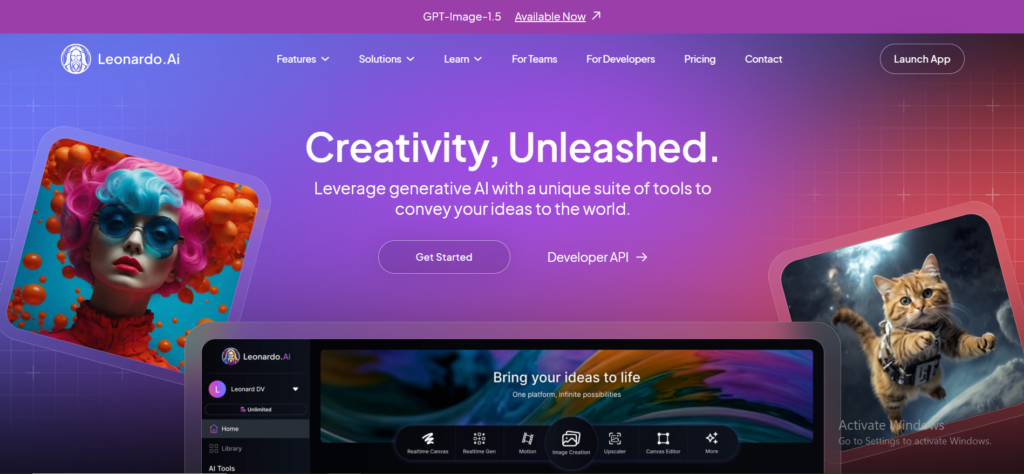
Read the full Leonardo AI Review with pricing breakdown Click Here
Midjourney is the benchmark for artistic image quality in AI generation. It produces cinematic, painterly, visually striking images that consistently outperform other tools on pure aesthetic impact. Artists, concept designers, illustrators, and creatives who prioritise the highest possible image quality over customisation tools reach for Midjourney first.
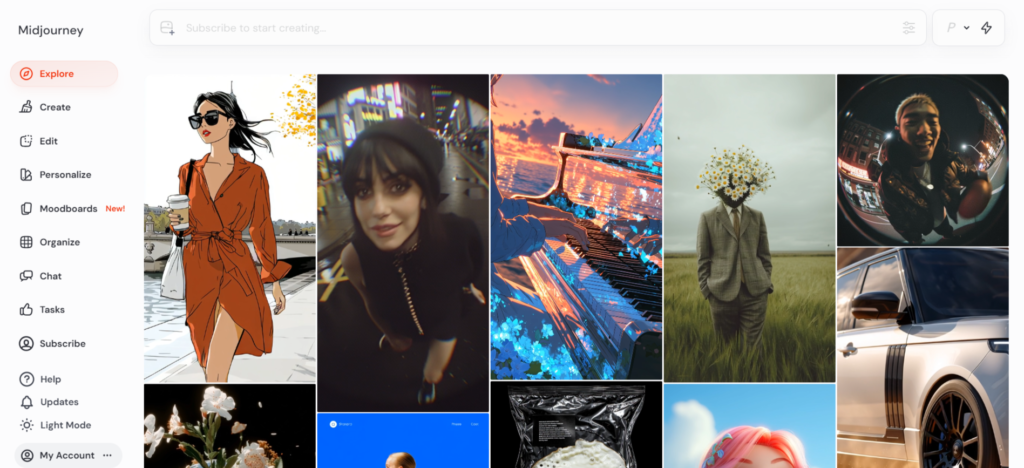
Read the full Midjourney AI Review Click Here
Feature Comparison
| Feature | Leonardo AI | Midjourney |
|---|---|---|
| User Interface | Web-based dashboard — browser only, no app | Web interface + Discord (both supported in 2026) |
| Current Model | Leonardo Phoenix, PhotoReal v2, 30+ models | Midjourney V6.1 (current production model) |
| Prompt Control | Advanced — negative prompts, model selection, LoRA | Parameter-based (–ar, –chaos, –stylise) — powerful but different |
| Image Editing | Built-in — upscaling, inpainting, background removal | Very limited — vary, upscale, remix only |
| Custom Model Training | Yes — LoRA training (1–50 slots per plan) | No |
| Private Generations | All paid plans | Pro plan and above (Stealth Mode) |
| Free Tier | Yes — 150 tokens/day | No — removed in late 2024 |
| Output Consistency | High — especially with LoRA training | Medium — style consistent, character varies |
| Community | Moderate | Very large and active (680,000+ on Reddit) |
| Commercial Rights | All paid plans — full IP ownership | All plans — but $1M+ revenue companies need Pro/Mega |
Image Quality: The Honest Assessment
This is the most nuanced part of the comparison and the one where most reviews oversimplify. The question isn’t which produces “better” images — it’s which produces better images for your specific use case.
Midjourney V6.1 consistently produces the most aesthetically striking output of any AI image generator. Its images have a distinctive visual depth, cinematic quality, and artistic coherence that most other tools don’t match. For a single hero image that needs to stop people scrolling — a concept art piece, an editorial illustration, a dramatic scene — Midjourney’s output is hard to beat. The V6.1 update significantly improved hand and face rendering, which were the main weaknesses in earlier versions, making it genuinely competitive for portrait work and character-focused scenes.
Leonardo AI produces consistently polished, professional output across a wider range of use cases. Its PhotoReal v2 model competes with Midjourney for photorealism. Its game asset models produce character sprites and environment designs with a coherence that suits production pipelines. And its LoRA training capability means the same character, style, or product can be generated consistently across dozens of images — a capability Midjourney simply doesn’t have. For creators who need multiple images that belong to the same visual identity, Leonardo’s average-output consistency is a decisive advantage over Midjourney’s higher peak but more variable results.
| Aspect | Leonardo AI | Midjourney |
|---|---|---|
| Peak artistic quality | Very high | Highest available in consumer AI |
| Average consistency | High — predictable across generations | Medium — varies between prompts |
| Photorealism | Excellent (PhotoReal v2) | Excellent (V6.1) |
| Character consistency | Strong (LoRA training) | Weak — no custom model support |
| Game/concept art | Best in category | Very good |
| Text within images | Improving | Improved in V6.1 |
Quality verdict: Midjourney for single-image artistic impact and maximum aesthetic quality. Leonardo AI for consistent multi-image projects, game assets, and brand-aligned visual production.
Ease of Use: Genuinely Different Models
Leonardo AI is the more beginner-accessible platform. Sign up, the free plan gives 150 tokens per day, and you can generate your first image in two minutes with no configuration required. Style presets handle the complexity of model selection for new users, and the community feed provides prompt examples to learn from. The interface is clean and progressive — beginners use the simple mode, advanced users access negative prompts, guidance scale, model stacking, and seed control.
Midjourney’s reputation for requiring Discord was accurate until recently — but the 2026 web interface at midjourney.com has significantly changed the access story. You can now generate, organise, and browse directly in the browser without ever touching Discord. The prompt syntax (parameters like `–ar 16:9 –stylise 750 –chaos 20`) still has a learning curve, but it’s more manageable for new users than building a Discord workflow. For experienced users, Midjourney’s parameter system provides precise aesthetic control that feels natural once learned.
| Aspect | Leonardo AI | Midjourney |
|---|---|---|
| Interface | Browser dashboard — clean and intuitive | Web interface (2026) + Discord — both work |
| Setup time | 2 minutes to first image | 5–10 minutes (web), 15–30 min (Discord setup) |
| Learning curve | Low — presets handle model selection | Medium — parameter syntax takes practice |
| Free tier | Yes — 150 tokens/day, no card required | No — $10/month minimum |
| Mobile access | Browser only | Web interface works on mobile |
Ease of use verdict: Leonardo AI for absolute beginners and teams who want immediate productivity. Midjourney’s web interface has closed the gap significantly — but the absence of a free trial still means you pay before you know whether it fits your workflow.
Customisation and Control
Leonardo AI’s LoRA (Low-Rank Adaptation) model training is its most significant professional differentiator. You provide reference images of a specific character design, art style, or product appearance, train a custom model on them, and then apply that model to all future generations. The result is visual consistency that simply isn’t achievable through prompt engineering alone — the same character looks like the same character across 50 different scenes. This is what makes Leonardo production-viable for game development, brand asset creation, and any project requiring visual identity to hold across multiple images. Apprentice plan includes 1 LoRA slot/month; Artisan provides 20; Maestro provides 50.
Midjourney’s control system works through parameters: aspect ratio (`–ar`), style weighting (`–stylise`), variation chaos (`–chaos`), image reference weighting (`–iw`), and the Style Reference feature (added in V6) which allows a reference image to influence the output’s aesthetic. This gives experienced Midjourney users a sophisticated toolkit for aesthetic control — but it’s fundamentally different from custom model training. You can reliably reproduce a visual style with Midjourney, but you cannot reliably reproduce a specific character or subject consistently.
| Aspect | Leonardo AI | Midjourney |
|---|---|---|
| Custom model training | Yes — LoRA (1–50 slots per plan) | No |
| Negative prompts | Yes — fully supported | Limited — `–no` parameter only |
| Style reference images | Yes — image-to-image and reference upload | Yes — `–sref` parameter (V6+) |
| Character consistency | High (LoRA) | Low without external tools |
| Output repeatability | High — seed + model locking | Medium — seed helps but varies |
Customisation verdict: Leonardo AI clearly for any workflow requiring consistent replication of characters, styles, or brand visuals. Midjourney for users who want aesthetic style control without the learning investment of LoRA training.
Commercial Usage and Licensing
Both platforms allow commercial use, but with important differences in the details. Leonardo AI’s free plan generates public images that Leonardo AI can use to improve its models — making it unsuitable for commercial client work where content confidentiality matters. All paid plans (Apprentice and above) include private generation mode with full IP ownership, making them commercially viable from the $10/month tier. Leonardo AI’s commercial terms are straightforward — paid subscribers own what they generate privately.
Midjourney includes commercial rights on all plans, with one significant caveat: companies earning more than $1 million in annual revenue are required to use the Pro plan ($60/month) or Mega plan ($120/month). For individual creators, freelancers, and small businesses below that threshold, the Basic or Standard plan includes commercial rights. Midjourney’s Stealth Mode (private generations — not publicly visible in the community gallery) is exclusive to the Pro plan and above — meaning Basic and Standard subscribers’ generations are publicly visible, which matters for client work confidentiality.
| Aspect | Leonardo AI | Midjourney |
|---|---|---|
| Commercial rights | All paid plans | All plans (Pro/Mega required for $1M+ revenue companies) |
| Private generations | All paid plans | Pro plan and above only (Stealth Mode) |
| IP ownership clarity | Clear — paid subscribers own private generations | Clear — with revenue threshold caveat |
| Entry price for commercial use | $10/month (Apprentice) | $10/month (Basic) — but generations are public |
| Entry price for private commercial use | $10/month | $60/month (Pro with Stealth Mode) |
Commercial verdict: Leonardo AI wins for private commercial work — private generations are available from the $10/month Apprentice plan. Midjourney requires the $60/month Pro plan for equivalent privacy (Stealth Mode). For public commercial use where privacy isn’t a concern, both are comparable from $10/month.
Performance and Speed
Leonardo AI’s generation speed is predictable and consistent — paid plans give Fast mode generation (10–20 seconds per batch) and Relax mode for slower off-peak generation without consuming tokens. The cloud infrastructure is stable and rarely experiences significant degradation. For professional workflows where consistent throughput matters more than peak generation speed, Leonardo’s reliability is a practical advantage.
Midjourney’s speed varies by plan. Fast GPU hours are the limiting resource — when they’re exhausted, you either pay for additional hours ($4/hour on any plan) or wait for Relax mode (unlimited but slower, available on Standard and above). During peak usage periods, generation queues can create delays. For users on the Basic plan with limited Fast GPU hours, this can create friction for high-volume production work. The web interface has improved the generation experience compared to Discord, with clearer queue status and faster access to settings.
Community and Support
Midjourney has one of the most active AI image generation communities available — over 680,000 members on r/midjourney, an enormously active Discord server with millions of users, and a well-developed culture of prompt sharing, style exploration, and collaborative experimentation. This community is a genuine learning resource: the easiest way to improve your Midjourney output is to study prompts from the community feed and adapt what works. The sheer volume of shared examples also makes it the best platform for discovering what AI image generation can produce aesthetically.
Leonardo AI’s community is smaller but more professionally focused. The community feed showcases work from designers, game developers, and commercial creators, with prompts that reflect professional production workflows rather than artistic exploration. For creators using Leonardo for specific professional applications, the community resources tend to be more directly applicable to their actual use cases. Leonardo’s platform support and documentation are solid; Midjourney’s support is primarily community-driven through Discord.
Pricing — Verified 2026 Numbers
This is the section most comparison posts get wrong. Here are the actual prices for both tools, verified as of June 2026.
Leonardo AI Pricing
| Plan | Monthly | Annual | Tokens/Month | Key Inclusions |
|---|---|---|---|---|
| Free | $0 | $0 | 150/day (resets daily) | Public generations, basic features, no LoRA, no private mode |
| Apprentice | $12/mo | $10/mo | 8,500 | Private generations, Alchemy Refiner, 1 LoRA/month, faster speed |
| Artisan | $30/mo | $24/mo | 25,000 | PhotoReal v2, 20 model slots, API access, relax mode |
| Maestro | $60/mo | $48/mo | 60,000 | 50 model slots, max priority queue, highest speed |
Midjourney Pricing
| Plan | Monthly | Annual | Fast GPU Hours | Key Inclusions |
|---|---|---|---|---|
| Basic | $10/mo | $8/mo | 3.3 hrs (~200 images) | Commercial rights, no Relax Mode, public generations only |
| Standard | $30/mo | $24/mo | 15 hrs | Unlimited Relax Mode, commercial rights, public generations |
| Pro | $60/mo | $48/mo | 30 hrs | Stealth Mode (private), 12 concurrent jobs, required for $1M+ revenue companies |
| Mega | $120/mo | $96/mo | 60 hrs | Everything in Pro + maximum GPU time for high-volume production |
Key practical notes on Midjourney pricing: there is no free tier (removed in late 2024); Basic plan’s 3.3 fast GPU hours runs out quickly for active users; extra GPU time costs $4/hour on any plan; Relax Mode (unlimited slow generations) requires Standard or above; and private Stealth Mode requires Pro at $60/month. For a creator who needs private commercial generations, Leonardo AI’s Apprentice at $10/month is significantly more affordable than Midjourney’s Pro at $60/month for the same privacy.
Overall Comparison Summary
| Category | Winner | Why |
|---|---|---|
| Ease of Use | 🏆 Leonardo AI | Free tier, no Discord required, faster onboarding |
| Artistic Image Quality | 🏆 Midjourney | V6.1 sets the aesthetic standard for the category |
| Customisation & Control | 🏆 Leonardo AI | LoRA training, negative prompts, 30+ models |
| Pricing (entry) | 🏆 Leonardo AI | Free tier vs $10 minimum; $10 private vs $60 for Midjourney Stealth |
| Commercial Use (private) | 🏆 Leonardo AI | Private from $10/mo; Midjourney needs $60/mo Pro for Stealth Mode |
| Performance & Reliability | 🏆 Leonardo AI | More consistent throughput; no GPU hour depletion model |
| Community & Inspiration | 🏆 Midjourney | 680,000+ Reddit community, most active AI art ecosystem |
| Game Assets | 🏆 Leonardo AI | Purpose-built models, LoRA consistency, 3D texture tools |
| Single Hero Images | 🏆 Midjourney | Highest peak aesthetic quality for artistic/cinematic outputs |
Final Verdict
There is no universally better tool — but there is almost certainly a better tool for your specific workflow.
Choose Leonardo AI if you generate images professionally or at volume — game developers who need consistent character art, marketers building visual campaigns, content creators who publish frequently, and any business needing a reliable visual production workflow. The combination of a free tier, affordable private commercial plans from $10/month, LoRA training for consistency, and comprehensive editing tools makes it the more practical tool for most professional use cases. It’s also the right choice if you’re new to AI image generation and want to explore without spending anything first.
Choose Midjourney if maximum artistic image quality is your primary criterion — concept artists, illustrators, designers who need a single visually exceptional output, and creators building editorial or portfolio work where aesthetic impact matters more than consistency or volume. The V6.1 model’s quality for cinematic and artistic scenes is the best available in consumer AI. Be prepared to pay $10/month minimum (no free tier), and budget for the Pro plan ($60/month) if private generations matter to your workflow.
Many professional creators use both: Leonardo AI for volume production and brand-consistent assets, Midjourney for high-stakes single images where visual impact is the priority. The combined cost of both Standard tiers ($30/month Leonardo Artisan annual + $30/month Midjourney Standard) is how many creative studios operate in 2026.
Is Leonardo AI better than Midjourney?
Neither is universally better — they excel in different areas. Midjourney V6.1 produces the highest peak artistic quality available in consumer AI, making it the first choice for concept art, cinematic visuals, and editorial illustrations. Leonardo AI is better for professional workflows requiring consistency across multiple images — game assets, brand visuals, marketing campaigns — thanks to its LoRA training, comprehensive editing tools, and more accessible pricing. Leonardo also wins on practical factors: a free tier (Midjourney has none), private commercial generations from $10/month (Midjourney requires $60/month for Stealth Mode), and built-in editing tools Midjourney doesn’t have.
Which AI tool gives better image quality?
Midjourney produces more aesthetically striking, cinematic, and artistically coherent images — consistently rated the highest-quality output in consumer AI image generation. The V6.1 model, current as of 2026, significantly improved hand and face rendering which were previous weaknesses. Leonardo AI’s PhotoReal v2 model is highly competitive for photorealism specifically, and its average output quality is more consistent than Midjourney’s across varied prompts. If your goal is a single exceptional image, Midjourney. If your goal is reliable professional quality across dozens of images, Leonardo AI.
Is Leonardo AI or Midjourney better for beginners?
Leonardo AI is the more beginner-accessible tool. A free account gives 150 tokens per day — enough for approximately 25 standard images daily — with no credit card required. Style presets handle model selection complexity, and the first image can be generated within two minutes of signup. Midjourney removed its free trial in late 2024, so beginners must pay $10/month before generating a single image. Midjourney’s parameter prompt syntax also has a learning curve, though the 2026 web interface has made it more accessible than the earlier Discord-only model. For someone new to AI image generation, Leonardo’s free tier lets you evaluate whether the tool fits your workflow before spending anything.
Which tool is best for commercial use?
It depends on whether you need private commercial generations. For private commercial work (client projects, confidential brand assets), Leonardo AI is significantly more cost-effective: private generation mode is included from the $10/month Apprentice plan. Midjourney’s equivalent private generation feature (Stealth Mode) requires the $60/month Pro plan. For public commercial use where image privacy isn’t required, both tools include commercial rights from their entry paid tiers ($10/month for both). Companies with over $1 million in annual revenue using Midjourney must use Pro or Mega plans regardless.
Does Midjourney still require Discord?
No — not since the launch of the Midjourney web interface. You can now generate, organise, and manage your images at midjourney.com in a standard browser interface without any Discord involvement. Discord remains a supported access method for users who prefer it. This is a significant change from earlier versions of Midjourney where Discord was the only access path — many older comparison articles still list Discord as a disadvantage that no longer applies in 2026.
What is the current Midjourney model in 2026?
The current production model is Midjourney V6.1, which launched in mid-2025 as an upgrade to V6. V6.1 significantly improved hand rendering, face detail, and text within images — all historical weaknesses of earlier Midjourney versions. It also improved consistency across related generations and made the parameter system more responsive to prompt details. The Niji mode (for anime and illustrated art styles) has also been updated and remains available as a distinct generation mode. All Midjourney subscriptions use V6.1 by default.
Which AI image generator is better for game development?
Leonardo AI is the stronger choice for game development by a significant margin. The combination of models specifically designed for game asset aesthetics (characters, environments, weapons, UI elements), LoRA training for maintaining consistent visual style across an entire project, 3D texture generation tools, and the ability to generate hundreds of assets per month within the token system makes it purpose-built for game development workflows. Midjourney produces excellent individual character and environment illustrations, but lacks the consistency tools and volume economics that production-scale game development requires. Most indie game studios use Leonardo AI as their primary asset generator and Midjourney occasionally for high-impact concept art.
Is Midjourney worth the price without a free trial?
Yes — for the right user — but it’s a meaningful commitment given there’s no free trial. The most practical approach: test Leonardo AI’s free tier first to confirm AI image generation fits your workflow and you enjoy the creation process, then evaluate Midjourney’s Basic plan ($10/month) for its artistic quality. If Midjourney’s aesthetic output is what you’re looking for, the Standard plan at $30/month ($24 annual) is the recommended entry point — Basic’s 3.3 fast GPU hours runs out quickly for regular use, and Standard adds unlimited Relax Mode for continued generating after fast hours are exhausted.





I am Ashish Yadav a software engineer and AI tools researcher with over five years of practical experience working with real-world systems and automation. I am founder of CognifyFuture, where I analyzes, tests, and breaks down AI tools with a focus on what actually works—not what’s trending.
My content is built on hands-on usage, not theory. Instead of generic advice, I focuses on real implementation—how AI tools can be used to automate tasks, improve efficiency, and solve any specific business or individual problems.
Through CognifyFuture, My aims is to eliminate confusion around AI by delivering clear, honest, and actionable insights that help users make smarter technology decisions.