What if I told you the single highest-performing email you’ll ever send isn’t a big promotional blast — it’s the very first one?
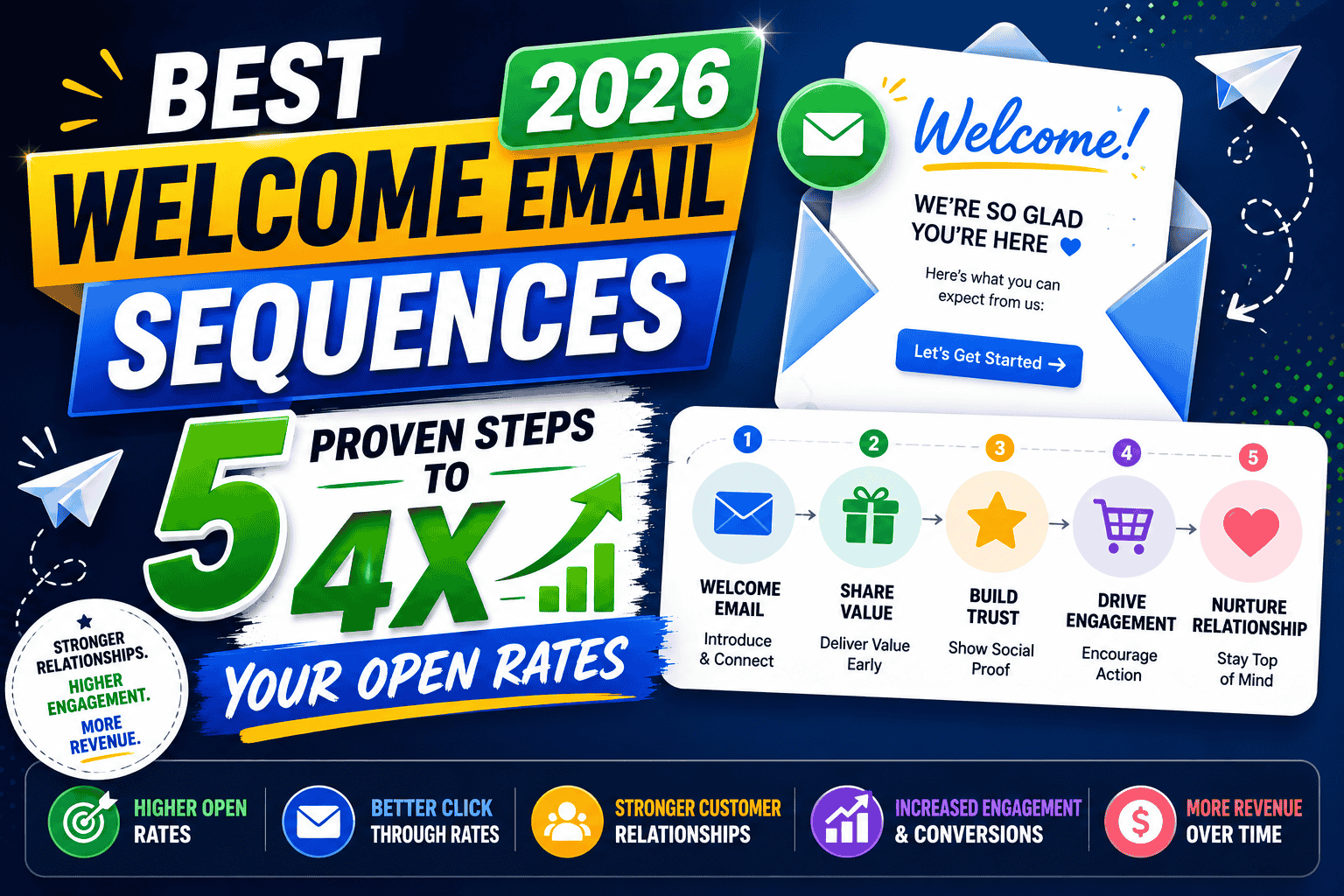
Welcome emails get roughly 4x higher open rates and 5x higher click-through rates than regular campaigns. Benchmark data from Omnisend puts automated welcome emails around a 35% open rate and a 2.11% conversion rate — numbers that make almost every other email you send look underwhelming by comparison. And yet most businesses still treat the welcome email as an afterthought: a single “thanks for subscribing” message with no real strategy behind it.
This gap between performance and effort invested is, frankly, the easiest win available in email marketing right now. Most other automations — abandoned cart, re-engagement, post-purchase — require ongoing tuning to perform well. A welcome sequence, built once with the right structure, keeps converting new subscribers at a consistently elevated rate for as long as people keep signing up, with minimal ongoing maintenance required.
While reviewing the best welcome email sequences, I went through what actually separates a high-performing welcome sequence from a forgettable one to answer the questions that matter when you’re building yours:
- How many emails should actually be in a welcome sequence — and does more always mean better?
- What should each individual email in the sequence actually be trying to accomplish?
- How fast does the first email need to go out, and does timing really matter that much?
- What separates a welcome email that converts from one that just gets deleted?
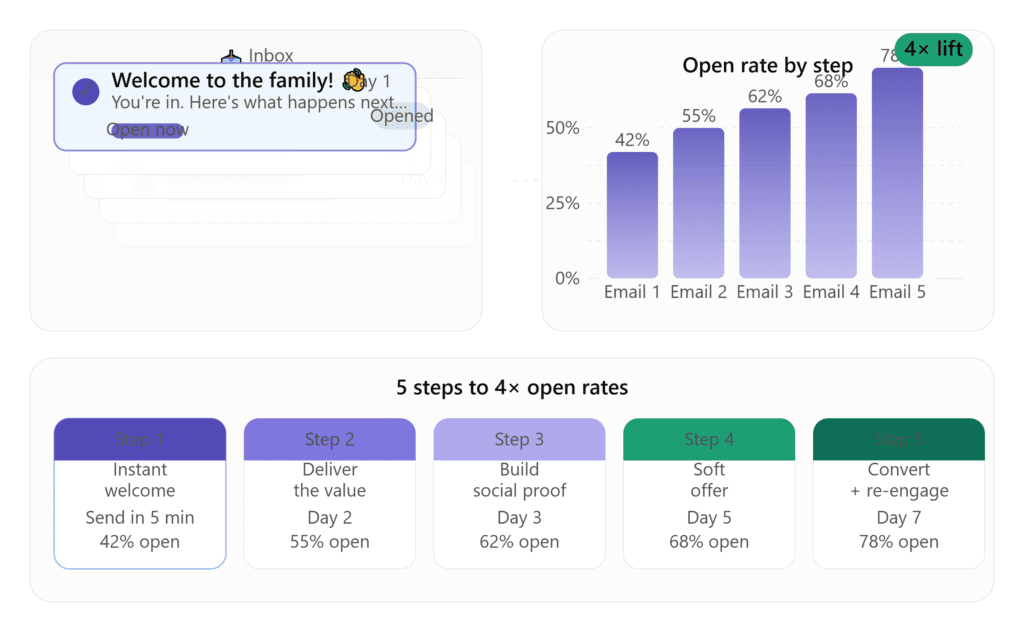
Short answer: a strong welcome sequence is 3-5 emails spread across roughly two weeks, each with a single distinct purpose (confirm and set expectations, deliver value, build trust, nudge toward a first action, and reinforce with social proof). The first email should go out within seconds to minutes of signup — delayed welcome emails see open rates drop by 50% or more. Below, I’ll walk through exactly how to structure each email in the sequence.
Why the Welcome Sequence Outperforms Everything Else You Send
Before getting into structure, it’s worth understanding why this particular automation consistently outperforms regular campaigns by such a wide margin. The answer comes down to timing and intent: a welcome email arrives at the single moment a subscriber’s interest in your brand is at its peak — they just took an action (signing up) that signals genuine curiosity, and they’re still mentally primed to engage.
74% of new subscribers actively expect to receive a welcome email when they join a list — it’s not an intrusion, it’s an anticipated next step. Compare that to a promotional campaign sent to the same subscriber six weeks later, competing with dozens of other unread emails and zero immediate context for why it landed in their inbox. The welcome sequence isn’t outperforming other campaigns by accident; it’s capturing attention other emails simply can’t access.
How Many Emails Should Be in Your Welcome Sequence?
The honest answer is “it depends on your purchase cycle,” but for most small businesses and content creators, 3-5 emails spread across 10-14 days hits the right balance — enough to build a real relationship without overwhelming someone who just met your brand.
Businesses with longer consideration cycles (high-ticket products, B2B services) can extend to 5-6 emails over a longer window, since the goal is staying top-of-mind through a slower decision process. Businesses with fast, low-consideration purchases (a $20 ecommerce impulse buy) can compress to 2-3 emails over a shorter window, since the goal is capturing a fast first purchase before interest fades.
If you’re choosing a platform to build this automation in, see our Best Email Marketing and Automation Tools 2026 roundup for options that support visual, multi-step welcome flows.
Best Welcome Email Sequences: The 5-Email Framework: What Each Email Should Actually Do
Email 1: Confirm, Set Expectations, Single CTA (Send Within Minutes)
This email has one job: confirm the signup worked, set expectations for what’s coming, and give exactly one clear next step. Resist the urge to cram in your full product catalog or three different calls-to-action — decision fatigue from multiple CTAs measurably reduces conversion on a first-touch email.
Tell the subscriber explicitly what to expect: how often you’ll email, what kind of content or offers they’ll get, and why it’s worth staying subscribed. This single piece of expectation-setting does a lot of work toward reducing future unsubscribes, since surprise and mismatch (signing up for “occasional updates” and getting daily promotions) is one of the most common reasons people unsubscribe early.
Timing matters enormously here. Delayed welcome emails see open rates drop by 50% or more compared to instant delivery — this should be the single fastest-firing automation in your entire system, triggering within seconds of signup, not hours.
Email 2: Deliver Real Value (Day 2-3)
If your welcome series stops at “thanks for subscribing” and a generic discount code, you’re leaving the strongest part of the relationship-building opportunity unused. This email should deliver something genuinely useful on its own — a piece of content, a resource, or an answer to the question that likely brought someone to your list in the first place.
For ecommerce, this might be a styling guide or a “how to choose the right [product category]” resource. For a SaaS product, this is the moment to drive one specific in-product action — “import your contacts” or “send your first campaign” — rather than another generic feature overview. For a content business, this might be your single best, most-shared piece of writing.
Email 3: Build Trust and Credibility (Day 4-6)
This is where social proof earns its place — testimonials, reviews, case studies, or simply your story and credentials. New subscribers haven’t yet decided whether to trust you, and this email’s job is to close that gap before you ask for anything transactional.
This doesn’t need to be heavy-handed. A short, specific customer story (“here’s how [name] used this to solve [specific problem]”) does more credibility-building work than a wall of five-star review screenshots, because it’s concrete and relatable rather than generically positive.
Email 4: The Incentive or Conversion Push (Day 7-10)
By this point, the subscriber knows what to expect, has received real value, and has some trust built. This is the natural place for a clear incentive — a discount code, a limited-time offer, or a direct invitation to take the action you actually want (purchase, book a call, start a trial).
Putting the incentive here rather than in email 1 matters: a discount code in the very first email trains subscribers to expect a deal before they’ve engaged with anything else you offer, while the same code arriving after three emails of genuine value feels earned rather than transactional.
Email 5: Reinforce and Transition (Day 12-14)
The final email in the sequence should feel like a natural close to the welcome experience and a bridge into your regular sending cadence. Reinforce the value proposition one more time, remind them how to reach you (reply, live chat, help center), and let them know what to expect going forward now that the welcome series is ending.
This email also doubles as a final, lower-pressure nudge for anyone who hasn’t yet engaged with the incentive from email 4 — a soft reminder rather than a repeat of the same hard sell.
Best Welcome Email Sequences Subject Lines: What Actually Drives Opens
Subject lines that promise a specific, concrete outcome see 20-30% higher open rates than generic welcomes like “Welcome to [Brand].” The difference between “Welcome to Acme” and “Your first project is three clicks away” is the difference between an announcement and an invitation — the second one tells the reader exactly what they get by opening.
A few practical patterns that consistently outperform generic welcomes: using the subscriber’s first name where your platform supports it, keeping the line short and specific rather than clever, and leading with the benefit rather than the brand name. “Here’s your 15% off code” beats “Welcome aboard!” because it tells the reader what’s actually inside before they decide whether to open.
Practical Use Case: Three Business Types, Three Sequences
An Ecommerce Store
Compress to 3-4 emails over 7-10 days, since impulse-driven purchases benefit from urgency rather than a long nurture window. Lead with brand story and product categories (email 1), a styling or use-case guide (email 2), social proof plus a discount code (email 3), and a final reminder with the code expiring soon (email 4).
A SaaS Product
Trigger the first email within seconds of signup and drive a single in-product action immediately — “complete your profile” or “send your first campaign.” Behavior-triggered follow-ups (based on whether the user completed that action) outperform purely time-based drips here, since the message can adapt to what the user actually did rather than guessing. A 14-day trial typically supports a 5-email sequence; compress accordingly for a 7-day trial.
A Content Creator or Newsletter
Extend slightly to 4-5 emails over two weeks, since the goal is building a reading habit rather than driving an immediate transaction. Lead with your best, most representative piece of writing (not necessarily your newest), explain your publishing cadence clearly, and use the final email to invite reply engagement — newsletters with active reply rates tend to see meaningfully better long-term deliverability.
Benchmarks: What “Good” Actually Looks Like
Knowing the numbers to compare against matters, since “good” is relative without context. Recent benchmark data puts automated welcome emails around a 34-38% open rate, a 3-4% click rate, and roughly a 2% conversion rate across ecommerce specifically — well above standard broadcast campaign performance, which typically sits closer to a 35% open rate but a meaningfully lower click rate (around 2.6%).
If your welcome sequence is landing well below these numbers, the most common culprits are: a delayed first send (check your automation trigger speed), a generic subject line, or a first email that asks for too much before delivering any value. If you’re meeting or exceeding these benchmarks, the more useful next step is testing improvements at the email level rather than restructuring the whole sequence — subject line variants, send-time optimization, or trimming a CTA down to one option.
What to A/B Test First (and What to Leave Alone)
Once a welcome sequence is live and collecting meaningful data, it’s tempting to test everything at once — but that makes it impossible to know which change actually moved the needle. Prioritize in this order, since each test builds on confidence in the one before it.
Test subject lines first. They’re the cheapest, fastest test to run, directly affect open rate (the top of the funnel for everything else), and don’t require touching the email’s content or structure. Run subject line variants on email 1 specifically, since it gets the most volume and the clearest read on what’s working.
Test send timing second. While email 1 should always fire immediately, the optimal spacing between emails 2 through 5 is worth testing — some audiences respond better to a tighter cadence (every 2 days) while others prefer more breathing room (every 4-5 days). Let actual open and click data guide this rather than assuming a fixed schedule works universally.
Leave the core sequence order alone until you have real data. The 5-purpose structure (confirm, deliver value, build trust, incentivize, reinforce) reflects a well-established pattern across benchmark sources, not a guess — don’t reorder it based on a hunch before you’ve given the standard structure a real test with actual subscribers.
Common Mistakes That Quietly Tank Welcome Sequence Performance
Treating It as a Single Email, Not a Sequence
A single “thanks for subscribing” message captures almost none of the relationship-building value a full sequence provides. If you only have time to build one automation this month, the welcome sequence is the highest-leverage place to invest that time — the open and click rate gap between a single email and a proper sequence is consistently the widest in this category.
Front-Loading the Discount
Leading with a discount code trains subscribers to wait for deals rather than engage with your actual content or product value. Save the strongest incentive for after you’ve delivered something of genuine value — it converts better and trains better long-term subscriber behavior.
Never Revisiting the Sequence After Launch
A welcome sequence isn’t a set-and-forget asset. Review open rates, click rates, and conversion at each individual email in the sequence periodically — if engagement consistently drops at a specific email, that’s a direct signal about which message needs revising, not the sequence as a whole.
A Worked Example: Welcome Sequence for a Skincare Ecommerce Brand
Abstract frameworks are easier to apply with a concrete example, so here’s how the 5-email structure might look for a small skincare brand, adjusted down to 4 emails over 9 days given the lower-consideration, faster-purchase nature of the product category.
Email 1 (immediate): “Welcome — here’s what to expect” — brief brand story, what makes the formulations different (e.g. fragrance-free, dermatologist-tested), and a single CTA to browse the best-selling starter set. No discount yet.
Email 2 (day 2): “Which routine is right for your skin?” — a short skin-type quiz or guide that segments subscribers by need (oily, dry, sensitive) and links to the matching product category. This email does double duty: it delivers genuine value and quietly builds a behavioral data point (which link they clicked) for future segmentation.
Email 3 (day 5): “What 200+ customers are saying” — three short, specific testimonials tied to common skin concerns, plus a founder note on why the brand exists. This is the trust-building email, with no direct sales push.
Email 4 (day 9): “Your welcome gift: 15% off, expires in 48 hours” — the incentive, now arriving after three emails of context and credibility rather than as the very first thing the subscriber sees. The 48-hour window adds gentle urgency without being aggressive.
Notice the pattern: by the time the discount arrives, the subscriber has been educated about skin type matching, reassured by other customers’ experiences, and given a brand story to connect with — the discount is closing a sale that’s already been substantially warmed up, not trying to manufacture interest from a cold start.
Building This in Your Email Platform
The good news is that every major email platform supports this kind of sequence natively through visual automation builders, but the implementation details differ slightly by platform.
If you’re ecommerce-focused, see our Best Email Marketing Tools for Shopify 2026 guide, since platforms like Klaviyo and Omnisend include pre-built welcome flow templates tied directly to purchase and browsing data.
For a simpler, newsletter-style welcome sequence without ecommerce-specific triggers, MailerLite and Brevo both include multi-step automation on their entry-level (and in Brevo’s case, free) plans, which is all this sequence structurally requires — you don’t need ecommerce-specific automation tools just to build a well-timed 5-email sequence.
Whatever platform you use, the one setting worth double-checking before launch is the trigger delay — confirm the first email is set to send immediately on signup, not on a delayed batch schedule, since this single setting has an outsized impact on the open rate of your highest-performing automation.
Final Verdict
The welcome sequence is, by a wide margin, the single highest-leverage automation you can build, and the data backs this up consistently across every benchmark source: 4x the open rates, 5x the click-through rates, and conversion rates that broadcast campaigns simply can’t match. If you’re running an email program with no automation at all, this is the one to build first.
Start with the 5-email framework above, adjust the timing and emphasis to fit your specific business type, and resist the temptation to front-load your best incentive before you’ve delivered any real value. Then treat the sequence as a living asset — check it against the benchmarks here every few months, and let the data tell you which individual email needs attention rather than assuming the whole thing needs a rebuild.
Related Reading
- Best Email Marketing and Automation Tools 2026 (full roundup)
- What Is Email Marketing Automation?
- Email List Segmentation
1. How many emails should be in a welcome sequence?
3-5 emails spread across 10-14 days works well for most businesses. Shorter, fast-purchase-cycle businesses (impulse ecommerce) can compress to 2-3 emails over a shorter window. Longer consideration-cycle businesses (B2B, high-ticket products) can extend to 5-6 emails over a longer window.
2. How fast should the first welcome email be sent?
Within seconds to minutes of signup. Delayed welcome emails see open rates drop by 50% or more compared to instant delivery, since the welcome email captures attention at the exact moment a subscriber’s interest is at its peak.
3. What is a good open rate for a welcome email?
Recent benchmark data puts automated welcome emails around a 34-38% open rate on average, well above standard broadcast campaign performance. Top-performing welcome emails can reach higher, with click rates around 3-4% and conversion rates near 2% across ecommerce specifically.
4. Should the first welcome email include a discount code?
Generally, no. Leading with a discount trains subscribers to expect deals before engaging with your actual value, and tends to convert worse than placing the incentive later in the sequence (after 2-3 emails of genuine value have been delivered) when it feels earned rather than transactional.
5. What should the welcome email subject line say?
Lead with a specific, concrete benefit rather than a generic greeting. Subject lines promising a specific outcome see 20-30% higher open rates than generic lines like ‘Welcome to [Brand].’ Including the subscriber’s first name and keeping the line short and specific also helps.
6. How is a SaaS welcome sequence different from an ecommerce one?
SaaS welcome sequences should be behavior-triggered rather than purely time-based, driving a single in-product action (like completing a profile or sending a first campaign) rather than a purchase. Ecommerce sequences typically compress to fewer emails over a shorter window to capture impulse-driven purchases before interest fades.
7. How often should I review my welcome email sequence?
Check engagement metrics (open, click, and conversion rates) at each individual email in the sequence every few months. If engagement consistently drops at a specific email in the chain, that’s a signal to revise that particular message rather than rebuilding the entire sequence.
8. What’s the biggest mistake businesses make with welcome emails?
Treating the welcome experience as a single email rather than a full sequence. A standalone ‘thanks for subscribing’ message captures only a fraction of the relationship-building value a proper multi-email sequence provides, and the engagement gap between the two approaches is consistently the widest in email marketing benchmarks.





I am Ashish Yadav a software engineer and AI tools researcher with over five years of practical experience working with real-world systems and automation. I am founder of CognifyFuture, where I analyzes, tests, and breaks down AI tools with a focus on what actually works—not what’s trending.
My content is built on hands-on usage, not theory. Instead of generic advice, I focuses on real implementation—how AI tools can be used to automate tasks, improve efficiency, and solve any specific business or individual problems.
Through CognifyFuture, My aims is to eliminate confusion around AI by delivering clear, honest, and actionable insights that help users make smarter technology decisions.