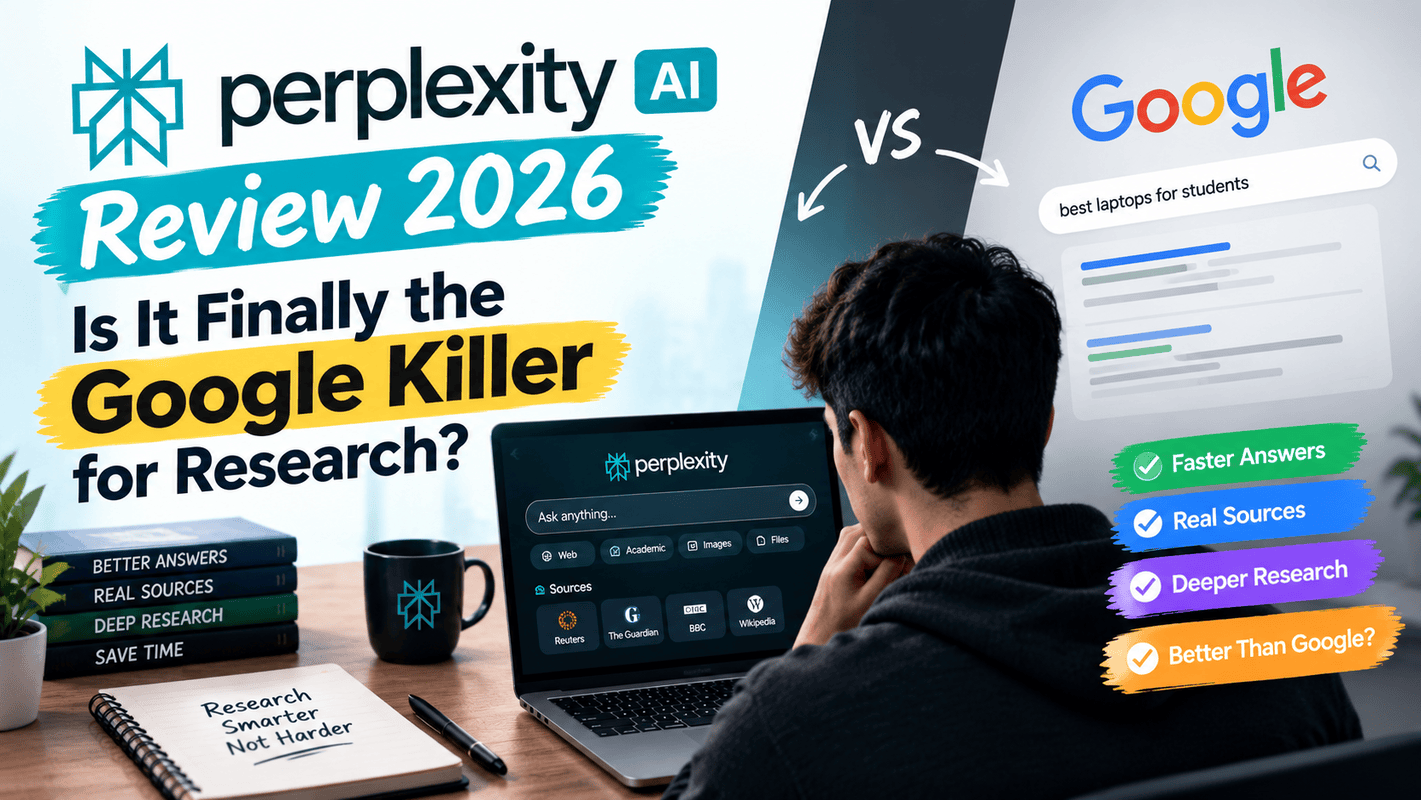
Can an AI search engine actually replace the ten browser tabs you open every time you research something? I spent three weeks using Perplexity AI as my primary research tool — for client work, fact-checking, and everyday questions — instead of defaulting to Google. This Perplexity AI review 2026 covers exactly what changed, what didn’t, and whether the paid tier earns its place in your monthly subscriptions.
If you’re comparing AI research tools this year, “Perplexity vs Google” and “is Perplexity Pro worth it” are probably the two questions on your mind. Both get a straight answer here, backed by actual use rather than a feature-list summary.
What Is Perplexity AI in 2026?
Perplexity AI is an “answer engine” — instead of returning a list of blue links like traditional search, it reads across multiple live sources and gives you a synthesized answer with inline citations you can click through to verify. By 2026, it’s expanded well beyond its original chat-search format: it now includes Perplexity Pro Search for deeper multi-step research, a Discover feed for trending topics, a browser extension, and a Spaces feature for organizing ongoing research projects.
The core pitch of this Perplexity AI review 2026 is simple: is it actually a better way to find trustworthy answers, or just a stylish wrapper around search results you could find yourself?
Perplexity AI Pricing in 2026: Free vs Pro
- Free tier: Solid daily usage limits for standard search, basic source citations, and access to a capable default model. Enough for casual, everyday research.
- Perplexity Pro: Unlocks higher usage limits, access to multiple premium reasoning models, deeper Pro Search (multi-step research that reads more sources per query), file uploads, and image generation.
- Enterprise Pro: Built for teams — shared workspaces, admin controls, and higher data-privacy guarantees for business use.
The honest verdict on pricing: casual users rarely need to pay. If you’re using Perplexity a handful of times a day for quick fact-checks, the free tier holds up well. The moment your work depends on deep, multi-source research — competitive analysis, market research, academic-style literature scanning — Pro’s expanded search depth becomes noticeably more valuable than the subscription cost.
Hands-On: How Perplexity Performs on Real Research Tasks
Everyday Fact-Checking
This is where Perplexity shines the brightest. Quick questions — statistics, definitions, “did this actually happen” checks — come back fast, with clickable sources sitting right next to the claim. Compared to scanning five search results yourself, it’s a genuine time saver, and the citation-first design makes it easy to spot when an answer is thin on sourcing.
Deep, Multi-Step Research
Pro Search is built for exactly this: complex questions that require reading across many sources rather than one. Ask it to compare regulatory approaches across countries or summarize a fast-moving news topic, and it does real synthesis work instead of just picking one source and paraphrasing it. It’s not flawless — occasionally it weights an older or lower-authority source too heavily — but it’s consistently faster than doing the same multi-tab research manually.
Academic and Technical Research
For students and researchers, Perplexity’s citation-first structure is arguably its best-fit use case in this entire review. It’s far easier to verify claims here than with a tool that doesn’t show its sources by default. That said, it’s still not a substitute for peer-reviewed database searches on anything requiring academic rigor — treat it as a fast orientation tool, then go to primary sources for anything you’ll cite formally.
Everyday Search Replacement
Can it fully replace Google? Mostly, for informational queries. For transactional searches — shopping, local business lookups, anything requiring maps or reviews — traditional search still edges ahead. The realistic use case isn’t “replace Google entirely,” it’s “replace Google for the subset of searches where you actually want an explained answer, not just a list of links.”
A Closer Look: How a Perplexity Search Actually Works
Understanding the mechanics helps explain why Perplexity feels different from a typical search engine, and why it can be more or less useful depending on what you’re asking. When you type a question, Perplexity doesn’t just retrieve pages — it reads across several live sources, extracts the relevant information from each, and generates a synthesized answer with each claim linked back to where it came from. Pro Search extends this by running multiple sub-queries behind the scenes for complex questions, effectively breaking one big question into several smaller research steps before combining the results.
This matters practically in two ways. First, it means the quality of the answer depends heavily on the quality of the underlying sources it finds — a niche topic with limited coverage online will produce a thinner answer regardless of how well the tool works. Second, it means specificity in your question genuinely changes the output quality. A vague prompt like “tell me about email marketing” returns a broad, generic overview. A specific one like “compare open rate benchmarks for B2B SaaS email newsletters in 2025 versus 2023” pushes the tool to search more precisely and produce a far more useful, source-backed answer.
Perplexity AI Strengths
- Citation-first design — every claim is traceable to a source, which builds trust fast and makes fact-checking painless.
- Speed on complex questions — Pro Search compresses what would be several minutes of manual tab-hopping into one query.
- Spaces for organized research — grouping related searches into a project makes it genuinely useful for ongoing work, not just one-off questions.
- Clean, low-friction interface — minimal learning curve, works well on both desktop and mobile.
Perplexity AI Weaknesses
- Source weighting isn’t perfect — it occasionally leans on a lower-quality or outdated source when better ones exist.
- Weaker for creative or long-form writing — it’s built for research synthesis, not extended creative or persuasive writing tasks.
- Not a full search replacement — transactional and local searches are still better served by traditional search engines.
- Can feel repetitive on very niche topics — with a limited pool of quality sources, answers sometimes echo the same handful of pages.
Perplexity’s Discover Feed and Spaces: Underrated Features Worth Knowing
Two features rarely get the attention they deserve in most Perplexity AI reviews, and both changed how I actually used the tool day-to-day.
Discover is a curated feed of trending topics and news summaries, each built the same citation-first way as a regular search. It’s a genuinely good way to stay current without doom-scrolling a social feed — you get a synthesized summary of what’s happening plus the sources behind it, rather than a wall of competing headlines and hot takes.
Spaces is the feature that made Perplexity feel less like a search bar and more like an actual research tool. Instead of every question living in its own disconnected chat, you can group an entire project — say, “competitor pricing research” or “Q3 market trends” — into one Space, with its own uploaded files, saved sources, and running thread of questions. For anyone doing ongoing research rather than one-off lookups, this is the difference between Perplexity being a novelty and being a daily tool.
Perplexity AI for Business Use: Market Research and Competitive Analysis
One of the more practical, buyer-intent use cases worth calling out directly: small business owners and marketers using Perplexity for competitive research. Instead of manually searching “competitor name pricing,” “competitor name reviews,” and “competitor name reddit” as three separate searches, a single well-structured Pro Search query can pull a synthesized comparison with sources attached. It’s not a replacement for a dedicated market research tool if you’re running something at enterprise scale, but for a solopreneur or small team trying to understand a competitive landscape quickly, it removes a huge amount of manual tab-switching.
The same logic applies to trend research. Asking Perplexity to summarize recent discussion or sentiment around a topic — a product category, an industry shift, a regulatory change — tends to produce a faster, more organized starting point than a traditional search, precisely because it’s already done the reading-and-summarizing step for you. The caveat, worth repeating, is that “faster starting point” doesn’t mean “final answer.” Anything that will inform a real business decision deserves a click-through to the actual sources before you act on it.
Perplexity vs ChatGPT vs Google: Where Each One Wins
| Task | Best Tool | Why |
|---|---|---|
| Fact-checking with sources | Perplexity | Citation-first by design |
| Long-form writing / drafting | ChatGPT | Stronger generative writing depth |
| Local / transactional search | Maps, reviews, shopping integration | |
| Multi-step research synthesis | Perplexity Pro | Reads and combines many sources per query |
Perplexity AI Setup: Getting Started the Right Way
Getting real value from Perplexity comes down to a handful of habits that aren’t obvious from the interface alone. These made the biggest difference during testing for this Perplexity AI review 2026.
- Be specific, not conversational. Treat it more like a well-formed search query than a chat message — the more precise the question, the more precise the sources it pulls.
- Use Focus modes when available. Narrowing a search to academic sources, or to a specific type of content, filters out noise and improves relevance significantly on niche topics.
- Always click through on anything important. The citations are the whole point — use them, don’t just trust the synthesized summary at face value for anything you’ll act on.
- Set up a Space before starting a multi-day research project. Starting fresh searches each day scatters your work; a Space keeps context, files, and prior questions together.
- Ask follow-up questions instead of starting over. Perplexity retains context within a thread, so refining a question (“now narrow that to just the last six months”) is faster than rewriting the whole query.
Who Should Actually Pay for Perplexity Pro?
Researchers and Analysts
Strong fit. The combination of citation transparency and Pro Search’s multi-step depth genuinely speeds up early-stage research and competitive analysis.
Journalists and Content Marketers
Useful for fast fact-checking and background research before writing, though it should feed into your writing process rather than replace your primary drafting tool.
Students
Helpful for orientation and understanding unfamiliar topics quickly, with the added benefit of teaching good sourcing habits through visible citations. Still needs pairing with academic databases for formal citations.
Casual, Everyday Users
Free tier is usually enough. Unless you’re running deep research sessions daily, Pro’s extra depth may go underused.
Perplexity AI Pricing vs the Value It Actually Delivers
It’s worth being blunt about the return-on-investment question, since “is Perplexity Pro worth it” is one of the most common searches around this tool. If your job involves any regular research — writing, marketing, consulting, analysis — the time saved from not manually cross-referencing five to ten sources per question adds up fast. A single research session that would have taken thirty minutes of tab-hopping can often be compressed into five minutes with Pro Search, and that time savings compounds daily for anyone doing research-heavy work.
For casual users, the math looks different. If your typical use case is a handful of quick fact-checks a week — the kind of thing you’d otherwise type into Google and skim the top result for — the free tier’s limits are unlikely to become a real obstacle, and Pro becomes a “nice to have” rather than a necessity. The honest advice, consistent with how this whole review has approached value: track your actual weekly usage against the free tier’s limits for two weeks before paying for anything.
Who Should Think Twice Before Paying for Perplexity Pro
In fairness, Pro isn’t the right purchase for everyone reading this. If most of your searches are transactional — shopping around, checking store hours, comparing local services — a traditional search engine will simply serve you faster and better; Perplexity isn’t built for that kind of query and paying for Pro won’t change that. Similarly, if your work leans heavily on long-form creative writing rather than research and fact-checking, a dedicated writing assistant will likely deliver more value per dollar than Perplexity’s research-first design. And if you already have a paid research workflow you’re happy with — a subscription database, a well-organized bookmarking system, a research assistant — it’s worth trialing Perplexity’s free tier for a couple of weeks before assuming Pro adds enough on top to justify the cost.
Common Perplexity Problems and How to Fix Them
- “The answer feels shallow.” — Fix: switch to Pro Search mode, which reads more sources per query instead of settling for a quick synthesis.
- “It cited a weak source.” — Fix: click through and verify — this is exactly why citation-first design matters; use it as a starting point, not a final verdict.
- “It’s not finding recent news.” — Fix: be explicit about wanting the most recent coverage; specify a timeframe in your query.
- “My research is scattered across chats.” — Fix: use Spaces to group everything related to one project instead of starting fresh searches each time.
Perplexity AI Browser Extension: Does It Actually Help?
Beyond the standalone app and website, Perplexity offers a browser extension that layers research directly into whatever page you’re already on — highlight text and ask a question about it, or pull up a quick summary without leaving the tab. In daily use, this turns out to be more useful than it sounds. Instead of copying a confusing paragraph into a separate chat window, you can get a contextual explanation right where you’re reading, which removes a surprising amount of friction from research-heavy browsing sessions. It’s a small feature, but it’s the kind of small feature that quietly becomes part of your daily habit once you’ve used it a few times.
Perplexity AI Review 2026: Final Verdict
After weeks of using Perplexity as a daily research tool, the honest conclusion is this: for anyone whose work depends on finding and verifying information quickly, Perplexity AI in 2026 is one of the best-designed tools available, precisely because it treats sourcing as a feature rather than an afterthought. It won’t replace every search you do, and it’s not a writing tool — but for research specifically, it’s earned a permanent spot in the workflow.
Perplexity AI vs Traditional Bookmarking and Note Tools
Before Spaces existed as a feature, most researchers relied on a patchwork of browser bookmarks, a notes app, and maybe a spreadsheet to keep track of sources across a project. Perplexity’s approach — where the search history, saved sources, and running research thread live in one place automatically — removes a step that used to be entirely manual. It’s not a full project management tool, and it won’t replace a dedicated knowledge base for a large team. But for an individual or small team’s research workflow, having the sourcing and the organization happen in the same tool, without extra copy-pasting, is a meaningful quality-of-life improvement that’s easy to underestimate until you’ve actually relied on it for a real project with a deadline attached.
Conclusion: Should You Try Perplexity AI?
If your work involves regular fact-checking, competitive research, or staying current on fast-moving topics, Perplexity AI is worth testing against your existing workflow for two weeks before deciding on Pro. Track how often you’d have opened five browser tabs instead of asking one clear question — that’s the real measure of whether it’s paying for itself.
What’s your experience been with AI search tools so far? Share it in the comments — it genuinely helps other readers deciding between options.
Frequently Asked Questions About Perplexity AI
1. Is Perplexity AI better than Google for research?
For informational queries where you want an explained, sourced answer, yes, often. For transactional or local searches, traditional search engines still perform better.
2. Is Perplexity Pro worth it in 2026?
Yes, if you do regular deep research, competitive analysis, or fact-checking. Casual users asking occasional questions will likely be fine on the free tier.
3. Does Perplexity AI cite real sources?
Yes, citations are built into the core experience, with clickable links to the original sources for every claim.
4. Can Perplexity AI replace ChatGPT?
Not entirely. Perplexity is optimized for research and sourcing; ChatGPT is stronger for long-form writing and creative tasks. Many users benefit from using both for different jobs.
5. Is Perplexity AI good for students?
Yes, especially for orientation research and understanding new topics quickly. For formal academic citations, pair it with dedicated academic databases.
6. How accurate is Perplexity AI?
Generally strong, thanks to its citation-first structure, though source weighting isn’t perfect. Always verify high-stakes claims by checking the linked sources directly.
7. What is Perplexity Pro Search?
A deeper research mode that reads and synthesizes across more sources per query, designed for complex, multi-step questions rather than quick lookups.
8. Is Perplexity AI free to use?
Yes, there’s a capable free tier with daily usage limits. Perplexity Pro is the paid upgrade for heavier research needs and premium model access.





I am Ashish Yadav a software engineer and AI tools researcher with over five years of practical experience working with real-world systems and automation. I am founder of CognifyFuture, where I analyzes, tests, and breaks down AI tools with a focus on what actually works—not what’s trending.
My content is built on hands-on usage, not theory. Instead of generic advice, I focuses on real implementation—how AI tools can be used to automate tasks, improve efficiency, and solve any specific business or individual problems.
Through CognifyFuture, My aims is to eliminate confusion around AI by delivering clear, honest, and actionable insights that help users make smarter technology decisions.